✕
Cold Storage Is a Systems-Level Envelope Challenge
Keeping controlled interior temperatures stable over time is critical to the success of cold storage facilities. While this objective may seem simple in theory, bringing together the roof, walls, slab, and foundation as one continuous system is a complex challenge facing both new construction and retrofit projects. Because envelope performance directly influences refrigeration loads, the stakes are significant. According to the National Renewable Energy Laboratory, refrigerated warehouses have some of the highest energy-use intensities in commercial building stock, with refrigeration equipment consuming up to 70 percent or more of total building electricity.
For design teams, the building envelope is more than a protective enclosure—it is the front-line defense for controlling heat, air, vapor, and moisture. This is especially true when preventing air and moisture from entering the structure at critical tie-ins and penetrations, where even the smallest breaks in building envelope continuity increase the risk of condensation, ice formation, insulation degradation, and long-term performance issues. If these factors are not effectively managed, the thermal stability, assembly performance, and long-term resilience of a structure can be compromised.
Where Cold Storage Envelopes Fail First
The primary threat to cold storage facilities is the movement of warm, humid air toward the cold surfaces on or within a structure. Without a continuous building envelope, this hygrothermal movement can lead to condensation, frost, or ice that degrades or undermines assembly performance.
These risks often concentrate at the weakest points in the building envelope: transitions from roof-to-wall, wall-to-foundation wall, and foundation wall-to-slab, roof penetrations, edge and termination details, and retrofit tie-ins to existing assemblies. The challenge is even greater in facilities with more than one temperature zone or box-in-box construction, where interior partitions, structural penetrations, and transitions between cooler and freezer areas require continuity across control layers to maintain consistent temperature control.
In existing facilities, those risks can be compounded by older roof assemblies and penetration flashings, tie-ins to prior materials, and outdated details that fail to meet modern thermal or vapor-control expectations.
In cold storage, the weakest transition can define the performance of the entire facility. Building-enclosure guidance from WJE/IIBEC emphasizes that the four major building-enclosure control layers affecting hygrothermal performance—liquid water, air, water vapor, and thermal—should be designed and installed for continuity.
Continuity & Compatibility: Designing for a Six-Sided Strategy
Whether the project is new construction or a legacy structure, modern cold storage envelope design requires full-scope planning and execution. Rather than applying a tactical approach that addresses the roof, foundation walls, and slab as individual puzzles to solve, project teams should prioritize an all-encompassing, six-sided envelope strategy. This strategy calls for architects and specifiers to consider both continuity and compatibility.
On Continuity
A break in continuity across any of the four control layers can have serious consequences for cold storage facilities, such as ice lens formation behind the vapor retarder or frost heave at the slab. Even the smallest fluctuation in temperature risks a disruption in operations and/or lost inventory. To help avert such risks, much depends on making sure that the materials specified not only protect against water, air, vapor, and thermal energy, but also integrate seamlessly with any adjacent assemblies.
The same holds true for box-in-box facilities where moisture and heat can transfer between interior zones, as well as through the exterior envelope. For this reason, all ceilings, doors, floors, and interior walls separating coolers, freezers, and non-refrigerated areas (e.g., corridors, dry storage rooms, loading docks) must also maintain control layer continuity. Similarly, penetrations such as mechanical and structural supports must be carefully detailed.
On Compatibility
The next layer of coordination is product and material compatibility. This is the critical point where the roofing, air barriers, vapor barriers, below-grade waterproofing, and insulation must coalesce as one multi-functional system—with an end goal of verifying that the materials, sequencing, responsibilities, and warranty requirements work together across trades and assemblies.
This stage is also where early design reviews from manufacturers can add value. As a leader in integrated building envelope systems for cold storage, Carlisle brings both category expertise and material innovation to the specification process, supporting architects and specifiers with resources that include specification guidance, architectural details, design review, tie-in evaluation, warranty verification, roofing system design assistance, and tapered insulation support.
Key Decisions for Designing a Continuous Envelope
Taking cold storage envelope continuity from a concept to an informed and actionable design plan is where the real work begins. For architects, this can be broken down into a set of design decisions: identifying control layer locations, maintaining control layer continuity, identifying the most high-risk details, and coordinating critical tie-in designs and warranty requirements.
Control Layer Locations
Begin by looking within each assembly to identify where the water-, air-, vapor-, and thermal-control functions occur. Once those are identified, determine how each layer will stay connected as the design moves from roof to wall, wall to foundation, from the exterior envelope to the interior, and in box-in-box zones.
Critical Details
Once the interconnectivity of layers is accounted for, it’s time to scrutinize those high-risk details that can make or break envelope integrity. Careful planning is necessary to identify critical areas such as edge details, penetrations, tie-ins, transitions between interior temperature zones, and terminations. Further, the challenge of critical detailing on retrofit projects cannot be neglected. Whereas new construction allows for planning for continuity from the start, retrofits require integrating new assemblies into older assemblies that may not meet modern expectations. This calls for verification of what legacy control layers are in place to ensure that there will be no chemical compatibility or adhesion challenges with the tie-ins.
Coordinating Specifications
Critical tie-in conditions occur where multiple building envelope systems and trades intersect, requiring a higher level of coordination than is typically addressed within individual specification sections. Transitions at roof-to-wall, wall-to-foundation, and foundation-to-slab interfaces often span multiple trades, creating gaps in responsibility, incompatible materials, and increased risk to long-term performance and warranty eligibility if not addressed holistically.
To mitigate these risks, the industry is seeing increased use of Section 01 35 13 Special Project Procedures to define the administrative and procedural requirements for obtaining a building envelope system compatibility warranty at critical tie-ins. Rather than deferring resolution to field installation or trade interpretation, project teams are utilizing manufacturer-supported design resources to develop project-specific details that align materials, sequencing, and performance requirements. Engaging Carlisle Design Services early in the design and submittal phases provides access to integrated detailing through the NVELOP program, helping ensure that all components at these transitions are compatible, coordinated, and warrantable across trades.
Using the Roof to Understand Envelope Continuity
While control layer continuity must be maintained across walls, foundations, slabs, below-grade conditions, and interior temperature-zone separations, the roof becomes the most visible stress test of the envelope strategy. Its large surface area, penetrations, edges, curbs, drains, and roof-to-wall transitions bring water, air, vapor, and thermal-control decisions together in one plane.
In aging facilities, reroofing can be one of the most practical ways to improve envelope continuity, but it forces existing conditions into the open. Drainage patterns, penetrations, deck conditions, curbs, edges, and tie-ins all affect how the control layers can be restored or extended.
Membrane selection matters, but in cold storage it is just one part of a larger continuity question: how the roof membrane works with insulation, cover boards, adhesives or fasteners, air/vapor-control layers, edges, penetrations, and transitions to maintain the intended envelope strategy.
A design built around coordinated assembly is a clearer path from detail to installation. When assembly components and warranty requirements are considered together, the design team can better evaluate how vulnerable roof conditions will perform as part of the larger envelope. Carlisle’s integrated roofing assemblies support this kind of coordination by bringing single-ply membranes, insulation, adhesives, cover boards, perimeter edge metal, accessories, details, and warranty considerations into one design conversation.
The same coordination logic becomes even more important where roofing, wall systems, below-grade waterproofing, air/vapor control, and transition details meet under overlapping scopes and warranty expectations.
R-Value, Roof Height, and the Retrofit Constraint
In cold storage, insulation does more than meet energy codes; it helps combat warm air and moisture intrusion. However, insulation can present additional challenges, especially to roofing systems. The required R-value can affect overall roof height and reroofing feasibility. This makes higher R-value insulation especially useful in reroofing and modernization projects where parapet heights, curbs, penetrations, rooftop equipment, and existing drainage conditions may limit how much roof height can be added.
In cold storage, insulation performance at lower operating temperatures matters because the assembly is being asked to limit heat gain under conditions that differ from conventional commercial roofs. Carlisle’s ThermaThin™ 7 polyiso insulation is an example of a material innovation that addresses roof assembly thickness and existing-condition constraints by delivering higher cold-temperature thermal performance in a thinner profile. Independent, third-party testing based on ASTM C518 shows ThermaThin 7 delivers approximately 36% higher R-value per inch at 25°F compared to conventional polyiso insulation. Having this higher cold-temperature performance in a thinner profile provides design flexibility for when roof height, tie-ins, and existing conditions constrain the assembly.
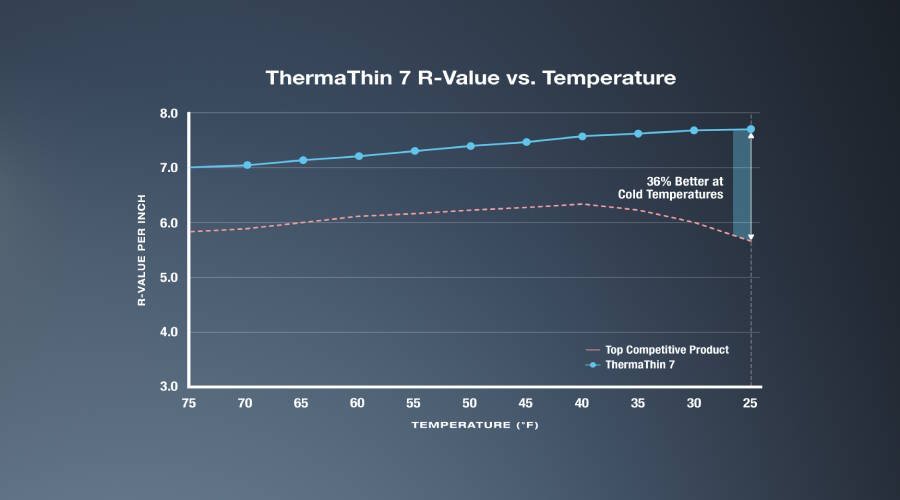
Cold-temperature R-value comparison for ThermaThin 7 and conventional polyiso insulation. Graphic: Carlisle SynTec Systems | Click to enlarge.
Conclusion
Cold storage facilities are becoming more demanding to design because the building envelope must perform as a continuous environmental boundary. That challenge applies to new construction and becomes more complex in aging facilities, where architects must improve performance while working around existing conditions.
For architects and specifiers, the opportunity is to move from component-by-component product selection to assembly-level coordination. Successful cold storage design at the assembly level depends on being able to trace air, vapor, thermal, and moisture-control layers across the envelope and through every major transition.
To explore cold storage envelope strategies, roofing assemblies, specification resources, and design support, visit Carlisle SynTec Systems’ dedicated cold storage resource page or connect with a Carlisle specialist.
By Austin Moss, Director of Strategic Accounts for Advanced Coatings at Henry, a Carlisle Company

Wesley Sherrer is Senior Product Manager – Insulation at Carlisle Construction Materials, where he supports product strategy, innovation, and customer-focused solutions for the building materials industry. With more than 25 years of construction experience, Wesley brings expertise spanning hands-on trade work, distribution, technical sales, sales leadership, product marketing, and general management.