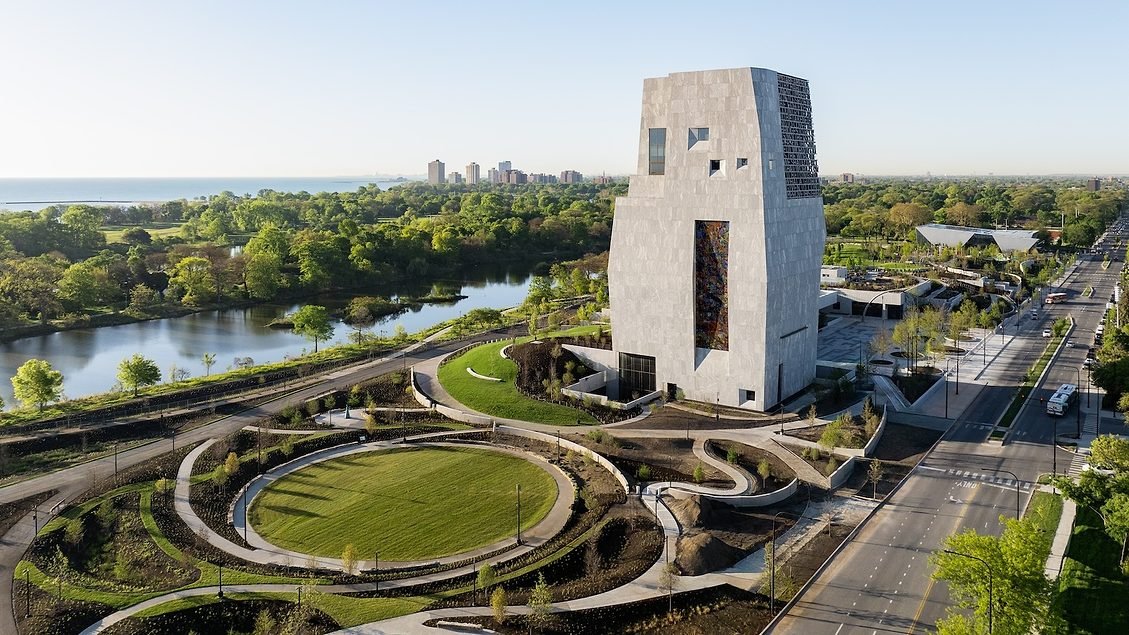
Today, Friday, June 19, Barack and Michelle Obama officially open the long-anticipated Obama Presidential Center (OPC), designed by Tod Williams Billie Tsien Architects | Partners (TWBTA) in collaboration with Chicago-based Interactive Design Architects. The date is significant: Juneteenth is a U.S. federal holiday commemorating the end of slavery.
The new complex, completed at an estimated cost of $850 million, is located on Chicago’s historically Black South Side, in Jackson Park, a 550-acre 19th-century lakefront legacy of lawns and lagoons designed by Frederick Law Olmsted and Calvert Vaux. As the site of the 1893 World’s Columbian Exposition, whose Palace of Fine Arts was expanded and rebuilt in 1930 as the Griffin Museum of Science & Industry, the park is no stranger to large-scale architectural ambition. But the Obama Foundation, a nonprofit organization whose mission is to cultivate and connect future leaders, had to overcome fiercely litigated opposition to its appropriation of almost 20 acres of publicly owned land for an expansive project of 276,000 square feet. Today, however, the grounds remain open to all and are much improved.
-4.jpg "Obama Presidential Center")
The campus features expansive public gardens and recreational facilities. Photo courtesy The Obama Foundation
Historically, these facilities, built to honor former presidents, have been libraries. But in this ever more digital age, the need for buildings to store physical documents has become anachronistic. “This will not be just a presidential library, which we tend to think of as a monument to the past and a bit of an ego trip,” said Obama at his initial presentation of the design in 2017. “Michelle and I want this to be about the future.”
OPC’s identifying landmark is a totemic tower, 225 feet tall, which serves as a museum and is anchored by two long, low, linear structures: the Forum and—yes—a library; though not one for scholars to study Obama’s presidency, but rather a branch of the city’s public system. These are connected below grade and form a campus around a plaza. (A new 60,000-square-foot athletic and events facility designed by Moody Nolan is not part of this composition but is located at the southwest corner of the campus.) The massing recalls another TWBTA project nearby, the University of Chicago’s 2012 Logan Center for the Arts, where a two-story horizontal building is punctuated vertically by a 10-story campanile.
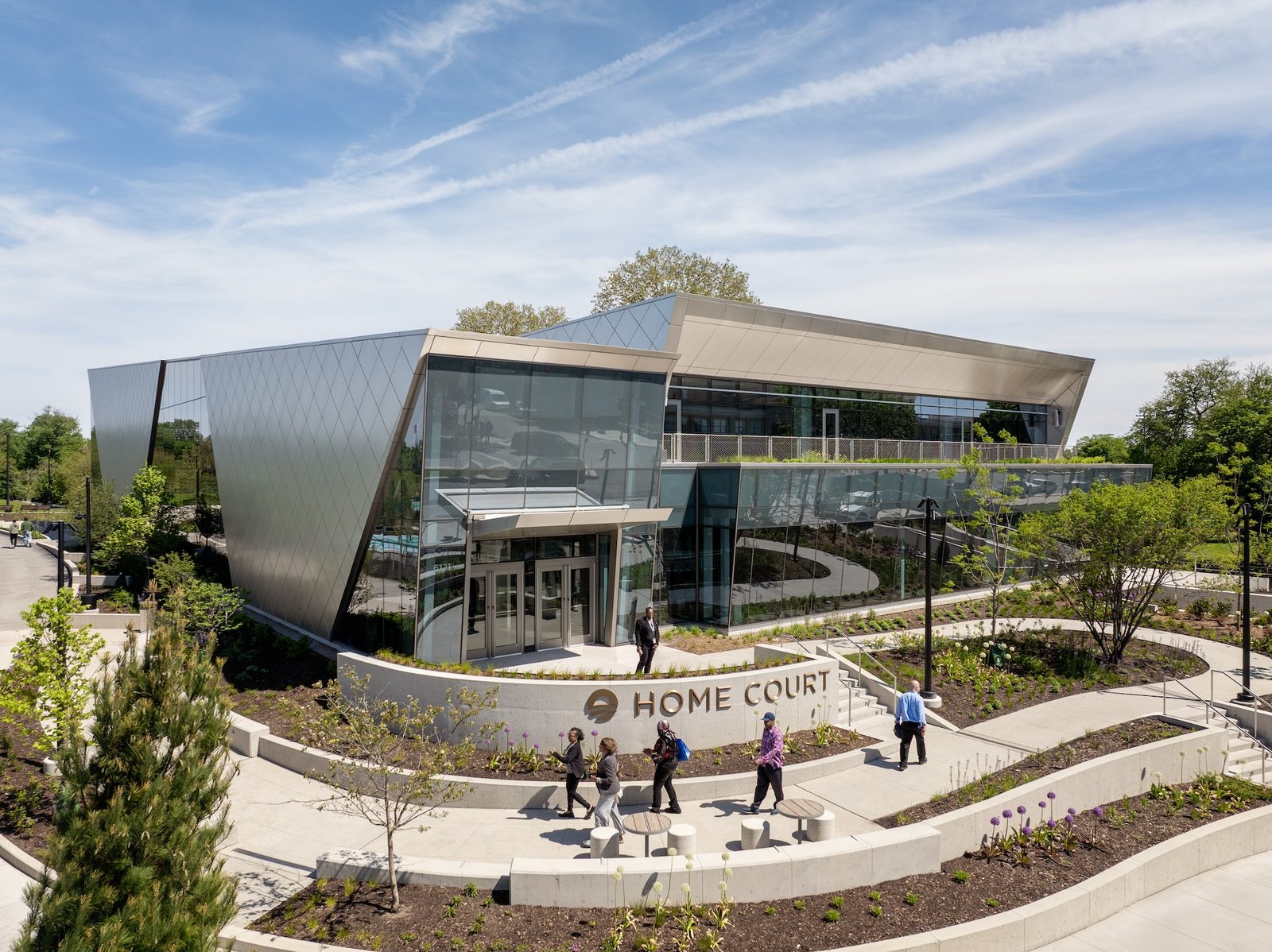
Home Court, an athletic facility on the campus designed by Moody Nolan. Photo courtesy The Obama Foundation
Site planning by Michael Van Valkenburgh Associates weaves the architecture into the park. Cornell Drive, a six-lane thoroughfare dating back to the 1960s, has been removed, reconnecting this area to neighboring lagoons and adding almost four acres of green space, which includes bicycle and pedestrian paths. Regraded topography and lushly planted roof terraces make the low-slung buildings, with adjacent gardens and courtyards, read more as landscape rather than as built form, especially when viewed from inside the park. The central plaza is a serene granite-paved rectangle, sheltered from busy Stony Island Avenue by a grove of honey locust and ginkgo trees. It marks the beginning of a carefully choreographed entry sequence for all three buildings.
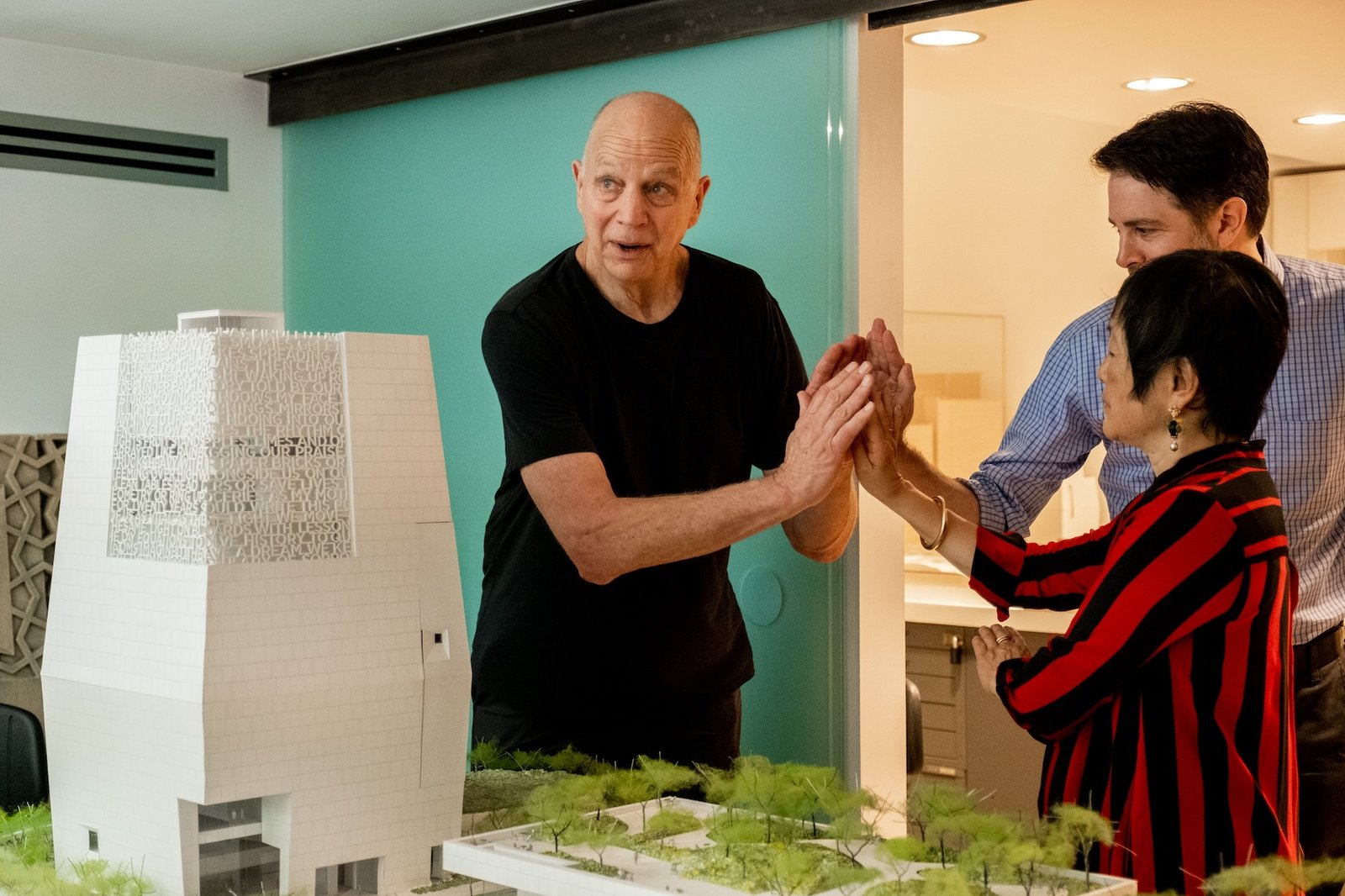
Tod Williams, Paul Schulhof, and Billie Tsien of TWBTA, pictured here in 2019, explain how the tower was inspired by four hands coming together. Photo courtesy The Obama Foundation
The museum tower’s canted form—like a slice cut from a sculpture by Constantin Brancusi or from the St. Regis Tower by Studio Gang eight miles to the north—is decidedly idiosyncratic and has drawn harsh criticism. It’s been nicknamed by many the “Obamalisk” and derided by critics as the “Obamausoleum” (in the Guardian), a “blind, ominous alien spacecraft” (in the Financial Times), and “cold and forbidding” (in the New York Times). On a more positive note, the Washington Post called it “understated and a bit reticent.” A video released in 2018 features the former president admitting he once wanted to be an architect and explaining the symbolism of the building’s shape. Showing an image of four cupped hands, with fingers pointing up, he said, “We designed it with this photo in mind: many hands, each one different, coming together as one.” Unfortunately, metaphors, no matter how noble their aspirations, rarely translate legibly into architecture.
In a lecture delivered at MIT in 2021, Williams and Tsien said Obama had suggested that they should look at the work of Brancusi when he found their preliminary design concepts “too quiet.” The pair had initially caught his eye with a competition proposal for a campus rather than a single structure, which would have been consistent with their predilection for buildings that sit discreetly in the landscape. But their hands-on client wanted one component of that campus to be big and bold. “He asked for something iconic,” recalled Tsien in the lecture. “That meant we had to design from the outside in, which is not what we usually do.” She repeated this sentiment at a press preview, saying that the duo had never struggled so much with form-making. “It was like imagining yourself inside Obama’s brain,” she added. “Brancusi evoked his desire to make something irreducible.”
Looking for quick answers on architecture and design topics?
Try Ask RECORD, our new smart AI search tool.
Ask RECORD →
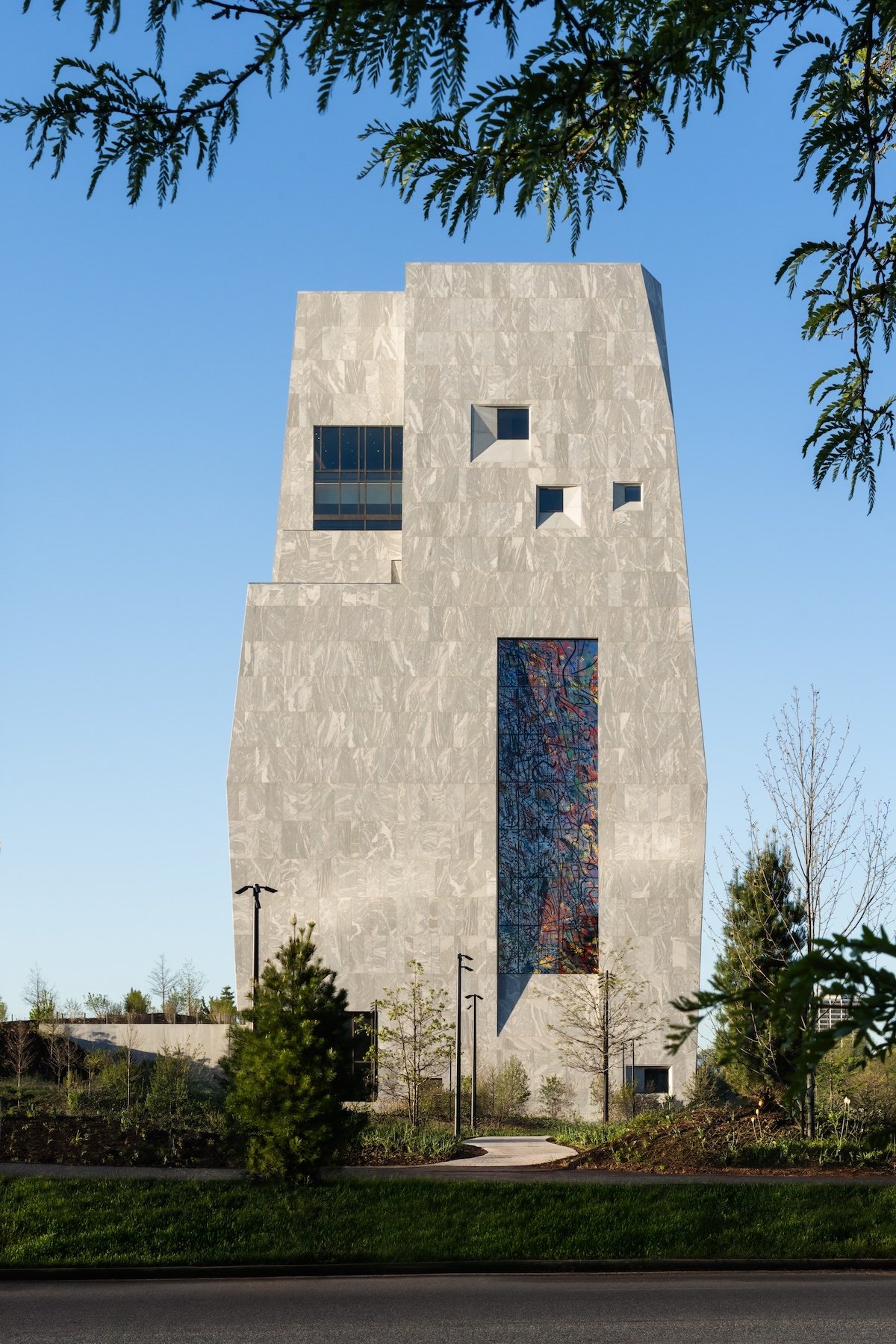
The tower rises eight stories over the campus and surrounding Jackson Park. Photo courtesy The Obama Foundation
The concrete tower is clad in vertical panels of heavily figured gray granite, quarried in New Hampshire. “He kept referring to Brancusi, so we tried to do something that felt carved from a solid,” said Williams, who cut away the structure’s corners to achieve a more sculptural shape. He and Tsien animated the south and north facades with multistory vertical apertures. Stained-glass fills the one to the north, which flanks an escalator. A light box—not a window, which was nixed by exhibition designers to minimize sun exposure—fills the one to the south, which also marks the entry. A bas-relief of vertical lines adds texture and scale at the southeast corner. The east elevation looks a bit blank.
The most prominent facade embellishment is a Pentagram-designed filigree of precast concrete letters, each five feet high and pigmented to match the granite, on the upper southwest corner. These reproduce an excerpt from Obama’s 2015 speech marking the 50th anniversary of the march from Selma, Alabama, to the state’s capital of Montgomery, a turning point in the fight for civil rights. The quote begins: “You are America. Unconstrained by habit and convention. Unencumbered by what is, ready to seize what ought to be.” Didactic? Yes, but if not here, then where? And visually, it’s a tour de force, especially when backlit at twilight, transforming what might have been a monotonous monolith into something lively and luminous.
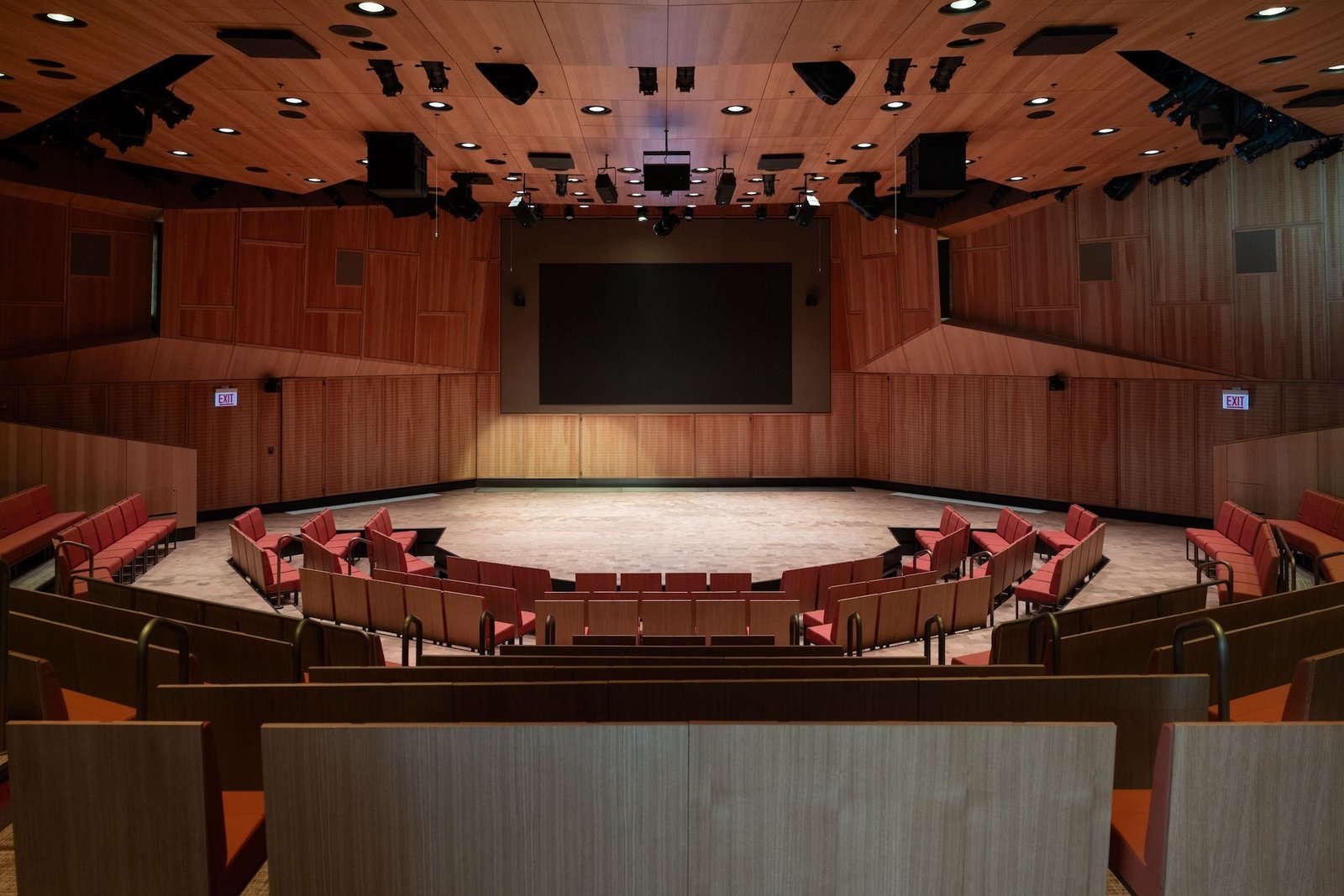
The center’s main auditorim is located in the Forum. Photo courtesy The Obama Foundation
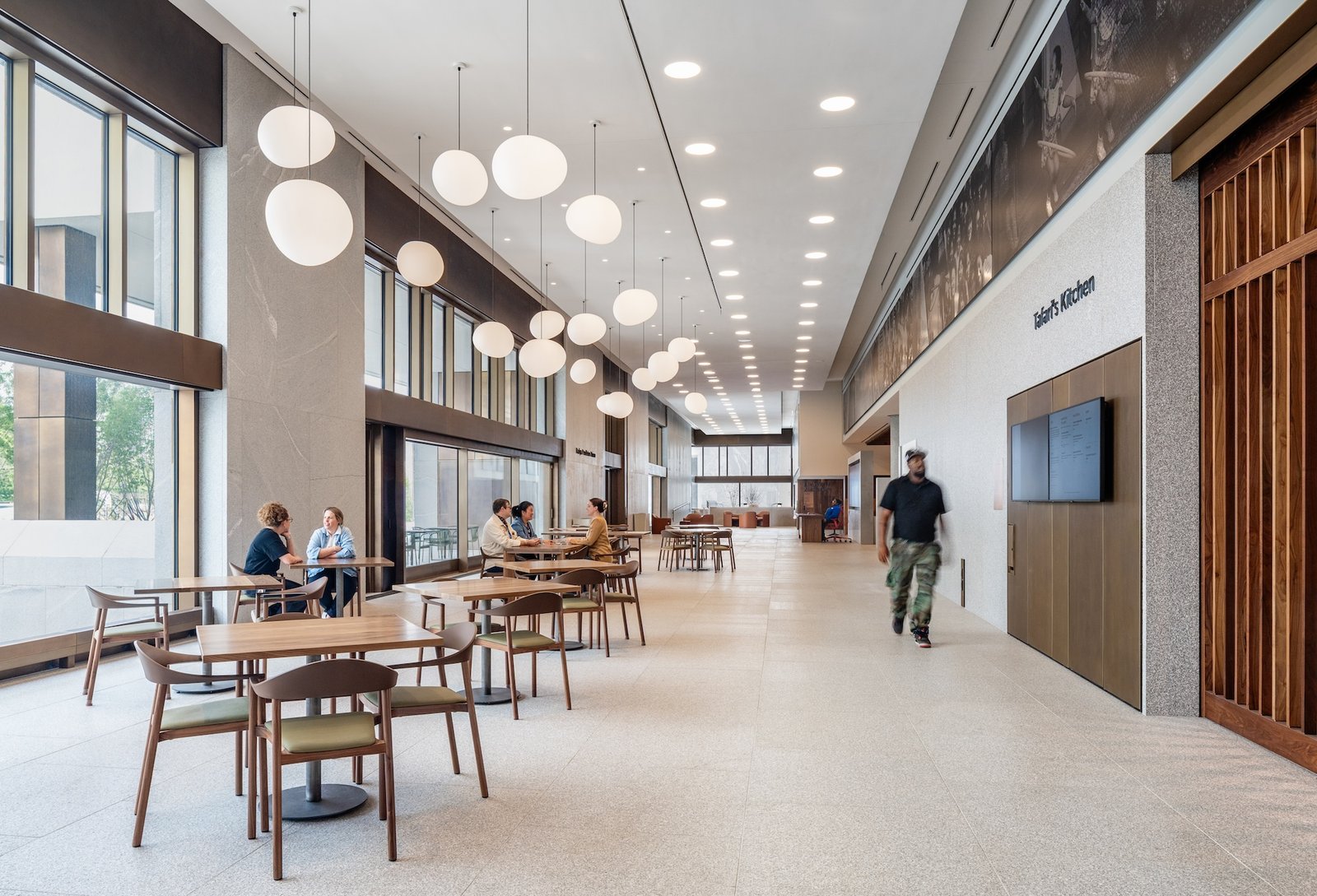
A seating area in the Forum’s Hadiya Pendleton Atrium. Photo courtesy The Obama Foundation
The Forum, which is open to the public with no admission fee, contains an airy atrium, lounges, meeting rooms, a 299-seat auditorium, a café, and a restaurant. The public library features a spacious community room and adjacent reading room, both filled with books, many chosen by the Obamas, and comfortable seating on which to peruse them. Both buildings have taut facades of granite and glass, with a deep soffit overhanging the Forum to shield it from western sun.
A mix of horizontal and vertical volumes enlivens the museum tower’s interiors. Art-filled atriums at the southwest and northeast corners connect the lobby to levels above and below. Space flows around two perpendicular concrete cores for stairs and elevators, which occupy considerable area; it’s hard to imagine the gallery floors won’t feel tight when filled with people. But a second northeast corner atrium at those levels should help to offset any sense of confinement. A window at that corner on the top floor overlooks Lake Michigan and the Beaux-Arts splendor of the Griffin, while the high-ceilinged Sky Room at the southwest corner opens onto panoramic views of Chicago through the sculptural grille of Obama’s words. To get there, gallery visitors must shift from a single up-only escalator to elevators, which makes for an awkward transition.
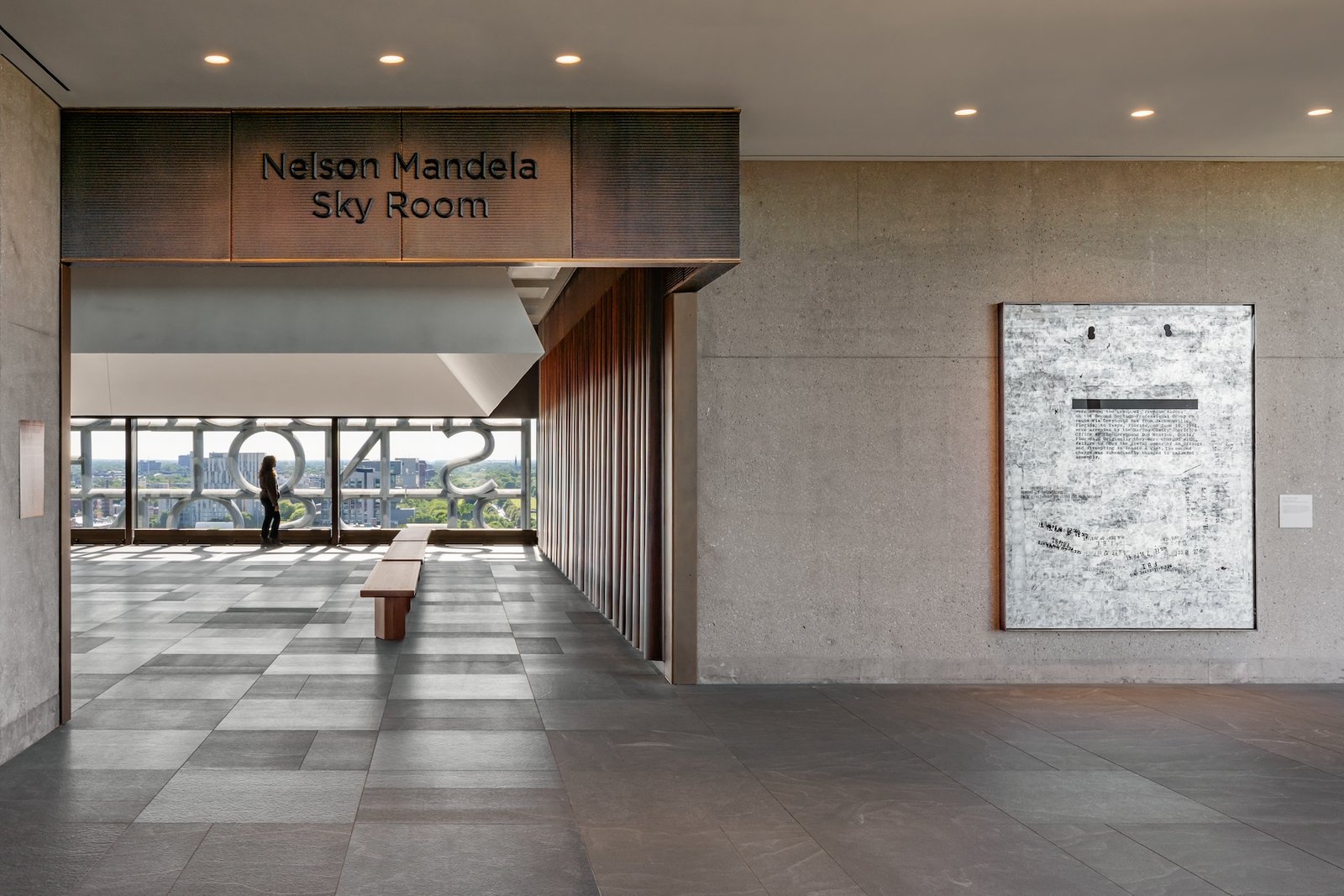
The entrance to the Sky Room. Photo courtesy The Obama Foundation
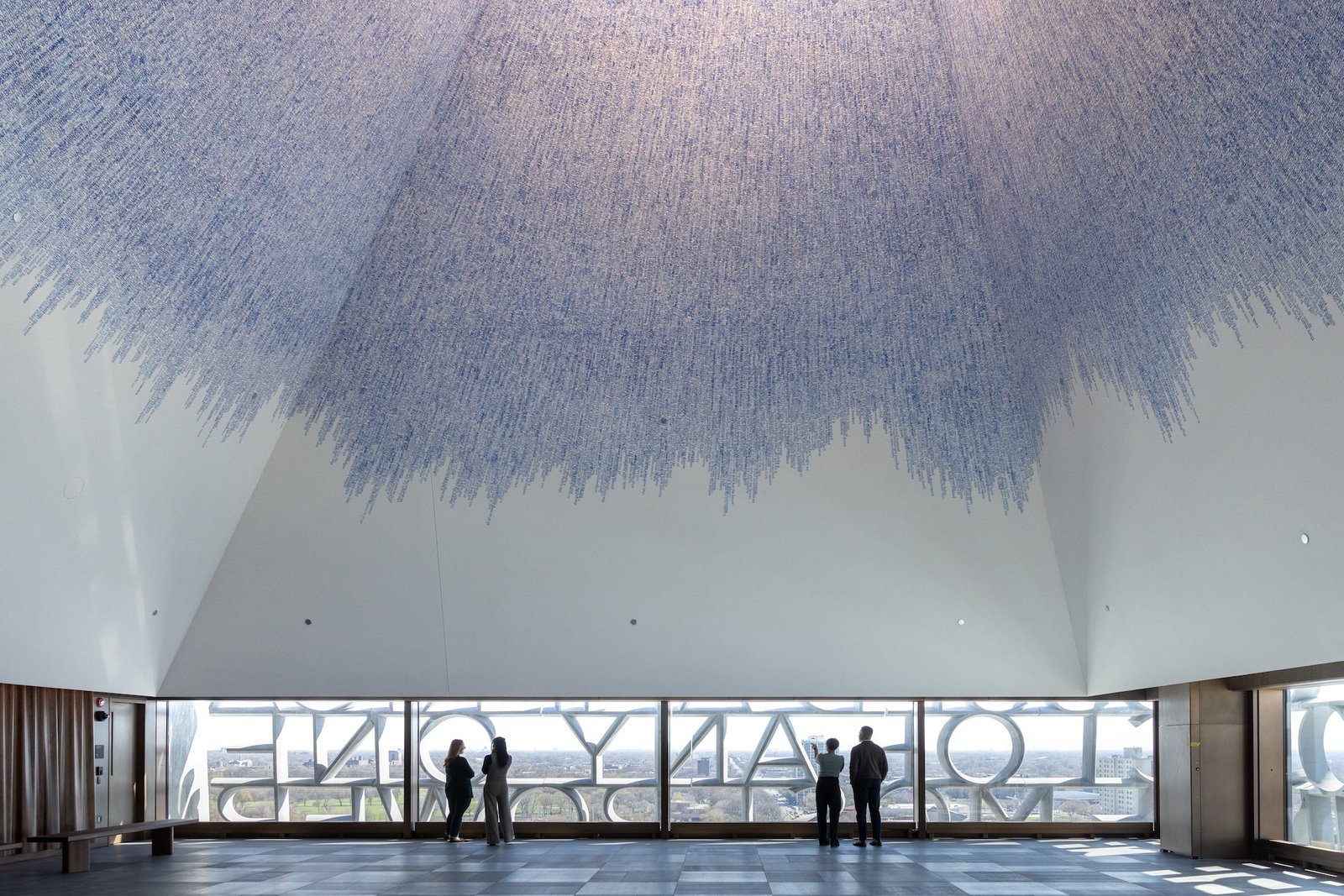
The Sky Room. Photo courtesy The Obama Foundation
The non-gallery spaces are luminous. On the lower level, where the three buildings become one, generous circulation and lounges abut sunny courtyards, so visitors never feel underground. The rich but subtle material palette includes sandblasted concrete with exposed aggregate, granite, and terrazzo, all in tones of gray and white, combined with wood and patinated bronze. In the northeast atrium, a grand stair with mesquite treads and open risers, flanked by panels of cast bronze, similar to those on the facade of TWBTA’s sadly demolished Folk Art Museum in New York City, leads down from the museum’s lobby. Handsome millwork includes paneling, both linenfold in the Sky Room and more gridded and planar in the auditorium, along with curvaceously carved benches, all of walnut. Everything is detailed with TWBTA’s usual elegance and precision.
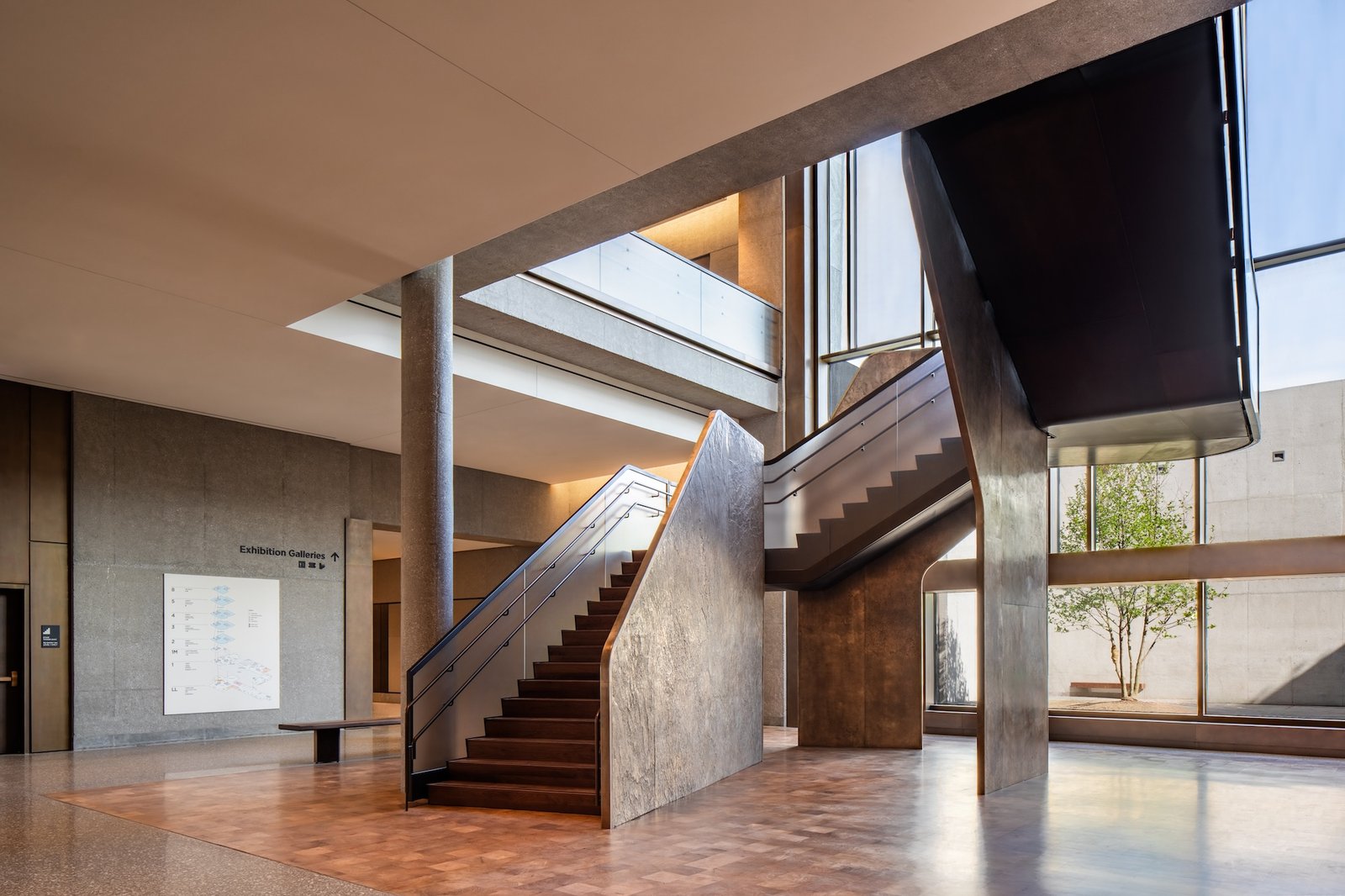
The grand stair in the museum’s Hope and Change Lobby. Photo The Obama Foundation
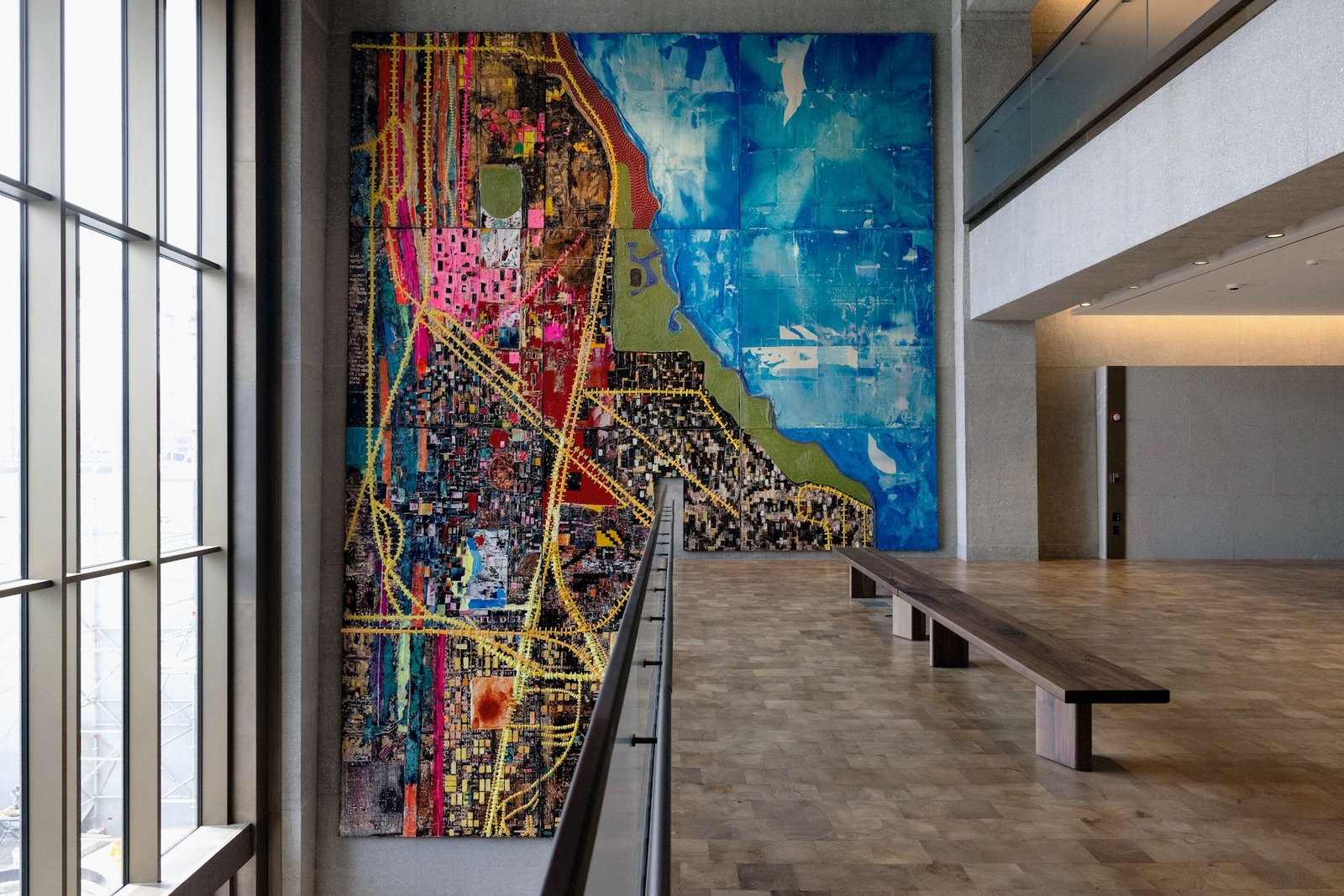
Mark Bradford’s City of the Big Shoulders on view in the Our Story Atrium. Photo courtesy The Obama Foundation
The OPC appears consistent with Obama’s own impressive record on sustainability and is targeting LEED Platinum certification. According to a press release, a campus-wide geothermal system works in tandem with renewable energy sources to provide heating, cooling, and electricity; no fossil fuels are used in day-to-day operations. However, unable to produce all required energy on-site, the OPC draws from off-site sources (The OPC did not reply to a request for information about them). Thirty percent of the campus has been planted with native or adopted vegetation, and it has a comprehensive water conservation system, which captures and reuses 98 percent of rain that falls on-site.
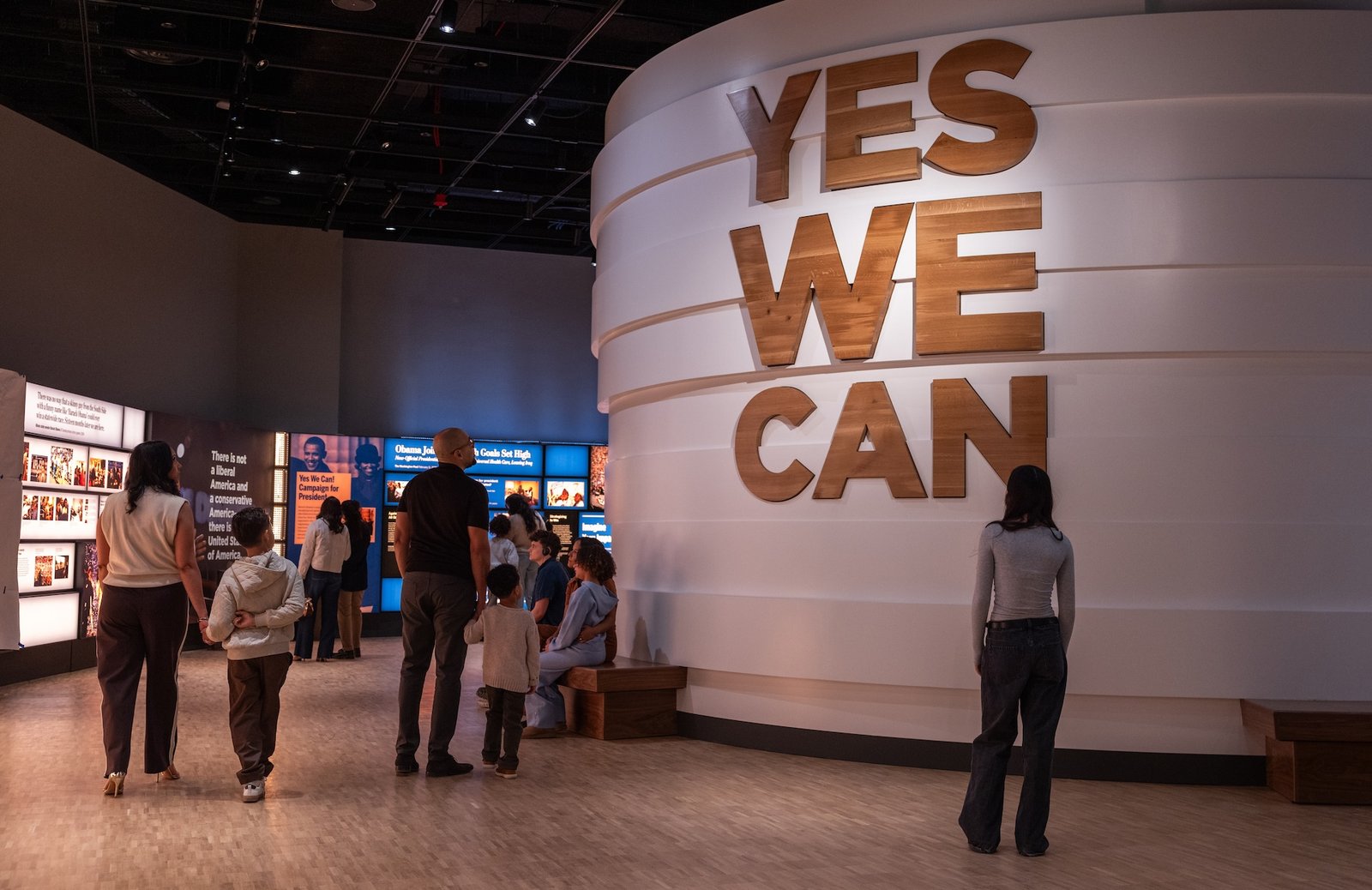
In 2017, Obama claimed to have agreed reluctantly to a museum “because, let’s face it, we all want to see Michelle’s dresses.” And there are 12 of them, all smartly displayed on one of four gallery floors. These offer visitors a vertical tour of the Obamas’ story in the context of history. Designed by Ralph Appelbaum Associates, it begins with “Toward a More Perfect Union,” chronicling abolition and the civil rights movement before moving on to themes of leadership, democracy, community, and civic engagement. It includes a full-scale replica of the Oval Office—as many presidential centers do—and ends with “We the People,” which turns the focus onto ordinary Americans. Obama’s baritone is omnipresent as he narrates 37 short films playing on multiple screens. Is this an exercise in legacy-burnishing? Perhaps, but that’s the norm in such buildings.
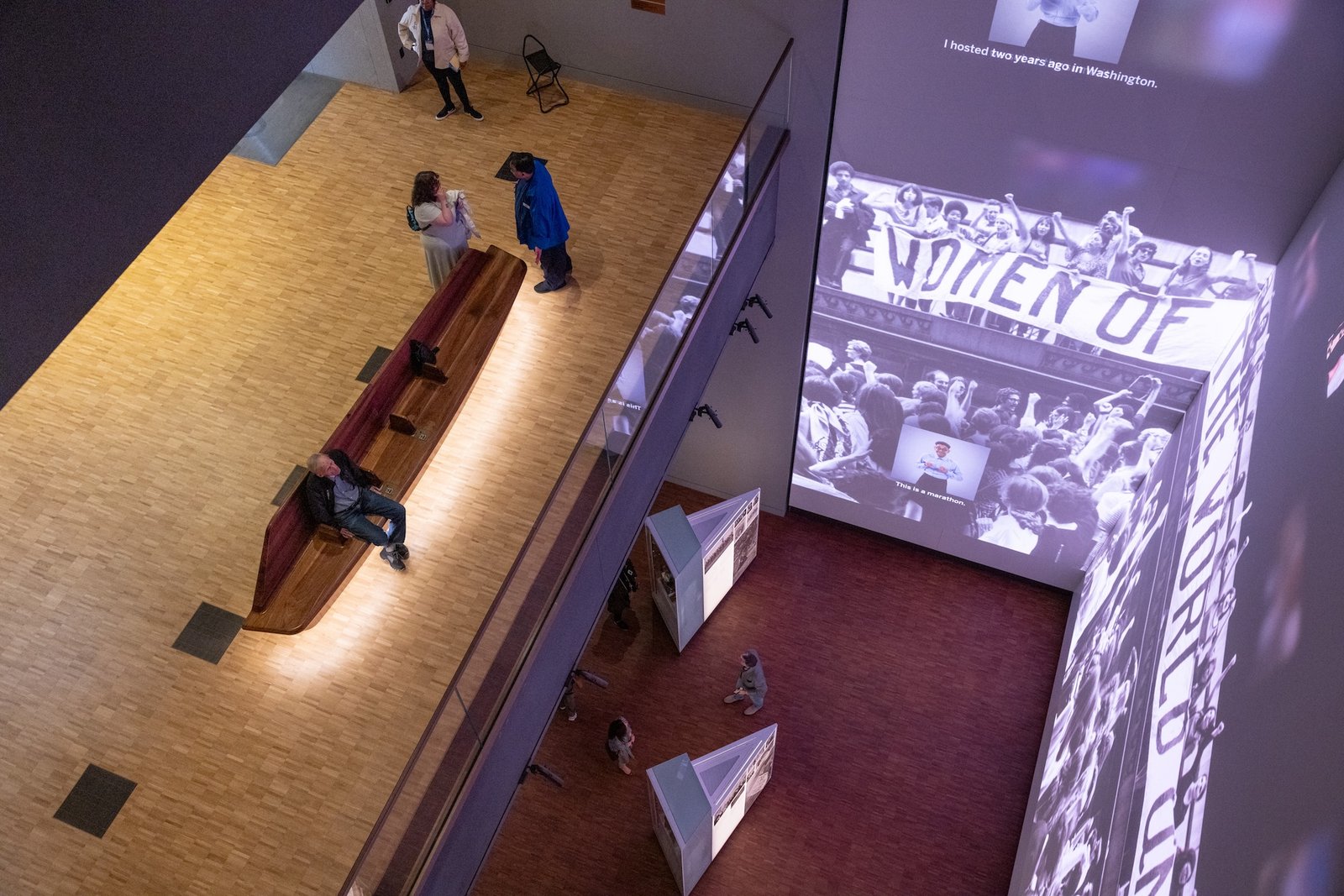
1
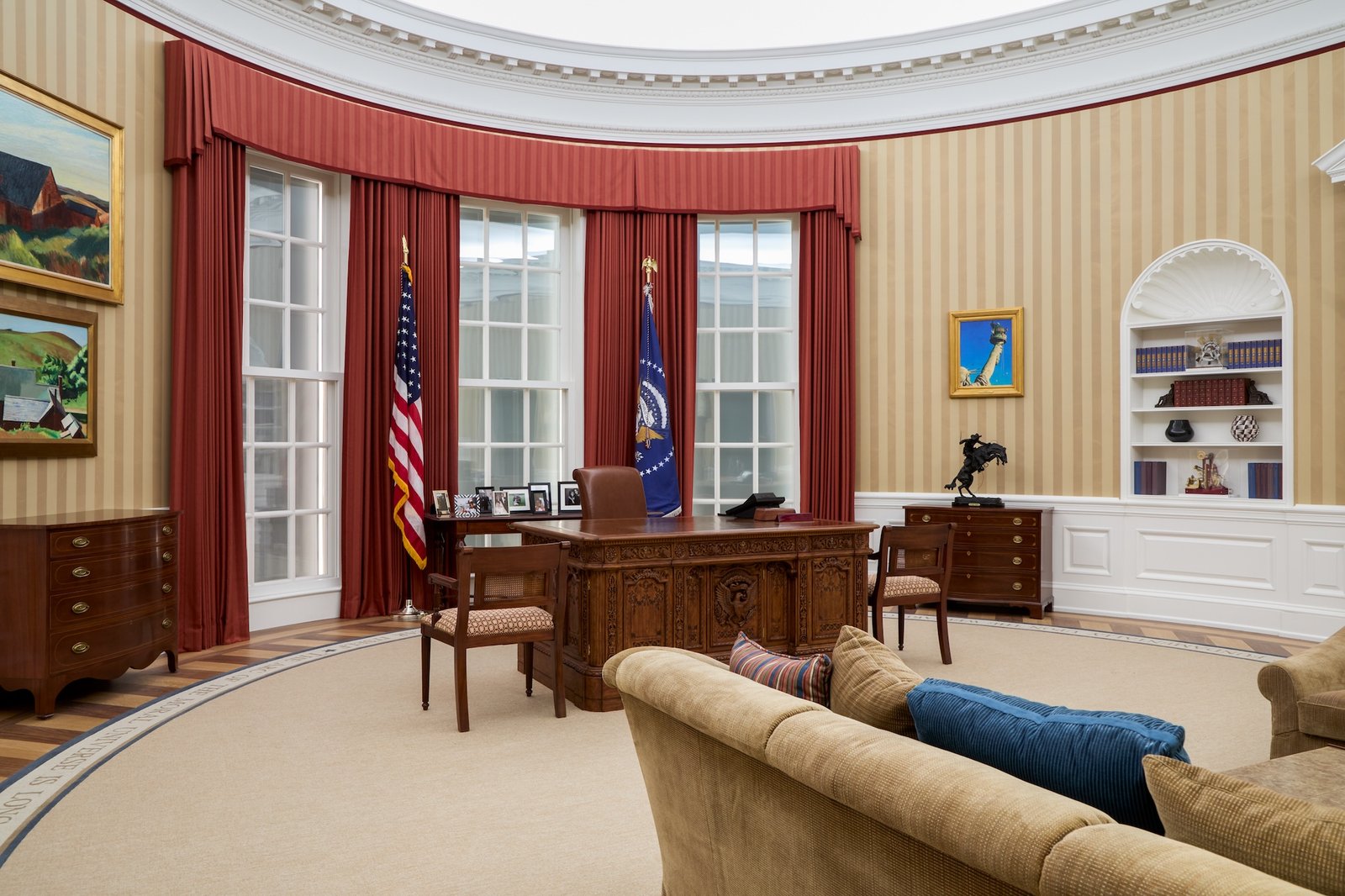
2
3
The museum features benches designed by Chicago-based artist and designer Norman Teague (1); an Oval Office experience (2); and a range of interactive exhibits (3). Photos courtesy The Obama Foundation
Much criticism of the OPC has focused on its tower’s impenetrable opacity. But that is the nature of many museums, which tend to have few windows to carefully control lighting in galleries. And transparency, desirable though it may be, has become a shopworn cliché in both architecture and politics. Nonetheless, because we’ve become so accustomed to an architecture of lightness, made possible by steel frames and curtain walls, we tend to forget that for millennia, buildings were conceived as dense and weighty masses of masonry. That may explain, at least in part, why the OPC tower looks rather odd to contemporary eyes.
In the enigmatic tower, Obama got the icon he requested. There’s no denying its monumentality, which seems strangely suitable for both its site and its stature. It harks back to a time when modernist architects were lauded as heroic form-givers. Ironically, it also harks back to a time when museums were created as cloistered containers even though this one’s mission is aligned with the current paradigm of openness, social engagement, and community outreach.
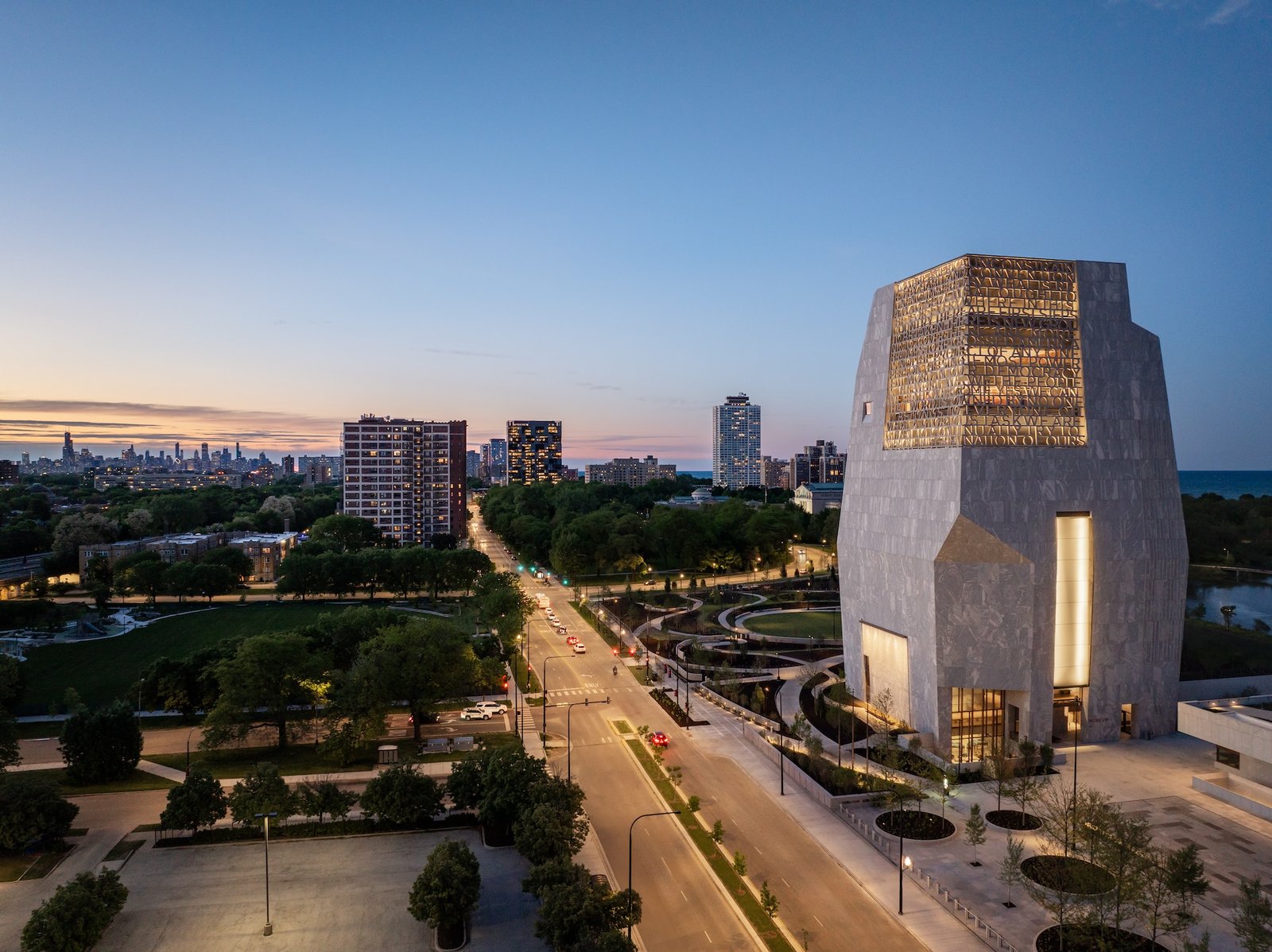
The Obama Presidential Center pictured on the evening of May 20. Photo courtesy The Obama Foundation
The tower is emphatically opaque, giving little hint of the spaces within. And its solid, sculpted silhouette, rendered at the request of a demanding client, suggests mass rather than volume. This works in tandem with its opacity to evoke a brooding, monolithic gravitas. That may be an unlikely look for the OPC’s upbeat goal of inspiring people to change the world. But it seems eminently appropriate for a civic monument to a man who, like the tower, is famously aloof and inscrutable. One critic’s “cold and forbidding” is another’s “cool and refined.”
Credits
Architect:
Tod Williams Billie Tsien Architects | Partners — Tod Williams, Billie Tsien, founding partner in charge; Paul Schulhof, partner in charge; Brian Abell, Aaron Fox, Evan Ripley, project managers; Jennifer Dempsey, Brian Bedford, project architects; Alex Odom, Isaac Southard, Mando Fytou, Pik-Tone Fung, Daniela Cruz, Octavia Giovannini-Torelli, Whangjin Suh, Jennifer Fang, project team
Associate architect:
Interactive Design Architects
Landscape Architects:
Michael Van Valkenburgh Associates, Site Design Group, Living Habitats
Exhibition Design:
Ralph Appelbaum Associates (museum)
Interior Designers:
Studio Goga (restaurant); Charles Sparks + Company (retail)
Curator of Art Commissions:
Virginia Shore, Shore Art Advisory
Engineers:
Thornton Tomasetti, Stearn Joglekar (structural); Altieri (mechanical, electrical); Stantec (fire protection, plumbing); David Mason Associates (civil)
Consultants:
Michael S. Smith Inc. (art and design); Threshold Acoustics (acoustics); Reg Hough Associates (architectural concrete); Shen Milsom & Wilke (AV/IT); Jensen Hughes (code/life safety); Lerch Bates (elevator); Heintges (facade); Entek Engineering (facade maintenance); Cini-Little (food service); PWGC Environmental Engineering & Consulting, GEOptimize (geothermal); Pentagram (screen); Manual Creative & Via (graphics/signage); DCL (sign fabrication); ArkaSpecs (hardware); Fisher Marantz Stone (lighting); Lerch Bates (material/waste management; WGI (parking); DVS (security); RWDI (smoke/falling ice); Conspectus (specifications); Atelier Ten, dbHMS (sustainability); Charcoalblue (theater); Wiss, Janney, Elstner Associates (waterproofing)
General Contractor:
Lakeside Alliance
Client:
The Obama Foundation
Size:
276,000 square feet
Cost:
$850 million (project)
Completion:
June 2026
Sources
Structure:
Concrete Collective, Paschen Concrete, Ozinga (concrete); Waukegan Steel, Nucor (steel)
Cladding:
Cleveland Marble Mosaic Company, A.Lacroix Granit, Granites of America (masonry); Tuschall Engineering Company, Pohl (metal panels); New Hudson Facades, Gartner of Permasteelisa Group; Architectural Glass and Metal (curtain wall); Bendheim (rainscreen); Envel, Fine Concrete, Ductal (precast); Thorne, Dryvit Systems, Tremco (EIFS, ACM); Kedmont, Henry (moisture barrier)
Roofing:
A1 Roofing, Soprema (Elastomeric); GCP Applied Technologies, Sika, Rockwool, Dupont, Owens, Corning
Windows:
Hope’s Windows
Glazing:
British Glass Technology (BGT), Vitro Architectural Glass, NSG Group/Pilkington, SEVASA; Cristacurva (skylights)
Doors:
U.S. Architectural Glass and Metal, Doorwayz, Dawson Custom Architectural Doors and Entrances, Forms+Surfaces, DH Pace, Parenti & Raffaelli, Daiek Woodworks, Oakton Architectural Glass, Panda Windows & Doors, Dormakaba; Cornell Door Solutions, McKeon Fire Shutters, Safti First (security grilles); Nanawall (special doors); Clark Doors (upswinging doors)
Hardware:
Sargent, Accurate Lock and Hardware (Locksets); Norton Rixson (locksets); Rockwood, Mariani Metal Fabricators (pulls); Magnasphere (security devices); Architectural Builders Hardware Mfg, Accuride, Adams Rite, BEA Sensors, Crown Industrial, Dormakaba, FritsJurgens, Hafele, Hawa Sliding Solutions, HES, IVES, Ilco, McKinney, National Guard Products, PEMKO, Schlage Door Hardware, Securitron, ZERO International
Interior finishes:
Escarpita, Thorne, Baswa Acoustic, Armstrong Ceilings, USG (acoustical ceilings); ALUR (demountable partitions); Parenti & Raffaelli, Mark Richey Woodworking (cabinetwork); Sherwin-Williams (paints and stains); Oosterbaan & Sons Co. (wall coverings); Mark Richey Woodworking, Huff Company, Ketsum & Walton, FilzFelt, Maharam, John Boyd Textiles, Opuzen, Knoll Textiles, Pallas Textiles, Carnegie Fabrics (paneling); Parenti & Raffaelli, Mark Richey Woodworking, Nevamar (plastic laminate); CS Architectural Woodworking, Parenti & Raffaelli, Corian (solid surfacing); Mariani Metal Fabricators, Specialty Construction, Chicago Ornamental Iron (ornamental metal); GI Stone, A.Lacroix Granit, Granites of America, Polycor, Bourbon, Fireclay Tile (floor and wall tile); Consolidated Flooring, Mondo Contract Flooring, Roppe (resilient flooring); Consolidated Flooring, Shaw Contract, Tarkett Commercial, Scott Group Studio (carpet); Consolidated Flooring, Kaswell Flooring Systems (wood flooring)
Lighting: :
SourceBlue, Ecosense Lighting, DuraLamp, Axis Lighting, Lighting Services, Boca Lighting and Controls, Lucifer Lighting Company, Foscarini Lighting, Louis Poulsen, Siemon & Salazar, Pagani Studio, Hervé Van Der Straeten, QTL Lighting (interior ambient); Edison Price Lighting, Pinnacle Architectural Lighting, Inter-Lux, USAI Lighting, DMF Lighting (downlights); BEGA, Targetti, New Star Lighting, Lumenpulse, B-K Lighting, Lighting Quotient, Remains Lighting Co. (exterior); Lutron (dimming)
Conveyence:
Otis (elevators/escalators)
Plumbing:
Marsh-Adamson, Wahaso (rainwater harvesting); Jay R. Smith (roof drains); Sloan, Bemis, Duravit (commercial water closets); Sophstone, Grohe (commercial lavatories)
Energy:
Siemens, Elite, SunModo, Qcells, QC Geothermal