Claro Arena Las Condes, Santiago de Chile football stadium building, modern sports architecture images
post updated 20 February 2026
IDOM wins the ArchDaily Building of the Year with the Claro Arena
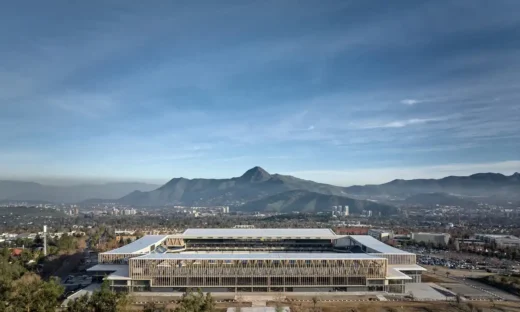
IDOM has been awarded the ArchDaily Building of the Year 2026 in the Sports Architecture category for its modernization project of the Universidad Católica Stadium (Claro Arena), located in Santiago, Chile.
Photos by Cristóbal Palma
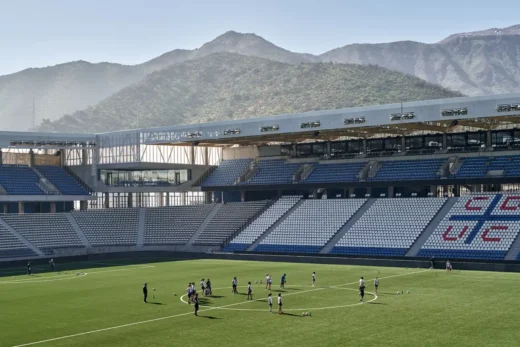
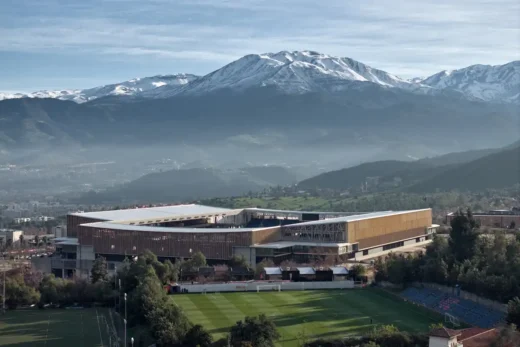
The project transforms the historic San Carlos de Apoquindo into a contemporary venue, expanding its capacity to 20,000 spectators and incorporating a set of innovative solutions in structure, sustainability, and user experience. The intervention preserves the original stands and integrates them into a new architectural system composed of a 360-degree perimeter boulevard and a lightweight upper extension that redefines the stadium’s identity.
The proposal stands out for its sustainable approach: it reuses the existing concrete structure, incorporates 1,600 m³ of Chilean laminated timber—which captures more than 1,500 tons of CO₂—and recycles demolition materials such as steel and plastics. The timber-slat façade and the mixed timber-and-steel roof optimize lighting, ventilation, and acoustic comfort.
With this recognition, IDOM strengthens its position as an international benchmark in sports infrastructure, reinforcing a trajectory built on innovation, structural efficiency, and a strong commitment to sustainability.
+++
Previously on e-architect:
Architects: IDOM
Location: Las Condes district of Santiago, Chile
Claro Arena, formerly known as Estadio San Carlos de Apoquindo, is a football stadium.
12 November 2025
Universidad Católica Stadium Modernization Project, Chile
The San Carlos de Apoquindo Stadium, currently known as the Claro Arena, was officially inaugurated on September 4, 1988. Located in the Las Condes district of Santiago, Chile, the stadium sits in the foothills on a gently sloping site facing the city.
The stadium was partially buried, with access at ground level on the east side, facing the foothills (called Fouilloux), and on the west side, facing the city of Santiago (called Livingstone). The mountain range is on one side, with Cerro Provincia dominating the view. Manquehue and the city of Santiago are on the opposite side.
Given the evolution of world football since its inauguration and the need to increase capacity from 12,000 to 20,000 players, the club launched a competition to address the modernization needed to meet the infrastructure’s present and future challenges.
The new stadium must address issues related to television broadcasts, as well as technological, sustainability, comfort, and hospitality issues specific to modern soccer. The competition’s focus also anticipated the aspiration to design a multipurpose building for ongoing activity, rather than limiting its use to two sporting events per month.
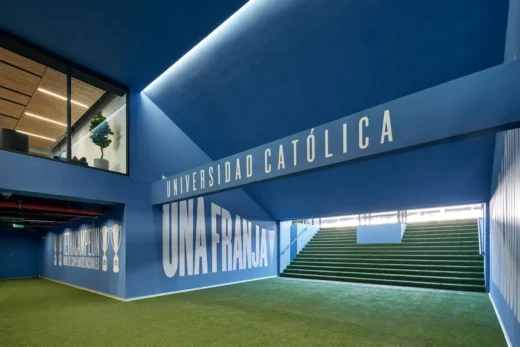
IDOM designed a modern soccer stadium in accordance with the highest standards. We conceived it as a rational building with a rigorous approach to the program, structure, and sustainability. The project considers the sun, wind, energy consumption, and interior and exterior comfort. The stadium has spaces to host activities 365 days a year and expands the hospitality offerings. Tailored to the club, the building is rooted in its tradition and history. Built from local materials, it offers an authentic soccer atmosphere outside while being visible from and respectful of the surrounding area.
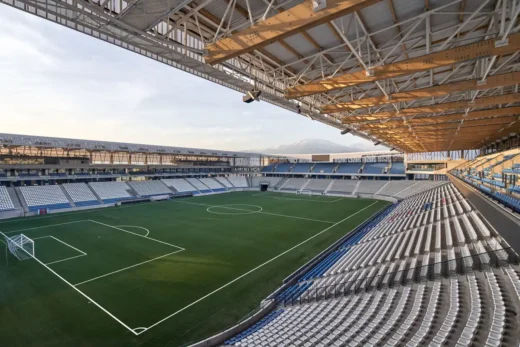
This section illustrates the process. While keeping the current stands practically intact, a continuous horizontal plane connects the bands and backgrounds to the Fouilloux access level, a 360-degree boulevard. The old stadium is anchored to the ground under this boulevard, and the extension with a lighter and more permeable structure rises above it.
In terms of layout, we opted for the most efficient geometry: a rectangle. Rather than curving and obstructing visibility, the corners were transformed into distinctive features that mark the building’s entrances and provide spectators with unique spaces.
PROGRAM (Function)
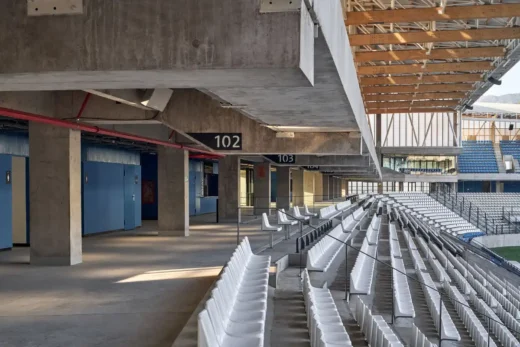
The lower stands of the original stadium offered excellent views that could be preserved with very few modifications, maintaining almost 95% of the original views. The 360-degree boulevard is located on the upper level.
New galleries are being built above the boulevard to house the general public in the back and the general public and boxes in the Fouilloux area.
In Livingstone, the expansion is taking place below and above the boulevard. Towards Santiago, below the boulevard, the new building will house new sports facilities, including dressing rooms, press rooms, and press work areas, as well as hospitality spaces, such as third-tier and premium areas, including VIP and presidential boxes. It will also house television, radio, and technical areas.
Additionally, four rooms in the corners will offer views of both the landscape and the sporting event. These multipurpose rooms can be used during games and events and are connected by the slabs behind the stands, which opens up the possibility of using the infrastructure in new ways for non-game events.
The playing field’s surface has been modified to be at the optimal height for maximizing visibility.
STRUCTURE AND ROOF
The original building’s entire concrete structure remains intact and in good condition. Therefore, the decision has been made to intervene as little as possible.
This meant that the stadium extension had to be built around the existing bowl.
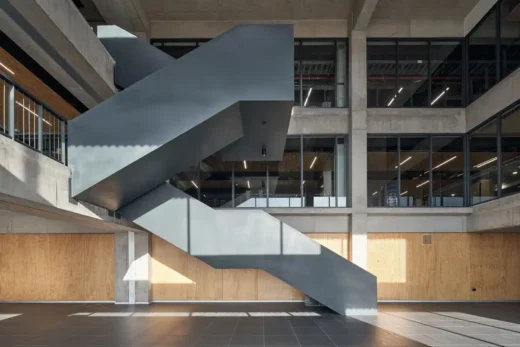
A concrete beam and pillar skeleton with reinforced slabs around 18 centimeters thick completes the building’s geometry at the ends and sides, along with their corresponding expansion joints. The expanded corners of the building are covered with an inverted mixed concrete-steel structure that optimizes the use of steel in tension areas while leaving concrete exposed inside rooms. Building height is regulated by law, and floor heights are limited by those of the original Livingstone building, which are very restrictive in some areas. These are the necessary boundary conditions to which the building must adhere.
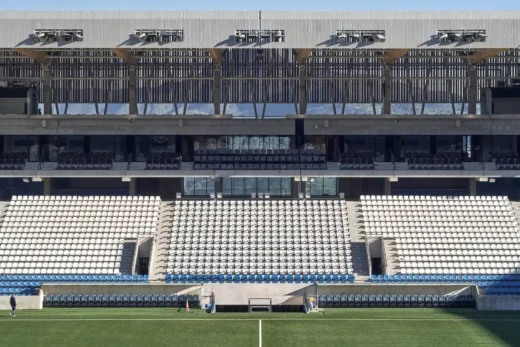
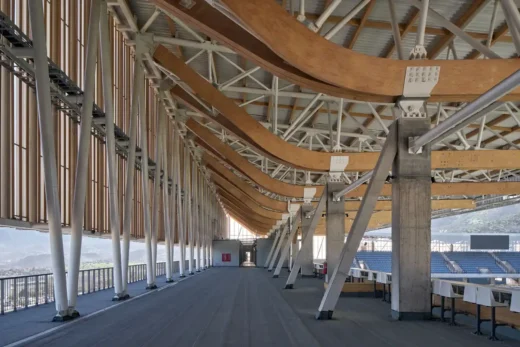
Due to Chile’s seismic conditions, we proposed a lightweight roof to limit the load at such a height above the ground. Chile is a country rich in wood. Thanks to the development of local technology and a strategic alliance between the club and the timber company CMPC, we were able to design a mixed wood and steel structure.
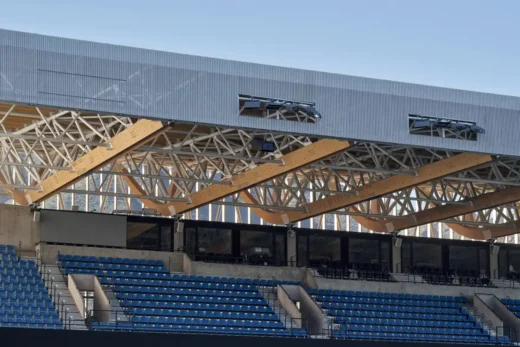
The roof structure is designed through multiple stages and iterations to conclude with the most efficient solution. The appropriate structural type is used for each span. At the ends, solid laminated wood beams span 17 m every 8 m.
At the sides, a three-dimensional mixed wood-steel structure is designed with supports every 8 m. This structure spans 27 m in Livingstone and 31 m in Fouilloux. Chilean engineer Mario Wagner proposed this structure, which can be understood as the deployment of two flat trusses that rotate to open up into the upper chord, taking the compressed lower chord as their axis. This reduces the span of the wooden purlins (rafters) of the roof. The lower wooden chords are made of curved laminated wood profiles so that forces are transferred to the pillar by compression. This minimizes the need for steel in the anchor plates. However, the pieces must be stabilized in their position.
A light sheet metal and TPO waterproofing complete the roof package on top of this.
ENVELOPING, SPORT COMFORT
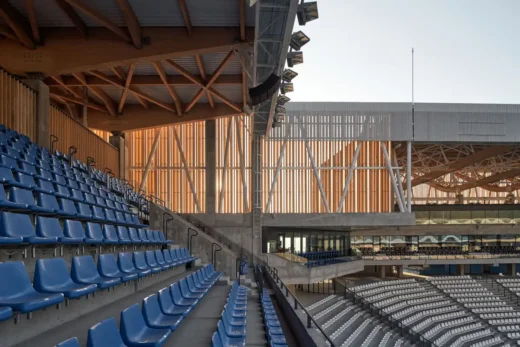
The competition had already proposed a solution for the façade that would improve the interior and exterior environmental conditions of the bowl. Since it is an open, un-air-conditioned space, the façade is designed to reduce afternoon glare, control noise emissions, and facilitate ventilation.
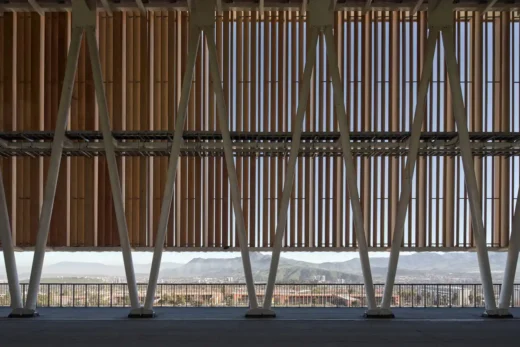
From the boulevard level to the roof, the building envelope is made of laminated Chilean radiata pine and maintains a vertical rhythm every meter with 500 mm x 90 mm slats that integrate LED lighting. Depending on the orientation and technical requirements of each façade, the space between the slats is appropriately filled in (it is left open on non-sunny façades, a frame of 250 mm x 60 mm slats is incorporated on sunny façades and oriented appropriately, and a translucent panel is incorporated on façades where acoustic protection is required). A continuous concrete strip marks where the wood begins on the boulevard and acts as a finishing touch.
SUSTAINABILITY, CIRCULARITY, AND LOCAL ECONOMY
The club’s typology and interests made it possible for manufacturers of steel, plastic, wood, and energy to become strategic partners in the design process. This allowed for the discussion of sustainability strategies across the board, overcoming design limitations and transcending certification frameworks.
The main actions can be grouped using the three Rs as follows:
Reduce construction costs by designing as efficiently as possible. The floor and roof areas were minimized. Instead of a circular design, a rectangular design with smaller square footage was chosen. Energy consumption was reduced through the use of efficient air conditioning and insulation systems, high-performance glass, and a double wooden facade for solar control. Water consumption can be reduced by recycling gray water and installing an artificial turf field with a drainage and water collection system. Use green energy and reduce electricity consumption with LED lighting technology and photovoltaic energy production in the stadium.
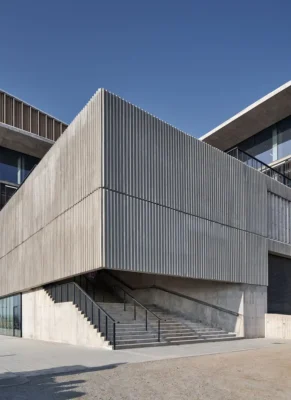
Reuse almost the entire concrete structure of the existing stadium to optimize the new building’s carbon footprint.
Recycle materials from demolition. The steel recovered from the metal roof of the 1988 building was recycled at the plant and used in the new construction. The plastic from the seats was also recycled and molded into new ones.
Additionally, 1,600 cubic meters of Chilean pine laminated wood was used, which spurred significant local industrial development. This development made it possible to supply the necessary volume of structural material and paved the way for the construction of large-span wooden buildings in Chile. This effort captured at least 1,500 tons of CO2.
Claro Arena, Las Condes, Santiago de Chile football stadium – Property Information
PROYECTO/ project: Proyecto de Modernización del estadio de Universidad Católica / Modernization Project of Universidad Católica Stadium
SITUACION (lugar) / Location: Cv Las Flores 13000, Las Condes, Región Metropolitana, Chile
CLIENTE / Client: Universidad Católica
Estudio / Office: IDOM
Arquitectos Autores / Project architects:
IDOM:
Borja Gómez: arquitecto principal/dirección de proyecto/asistencia en obra; Lead Architect / Project Direction / Site Assistance
César Azcárate: arquitecto principal/ Lead Architect
Arquitecto(S) / Architects:
(Arquitectos colaboradores) / Other architects IDOM: Agostina Sambataro, Carmen Prada, Clara Guzmán, Diego Rodriguez Segura, Felipe Vergara Galleguillos, Fernando Garrido, Jose Manuel Pando de Prado, Manuel Bouzas Barcala, María Francisca Navarro Valenzuela, Samuel Araneda (arquitecto, asistencia en obra/ Architect / Site Assistance), Simón Lucas Morgado, Tomás Santiago Pérez.
Colaboradores / Collaborators:
IDOM: Carlos Jose Vial Larraín, Cristian Lange, Francisco Javier Ruiz de Prada, Javier Dávila, Laudis Acosta, Rosaina Ivelisse, Carlos Castañón, Antonio Villanueva, Sergio Arús, Clara Guzman, Julio Fernández, Mario Torices, Felipe Gaona Moreno
Consultores / Consultants:
Acústica/Acoustics: IDOM; Ingenierías/Engineering: WSP; Project Management: WSP; Fachadas/Facades: IDOM-MIA; Revisor independiente de arquitectura/ Independent Architecture Reviewer: ARQUIGESTIÓN; Revisor independiente de estructuras/ Independent Structural Reviewer: SPOERER Ingenieros.
Constructora / Builder Cerro Apoquindo 4
Presupuesto Aproximado / Budget 50.000.000€
Superficie / Area: 39.592 m2
Año / Year: 2025
Autor de fotografías / Photographer: Cristóbal Palma
IDOM
Claro Arena, Las Condes, Santiago de Chile football stadium images / information received 121125
Location: Las Condes, Santiago de Chile, South America.
Chile Architecture
Contemporary Chile Architectural Projects
Chile Architecture Design – chronological list
Chile Building News
Casa GG, Region Metropolitana
Architect studio: Benjamín Goñi Arquitectos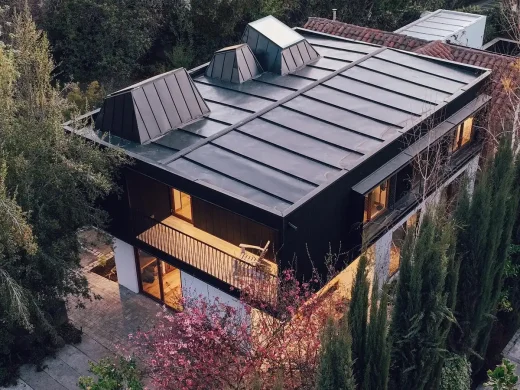
photo : Andrés Goñi
Santiago de Compostela Bus Station, Santiago de Compostela – A Coruña
Design: IDOM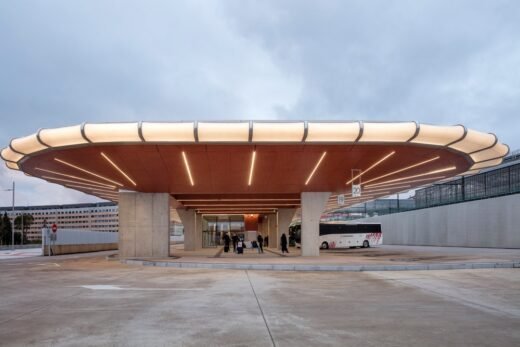
photo : Aitor Ortiz
Chile Architecture
The Winery at VIK
Chile Architect Studios – Design Office Listings
South American Architecture
Another large South American building design by IDOM on e-architect:
Markham Collegue Primary School, Lima
Design: IDOM and Rosan Bosch Studio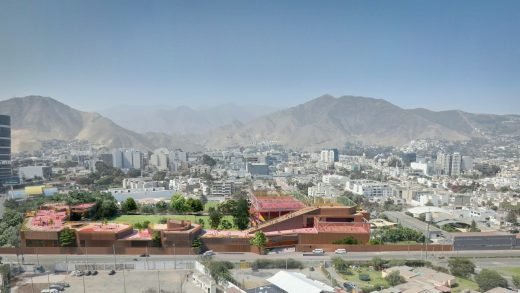
illustration : IDOM / Rosan Bosch Studio
Comments / photos for the Claro Arena, Las Condes, Santiago de Chile football stadium design by IDOM architects office page welcome