5 lower-impact outdoor material choices with long-term architectural value, property building exterior
25 April 2026
Sustainable material specification has long operated under an unstated assumption: that reducing environmental impact means accepting some degree of visual compromise.
Lower embodied carbon equals less design authority. Longer lifecycle equals plainer finish. This framing has shaped how both architects and homeowners approach exterior material selection for longer than it should have.
It is also largely wrong. The materials that perform best over time in outdoor environments are almost always the ones that were selected with longevity in mind from the outset, and longevity in materials tends to correlate with authenticity of manufacture, density of composition, and resistance to the maintenance cycles that eventually degrade lesser alternatives.
A facade that does not need repainting every five years has a lower operational carbon footprint.
A wall tile that does not need resealing annually is both easier to own and more sustainable by every meaningful measure.
The five outdoor materials below are selected specifically for their intersection of three criteria: reduced environmental maintenance demand (minimal or zero repainting, resealing, or replacement cycles over a standard building lifespan); long-term material performance under real exterior exposure conditions; and architectural value that compounds over time rather than diminishing.
Defining lower-impact in outdoor material specification
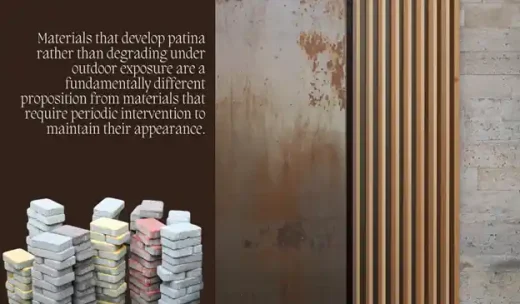
When architects and specifiers talk about lower-impact material choices, the conversation typically centres on embodied carbon at the point of manufacture: the energy required to extract, process, and deliver a material to site.
This is a legitimate and important measure, but it captures only part of the picture.
The operational dimension of material impact; how much intervention a material requires over its service life is at least as significant, and often more so over a thirty or fifty-year building lifespan.
As the principles of sustainable building design consistently emphasise, the lifecycle of a material includes not just its manufacture but its maintenance, repair, and eventual disposal or reuse.
A material with moderate embodied carbon that requires no repainting, no chemical treatment, and no replacement for sixty years is a substantially better environmental performer than a lower-embodied-carbon alternative that requires intervention every five.
The materials below are assessed against both dimensions: what they cost the environment at the point of manufacture, and what they demand over their service life.
All five are appropriate for exterior use in residential and commercial contexts and have established track records in contemporary architecture.
01. Through-body porcelain exterior wall tile
Zero-maintenance facade cladding with permanent colour and freeze-thaw resilience
Porcelain tile has been used as an interior surface material long enough that its performance credentials are well established.
What is less widely understood is how substantially the engineering of through-body porcelain for exterior vertical applications differs from interior or even exterior floor tile, and why that difference matters for facade specification.
The distinction begins with water absorption. Through-body porcelain manufactured for exterior wall use is fired to achieve a water absorption rate below 0.5 percent, the ANSI A137.1 threshold for genuine freeze-thaw resistance.
At this density, moisture cannot penetrate the tile body in quantities sufficient to cause freeze-expansion fracturing.
For architects specifying facade cladding in northern climates, this is not a minor performance advantage.
It is the difference between a material that will hold its appearance for fifty years and one that will begin to show surface spalling within a decade. As outlined in the e-architect guide to wall cladding systems, matching cladding material to climate exposure is among the most consequential specification decisions in exterior envelope design.
Colour performance is the second critical variable. Surface-glazed tiles carry their colour only on a thin applied layer, which UV radiation degrades at a measurable rate over time.
Through-body porcelain, where colour is carried through the full depth of the tile during firing, has no surface coating to degrade.
The colour present after twenty years of direct sun exposure is the same colour that was present on installation day.
OUTERclé’s stylish outdoor wall tiles for exterior facades sit specifically in this specification category.
Their range is engineered exclusively for exterior vertical applications, available across over 1,000 shapes, textures, forms, and colours in highest-quality porcelain.
The collection includes brick-format options for projects where material warmth and surface variation are priorities, as well as larger-format panels for clean contemporary facades.
The shared characteristic is the specification grade: these tiles require no sealing, no surface treatment, and no periodic maintenance beyond standard cleaning, which places them firmly in the lower-impact category when assessed over a full building lifespan.
For architects, the installation specification requires attention to substrate integrity, appropriate thin-set adhesive rated for exterior cycling, and expansion joint provision at perimeter and field intervals.
Where the substrate is an existing rendered wall, full bond to a sound render is critical; partial bond on a failing substrate will produce tile loss regardless of tile quality. Correct installation is what converts a high-quality tile specification into a genuinely low-maintenance one.
02. Thermally modified timber
Dimensionally stable exterior timber with no paint or chemical treatment requirement
Standard timber in exterior applications requires regular maintenance without exception of oiling, staining, or painting on cycles of between one and five years depending on species, exposure, and finish.
Over a 20 year period, that maintenance burden represents a significant operational cost and a non-trivial environmental load: the energy and material input of repeated treatment applications accumulates across the life of the building.
Thermally modified timber addresses this directly.
By heating timber (typically pine or ash) to temperatures between 160 and 220 degrees Celsius in the absence of oxygen, manufacturers chemically alter the cell structure in ways that permanently reduce the timber’s hygroscopicity; its tendency to absorb and release moisture.
The result is a dimensionally stable material that does not swell, shrink, or warp at the rates that make untreated timber maintenance-demanding in exterior conditions.
The environmental case for thermally modified timber is strong.
The modification process uses heat rather than chemical preservatives, meaning no biocides, no VOC emissions, and no contaminated material at end of life. When the timber is sustainably sourced FSC or PEFC certified, the material offers a credible low-impact profile from source to installation.
Several European manufacturers now produce thermally modified timber from forestry waste or thinnings, strengthening the lifecycle argument further.
In architectural applications, thermally modified timber is increasingly specified for cladding, decking, and screening in contexts where the natural warmth of wood is a design priority but maintenance cycles are a constraint.
The characteristic silver-grey weathering that develops on exposed thermally modified timber over the first eighteen months is a design feature for architects who understand the material; analogous to the patina development of metals like Corten and zinc.
03. Corten weathering steel
Self-protecting steel facade material with zero paint requirement and 40+ year service life
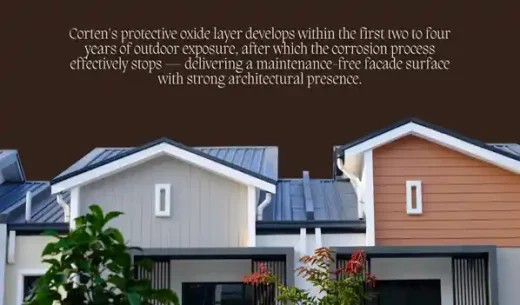
Weathering steel commercially known as Corten was developed in the 1930s for railway wagon bodies requiring extended service life without painting.
Its architectural adoption, which accelerated significantly through the 1960s and 1970s with projects like Eero Saarinen’s John Deere world headquarters and more recently in contemporary residential architecture, is a direct consequence of its core performance characteristic: the steel’s alloying elements (copper, chromium, nickel) cause its surface oxide layer to become a dense, stable, adherent patina that halts further corrosion rather than accelerating it.
Corten requires no painting, no coating, and no surface treatment of any kind once installed.
The patina development phase during which the surface transitions from mill finish through initial rust to the characteristic warm orange-brown takes between two and four years depending on climate.
After that point, the material is effectively self-maintaining for the remainder of its service life, which structural applications have demonstrated to exceed forty years.
04. Lime render
Breathable, self-healing exterior render with proven multi-century service life in masonry buildings
Portland cement, the dominant exterior wall finish in post-war residential construction, has a well-documented failure mode: it is substantially less vapour-permeable than the masonry substrates it is applied to.
Moisture that migrates into a wall through any route such as rising damp, wind-driven rain, condensation cannot easily escape through the render, leading to accumulation behind the surface and eventual failure of the render as a thermal expansion and contraction mechanism cracks it away from the substrate.
Lime render does not share this failure mode.
Hydraulic lime mortars and renders are highly vapour-permeable by nature, allowing walls to breathe in the manner that pre-cement construction depended on.
The maintenance profile of lime render is also substantially different from cement alternatives. Minor cracking in lime render is typically self-healing, carbonation of the lime over time deposits calcium carbonate in fine cracks and seals them.
Larger defects can be repaired with matching lime mortar without the visible repair lines that characterise cement render patching.
For architects specifying exterior finishes on historic or heritage-adjacent buildings, this repairability is not merely a maintenance advantage but a compliance requirement; the guidance on low-maintenance outdoor design from a whole-building perspective consistently identifies material compatibility between substrate and finish as the primary determinant of long-term performance.
Specification should be led by substrate type and climate zone; an experienced applicator who understands the material’s working properties is as important as the render formulation itself.
05. Zinc panel cladding
80-year service life facade material with natural patina development and full recyclability
Zinc is among the most underspecified facade materials in residential architecture, particularly in markets where aluminium composite panels have displaced it on grounds of initial cost.
This is a specification error with long-term consequences: aluminium composite cladding typically carries a thirty-year service life under best-case conditions and requires replacement thereafter.
Standing seam or interlocking zinc panel cladding, correctly installed and detailed, has a demonstrated service life of eighty years or more.
The environmental profile of zinc is nuanced but ultimately compelling.
Zinc has higher embodied carbon at the point of manufacture than some alternatives, but its service life, natural patina development (which eliminates any paint requirement), and critically; its near-complete recyclability at end of life substantially improve its lifecycle carbon performance.
Zinc is one of the few facade materials that can be fully reclaimed, remelted, and reused without quality degradation, making it a genuinely circular material in a way that composites and coated panels are not.
In architectural applications, zinc develops a surface patina of zinc carbonate and zinc hydroxide over the first five to ten years of outdoor exposure. This patina, which shifts from the initial blue-grey of mill finish zinc through a range of warm greys, is protective rather than degrading: it slows further oxidation and gives zinc facades their characteristic depth of surface.
Architects who specify zinc with this patina development in mind design buildings that improve in material quality over time; those who do not may find the weathering unexpected.
What these materials share: performance that compounds
The five materials above are not linked by a single sustainability metric.
- Their embodied carbon profiles differ substantially.
- Their aesthetic registers span warm industrial to refined mineral.
- Their installation requirements vary from specialist trade work to standard contractor capability.
What they share is a performance characteristic that is both architecturally valuable and environmentally significant: they do not need periodic intervention to maintain their appearance or structural integrity.
They do not require repainting cycles that consume energy and material every five years. They do not degrade in ways that demand early replacement.
And crucially, they tend to look better at ten years than they did at one, because the weathering and patina processes that occur in genuine materials read as depth and quality, not deterioration.
This is the case for specifying to last.
A building that chooses its exterior materials carefully, with a full-lifecycle view of what those materials will demand, builds both environmental credibility and architectural permanence into its fabric from the first day of occupation. That combination is, in the long term, what genuine quality in the built environment looks like.
Comments on this guide to 5 lower-impact outdoor material choices with long-term architectural value article are welcome.
Concrete Structures
New vaulted style of floor cuts concrete usage
Ground granulated blast furnace slag in concrete production
Enhance home curb appeal with custom concrete work
++
Architecture Design
Architectural News
Housing
New Houses
Comments / photos for the 5 lower-impact outdoor material choices with long-term architectural value page welcome.