✕
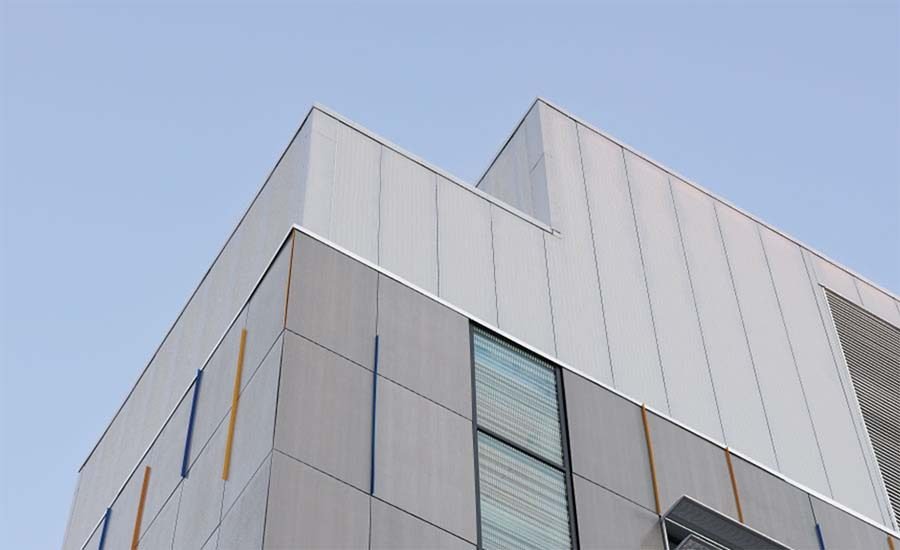
Aluminum honeycomb has moved from niche composite construction into mainstream facade systems, prized for one simple reason: it delivers stiffness and flatness without the weight penalty of thicker solid panels or heavy backup framing. As architects push for larger panels, tighter tolerances, and faster installation in constrained urban sites, honeycomb-backed cladding has become a practical enabler, supporting everything from thin stone and metal rainscreens to building-integrated photovoltaics (BIPV) that generate solar energy.
The material’s legacy traces back to the Apollo program, where it played a critical role in spacecraft heat shields, and now, over 60 years later, it is reshaping architectural cladding. In BIPV applications, manufacturers including Mitrex (Toronto, Ontario) use honeycomb as a structural core behind their energy-generating building materials, allowing the facade panel to serve as both cladding and an energy-generating component.
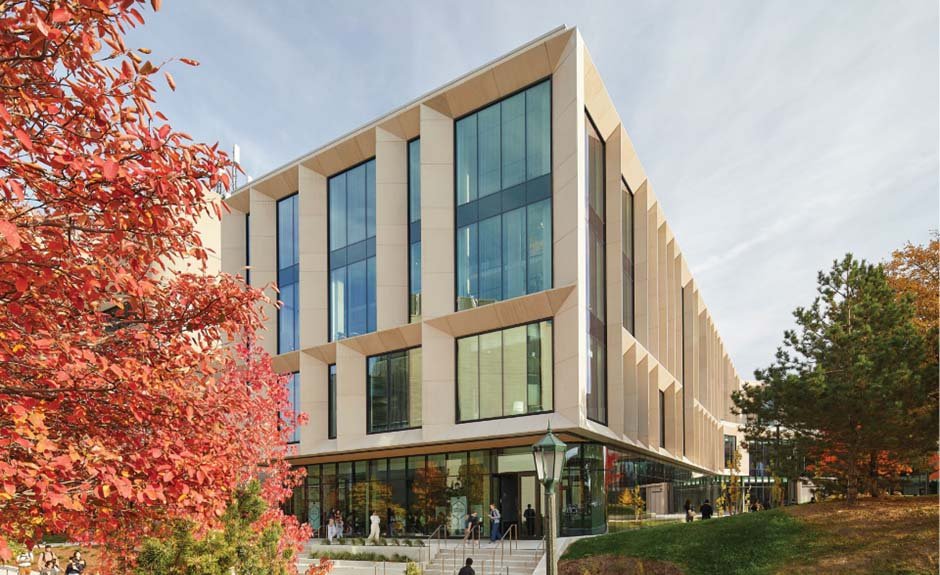
Architectural monolithic facade with closed-edge aluminum honeycomb backing and limestone facing installed at Western University Entrepreneurship & Innovation Centre, demonstrating how lightweight allows fast and hassle-free installation. Photo courtesy Mitrex, click to enlarge.
A Core Material That Changes Envelope Design
Inspired by nature, aluminum honeycomb takes its cue from one of the most efficient structures found in the natural world. The repeating hexagonal geometry maximizes strength while minimizing material, creating a core that is remarkably light yet exceptionally rigid. When this cellular core is bonded between thin aluminum skins, it forms a panel with an impressive strength-to-weight ratio, capable of long spans, consistent flatness, and strong resistance to deformation.
Its architectural value lies in the fact that this rigidity is inherent to the panel itself. Because the structural capacity is built into the assembly, sub-framing can often be reduced or eliminated, resulting in an envelope system with fewer materials, fewer layers, and fewer potential points of failure. The outcome is a streamlined assembly that is both efficient and adaptable to a wide range of finishes. This structural behavior aligns with current architectural priorities: simplified wall construction, reduced embodied carbon, and exterior systems that can accommodate larger panel sizes without compromising performance.
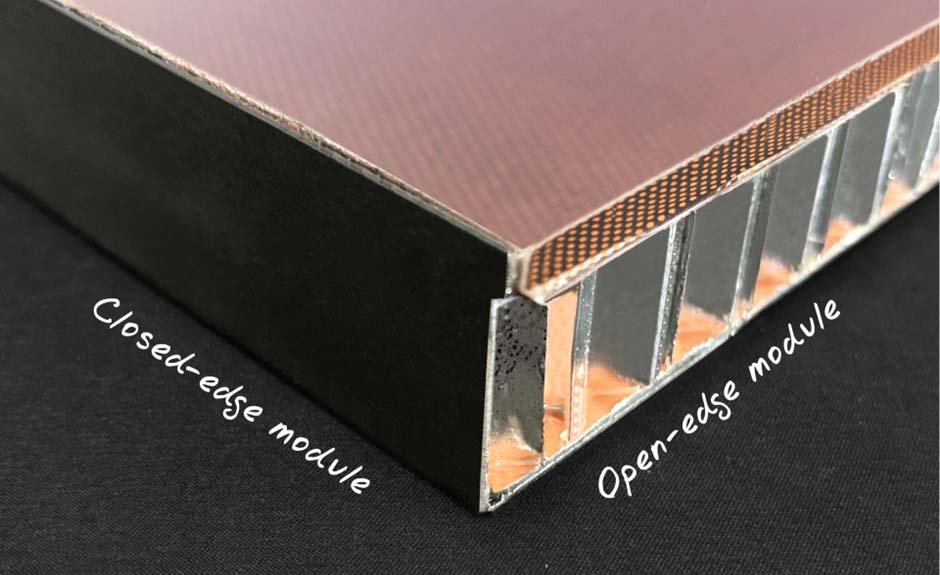
Close-up view of a BIPV module with aluminum honeycomb backing, illustrating the module’s closed vs open edges. Photo courtesy Mitrex
Installation Efficiencies and Changing Construction Sequencing
As contemporary envelopes become more complex, construction sequencing plays a critical role in overall building performance and delivery timelines. Honeycomb-based panels reduce the number of required support components, which simplifies coordination between trades and decreases the amount of on-site fabrication.
In high-rise construction, fewer attachment points and lighter panel weights translate directly into reduced crane activity, easier maneuvering in constrained urban sites, and a more predictable installation schedule. For projects near active streets or transit lines, these improvements meaningfully reduce disruptions and logistical challenges.
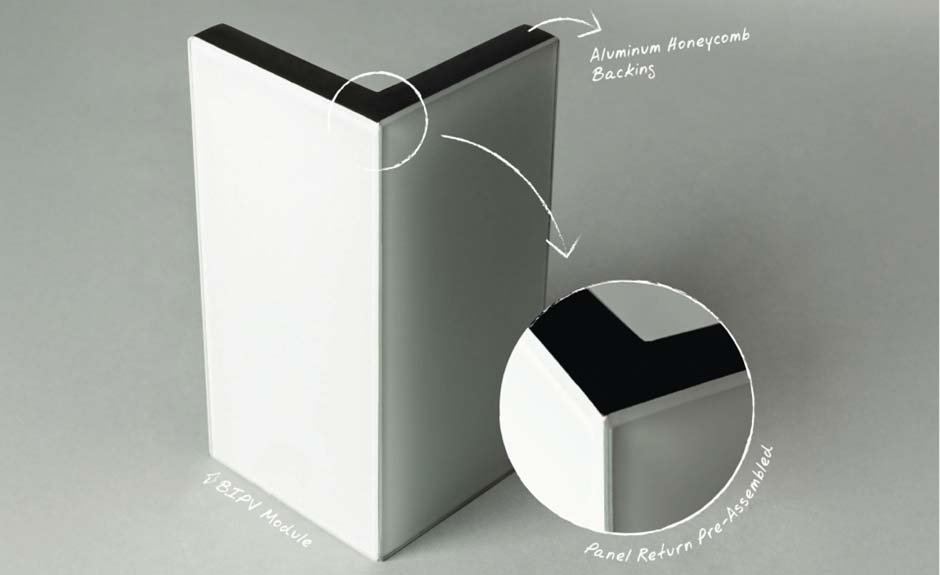
Close-up of a honeycomb-backed BIPV panel return. Photo courtesy Mitrex
Versatility in Application: From Stone Facades to BIPV
Two recent projects highlight how the same honeycomb core supports very different architectural goals: large-format stone cladding and BIPV facades.
SAMIH Building, University of Toronto Scarborough
The Myron and Berna Garron Health Sciences Complex (SAMIH) at the University of Toronto Scarborough is an instructive example of what honeycomb-backed BIPV panels make possible. The project required aligning with strict sustainability mandates, including a target that at least 20 percent of total building energy generation comes from renewable sources.
Initial plans relied primarily on rooftop solar panels, but this proved insufficient for the building’s needs. Through collaboration with Mitrex, the design evolved toward a fully integrated BIPV facade that would supply most of the system’s output.
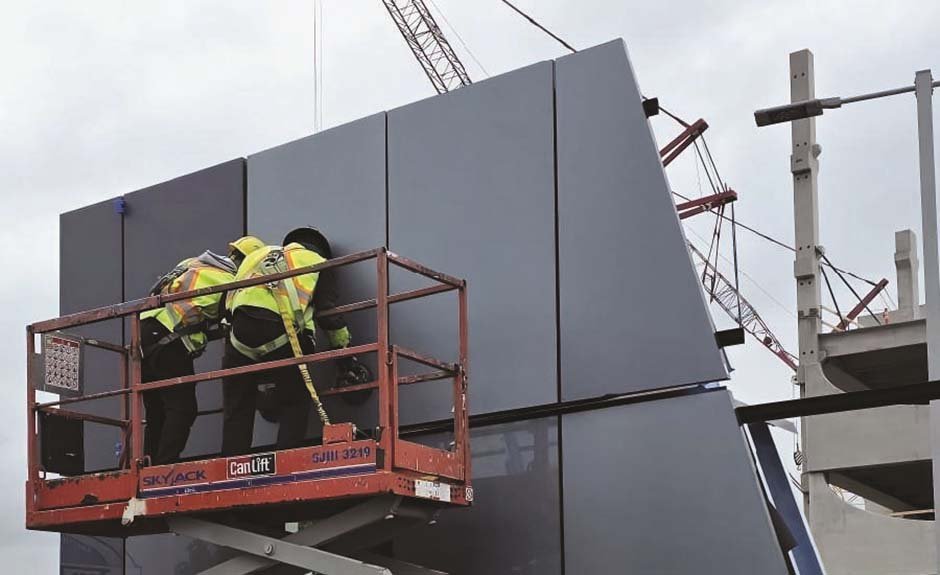
Mock-up of BIPV cladding with closed-edge aluminum honeycomb backing developed for the University of Toronto SAMIH project. Photo courtesy Mitrex
The final installation includes 632 kW of total solar capacity, with the facade itself contributing 513 kW and the remainder coming from rooftop modules. The building generates approximately 420,000 kWh per year, a significant contribution to the campus’s carbon-reduction goals.
SAMIH’s facade design underwent several phases of refinement. The initial concept consisted of a single color and two panel sizes. Over time, this evolved into a more intricate mosaic incorporating five colors and eight different module sizes, balancing architectural expression and solar efficiency. Darker shades were strategically chosen in certain zones to increase power production, while lighter colors were maintained elsewhere to align with broader aesthetic goals.
Equally noteworthy is the rainscreen installation system behind the BIPV panels. A thermally broken bracket system, semi-rigid insulation, and interlocking channels support modular installation while preserving air and moisture control layers. This pairing of honeycomb structure with a high-performing rainscreen demonstrates how BIPV can be integrated into complex facades without compromising durability, performance, or aesthetic intent.
On a university construction site where schedule certainty and access are critical, honeycomb-backed BIPV panels can offer important installation advantages. Their reduced weight and lower reinforcement requirements simplify handling and alignment, which helps the facade be installed in a more predictable, sequential manner with less on-site improvisation. This efficiency also creates room for design flexibility, allowing module sizes and layout patterns to develop into a more varied mosaic. Even as geometry, color distribution, or output-optimized zones evolve during design, the honeycomb core helps keep the panel system stable and consistently repeatable.
The SAMIH building showcases how honeycomb technology supports the combination of energy generation, design flexibility, and large-format panelization.
481 University Avenue, Toronto
Where SAMIH leverages honeycomb as a platform for solar generation, the 481 University Avenue project uses the same core for a different purpose. This mixed-use tower employs honeycomb-backed panels with a stone facing manufactured by Cladify, Mitrex’s sister company specializing in non-powered facades, across the 55-story facade. The heritage limestone base remains intact, while the tower above introduces contemporary cladding that sits lightly atop the structure.
On a dense downtown site bordered by active transit routes, cranes, and limited staging areas, the lightweight nature of honeycomb-backed stone panels provided clear advantages. The ability to install large modules quickly made it possible to maintain construction progress while minimizing road closures and disruptions. Site images from the project show honeycomb edges exposed at panel borders, emphasizing the system’s internal structural logic and demonstrating how facades can be assembled efficiently without heavy substructure requirements.
This example highlights how honeycomb panels enable the visual solidity of stone while retaining the manageability and performance of a lightweight composite system.
Together, the two projects demonstrate the material’s versatility: one facade expresses stone and mass, the other integrates solar energy into the envelope itself.
Performance Benefits That Extend Beyond Weight Reduction
While the weight reduction is an obvious advantage, aluminum honeycomb’s value extends into multiple performance categories that contribute to building longevity and efficiency.
Thermal Behavior
When paired with continuous exterior insulation and thermally broken attachment systems, honeycomb-backed panels can support a high-performance enclosure strategy with fewer interruptions.
Fire Performance
Mitrex BIPV with honeycomb backing is tested against international standards, including UL 61730 and UL 61215 for photovoltaic components, and fire classifications such as EN 13501 A2-s1,d0, and CAN/ULC requirements for facade materials. These ensure compliance in high-occupancy building types like universities, hospitals, high-rises, and public facilities.
Environmental Durability
Honeycomb-backed panels tolerate wind loads, humidity, and temperature swings effectively, which is essential for performance in extreme climates. Testing against standards such as ASTM E330 and E1996 ensures resistance to dynamic pressures and impact loads typical of urban high-rise sites.
Dimensional Stability
The honeycomb structure maintains flatness over time, supporting aesthetic consistency and minimizing deformation. This is particularly important for buildings with large-format stone or photovoltaic surfaces where visual continuity is part of the design intent.
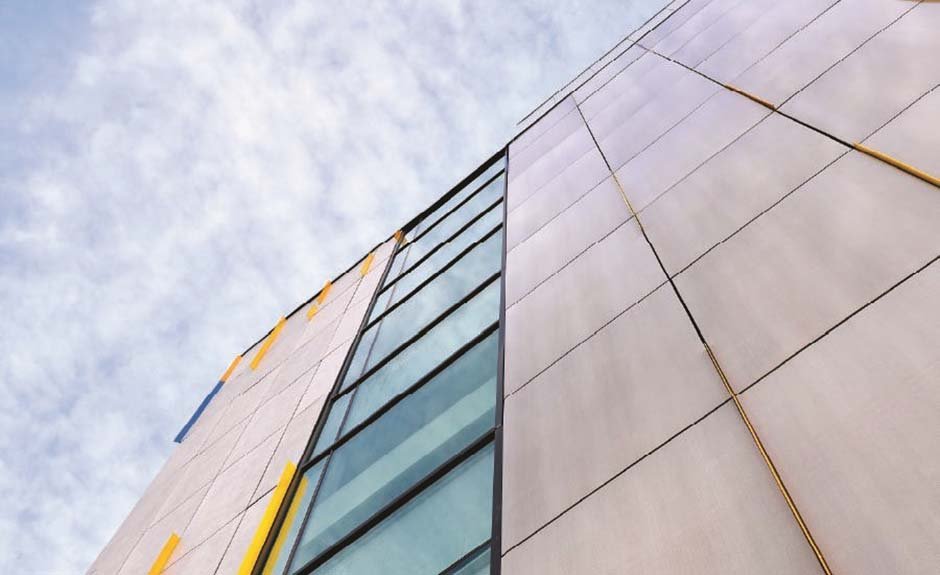
BIPV facade with closed-edge aluminum honeycomb backing at Chinook Hospital, demonstrating the use of solar cladding with aluminum honeycomb backing. Photo courtesy Mitrex
Sustainability and Embodied Carbon Considerations
Honeycomb-based systems contribute meaningfully to sustainability objectives through several pathways:
- Lower embodied carbon due to reduced framing and lighter structural demands
- Reduced transportation emissions compared to traditional thick stone systems
- Prefabrication that minimizes onsite waste
- High recyclability of aluminum
- Energy generation through optional BIPV integration
- Contribute to LEED points and green certifications
Many honeycomb-backed systems, including those manufactured by Mitrex and Cladify, are also supported by Environmental Product Declarations that provide transparent, third party-verified data on environmental impacts.
The SAMIH project is a strong example of sustainability impact. By integrating BIPV directly into the vertical facade rather than relying solely on rooftop panels, the project achieved a significantly larger renewable energy capacity within its existing architectural envelope. The resulting ~420,000 kWh per year provides measurable operational carbon reduction while meeting the University’s strict renewable energy requirements.
These attributes support the growing shift toward facades that contribute directly to building performance rather than acting solely as protective skins.
Aesthetic Freedom Supported by a Single Structural Logic
Because honeycomb cores support structural demands, designers have broad freedom in exterior finishes. Stone, porcelain, metal, patterned glass, or photovoltaic surfaces can all be integrated without requiring changes to the structural assembly. Mitrex’s customizable BIPV solutions even include custom color, pattern, and even stone and wood textured glass finishes on their building-integrated photovoltaics. The advanced superstructure, in combination with customizability, allows architects to treat the facade as a flexible design medium while maintaining predictable performance characteristics.
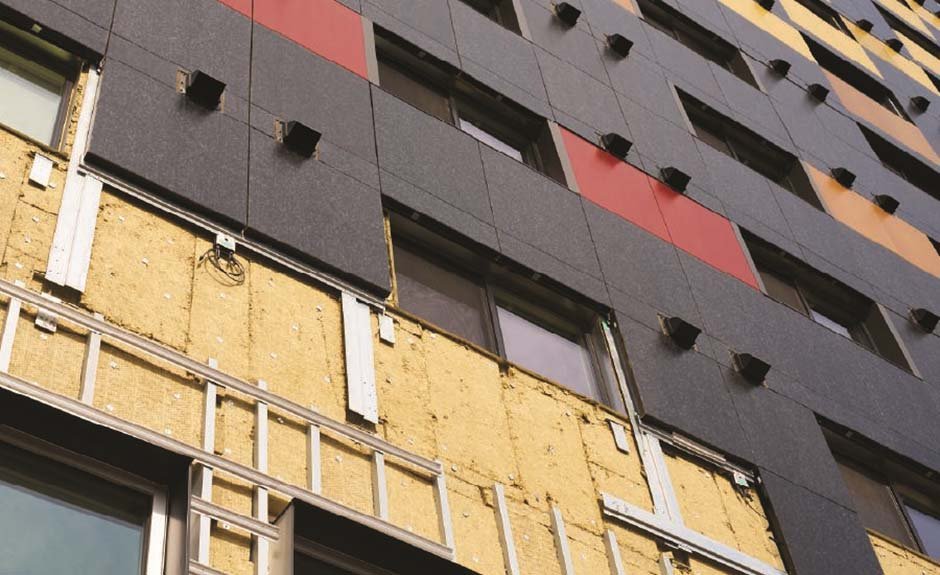
BIPV facade with closed-edge aluminum honeycomb backing used on the SunRise project. Photo courtesy Mitrex
A Material Well Suited for Future Facades
The demands placed on modern building envelopes continue to expand. Architects now expect facades to manage energy, provide durability, support design ambitions, and enable future-proof performance strategies. Aluminum honeycomb aligns naturally with these expectations.
Its structural efficiency supports larger panels and complex geometries. Its compatibility with BIPV encourages energy-generating facades. Its lightness and recyclability support lower-carbon construction. And its installation efficiency makes it suitable for dense urban projects where logistics matter.
As architectural priorities continue to evolve toward multifunctional, sustainable envelopes, aluminum honeycomb stands out as a material that expands what facades can do, both aesthetically and functionally. From stone expressions to active solar surfaces, the material provides a unified foundation for next-generation facade design.