Perhaps not every Apple customer can pinpoint the exact moment they were hooked, but I can: when my high school friend proudly showed me a first-generation iPod, a hand-me-down from her older sister. The device felt surprisingly sturdy and had a smooth back of polished stainless steel. But the novel mechanical wheel, which made scrolling through long playlists effortless, satisfied me most. And more than 1,000 songs could fit in my pocket, you say? I knew it was time to retire my lousy portable CD player for good. Soon after, I snagged my first Apple device. I’ve been a faithful devotee ever since.
When Apple cofounder Steve Jobs debuted the iPod in 2001, he upended the music industry. That same year, Jobs opened the first stores, upending the retail landscape as well. The timing was opportune. With the iPod, the company was expanding beyond personal computers and into consumer electronics. Apple’s many minimalist mall shops, stores, and flagships, which today number over 500 worldwide, became reliable places to try out products for the first time, or trade up for something new. As Apple turns 50, RECORD looks back at the design-minded tech powerhouse’s significant architectural output.
After largely unsuccessful store-within-a-store models, Apple began developing standalone retail prototypes in the late 1990s with Gensler and Eight Inc. Led by Jobs and Ron Johnson, then senior vice president of retail operations, this exercise established a set of standard components, executed in a simple palette, that could be easily deployed across dozens of locations: black shelving, wood floors, sinuous Corian counters to display equally curvy products (like the G3 or G4 iMac), and modular ceilings with linear aluminum troughs. Apple’s first two stores opened in May 2001—one in Tysons Corner Center in Virginia and the other at the Glendale Galleria in California; about 30 more followed over the next year.
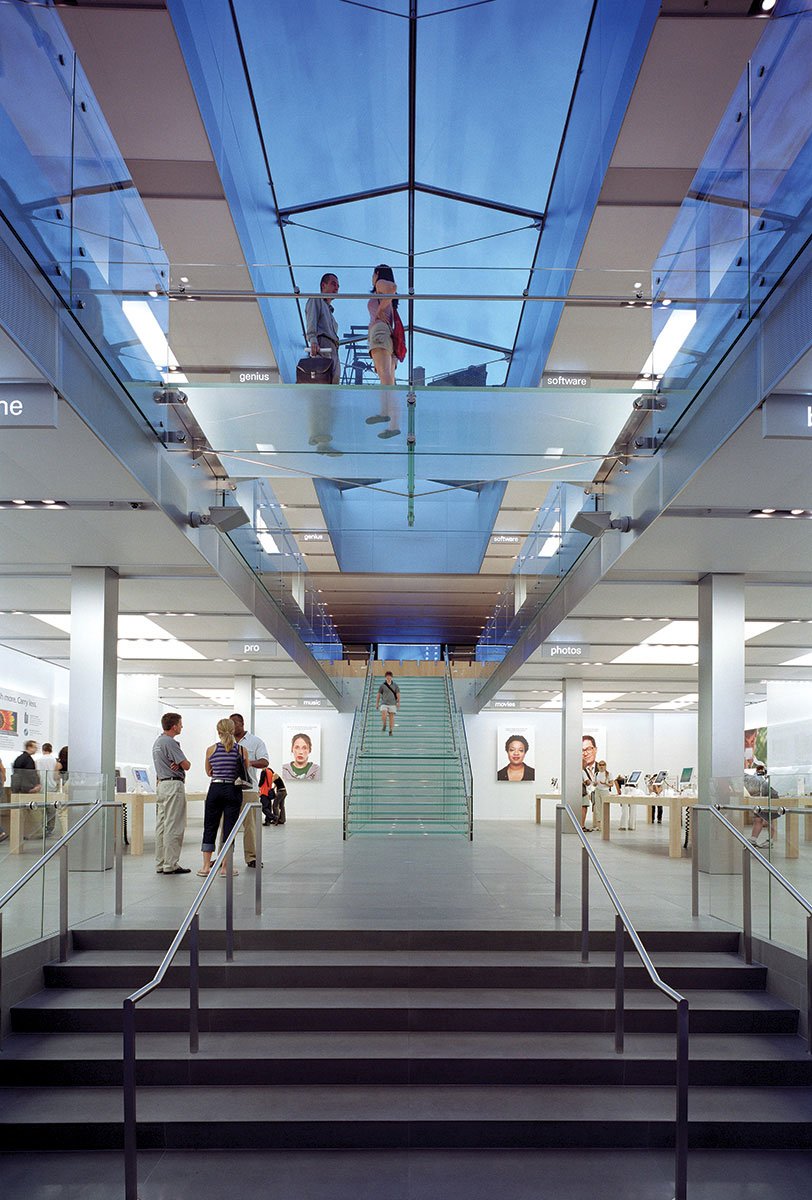
Apple SoHo was the first flagship store to open. Photo © Peter Aaron/OTTO
Jobs had also commissioned Bohlin Cywinski Jackson to design four flagships, the first of which opened in 2002 on Prince Street in New York City’s tony shopping district of SoHo. (Jobs, following his ouster from Apple in 1985 and before his return in 1997, had commissioned the firm to design a sales office for his venture, NeXT, as well as the headquarters of Pixar.) The 16,000-square-foot store, set within a neoclassical 1920s U.S. Post Office, was organized into different product zones, featured a so-called Genius Bar (a technical-support kiosk that still exists in many locations today), and even included a 46-person seating area for demos. It was also one of 75 ultimately realized by Bohlin Cywinski Jackson, which stepped away from its work with Apple in 2020.
Apple SoHo, just around the corner from Rem Koolhaas’s Prada Epicenter, expanded the mall locations’ sparing materiality to include cool-gray pietra serena–stone floors, bead-blasted stainless-steel details, and blond maple Parsons tables with wiring concealed in their legs—all laid out on a strict 30-inch grid with a precision consumers have now come to expect from the brand. “The display areas in particular were designed to be free of signage and distractions,” says Ray Calabro, a principal at Bohlin Cywinski Jackson. “We were trying to elevate these relatively small objects to their greatest potential, allowing people to really focus on them.” The store’s sleek interiors and guiding principles would become the basis of Apple’s proliferating retail build-out. And one material, more than any other, came to epitomize the company’s unending quest for perfection—glass.
“Historically, it’s difficult to encourage shoppers to go to a second floor,” explains Calabro. “The idea in SoHo was to make that ascent and descent magical in some way.” Beneath the building’s 70-foot-long skylight, the architects placed a 15-foot-high glass staircase, dramatically on axis with the main entrance, while a separate glass bridge daringly loomed overhead. For design connoisseurs—Apple attracts many—the elements were as much a subject of fixation as the gadgets neatly placed about.
To realize the stair and bridge, Bohlin Cywinski Jackson brought on James O’Callaghan, a structural engineer at Dewhurst MacFarlane, who had been critical in developing similar details and a translucent brise-soleil at the Rakow Research Library for the Corning Glass Company in upstate New York. “Apple was interested in the material from an engineering perspective—where the boundaries were and what the possibilities were,” recalls O’Callaghan, who soon after cofounded Eckersley O’Callaghan, which continues to collaborate with the tech company. “So we started to research how to take a more ambitious approach with glass.”
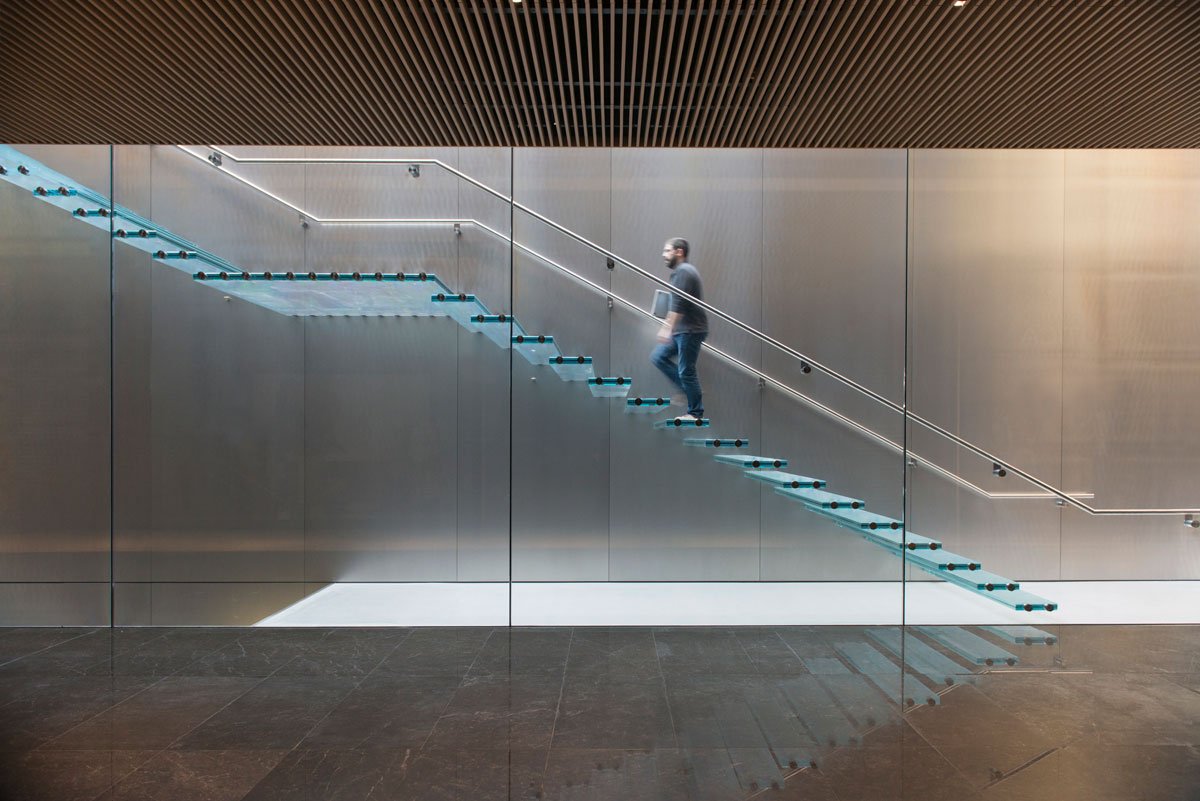
At Apple SoHo, the glass elements consist of sheets that have been laminated with a polymer interlayer. Concurrent advances in this technology, which made bonded assemblies stronger, allowed the designers to embed metal fittings between these layers rather than use external supports or clamps—a technical development from earlier glass staircases, such as those made famous by Eva Jiřičná. They then created a simple, easily reproducible exposed bolt that could connect various glass elements, such as treads and stringers. So novel was the approach that Apple successfully applied for a patent on the design.
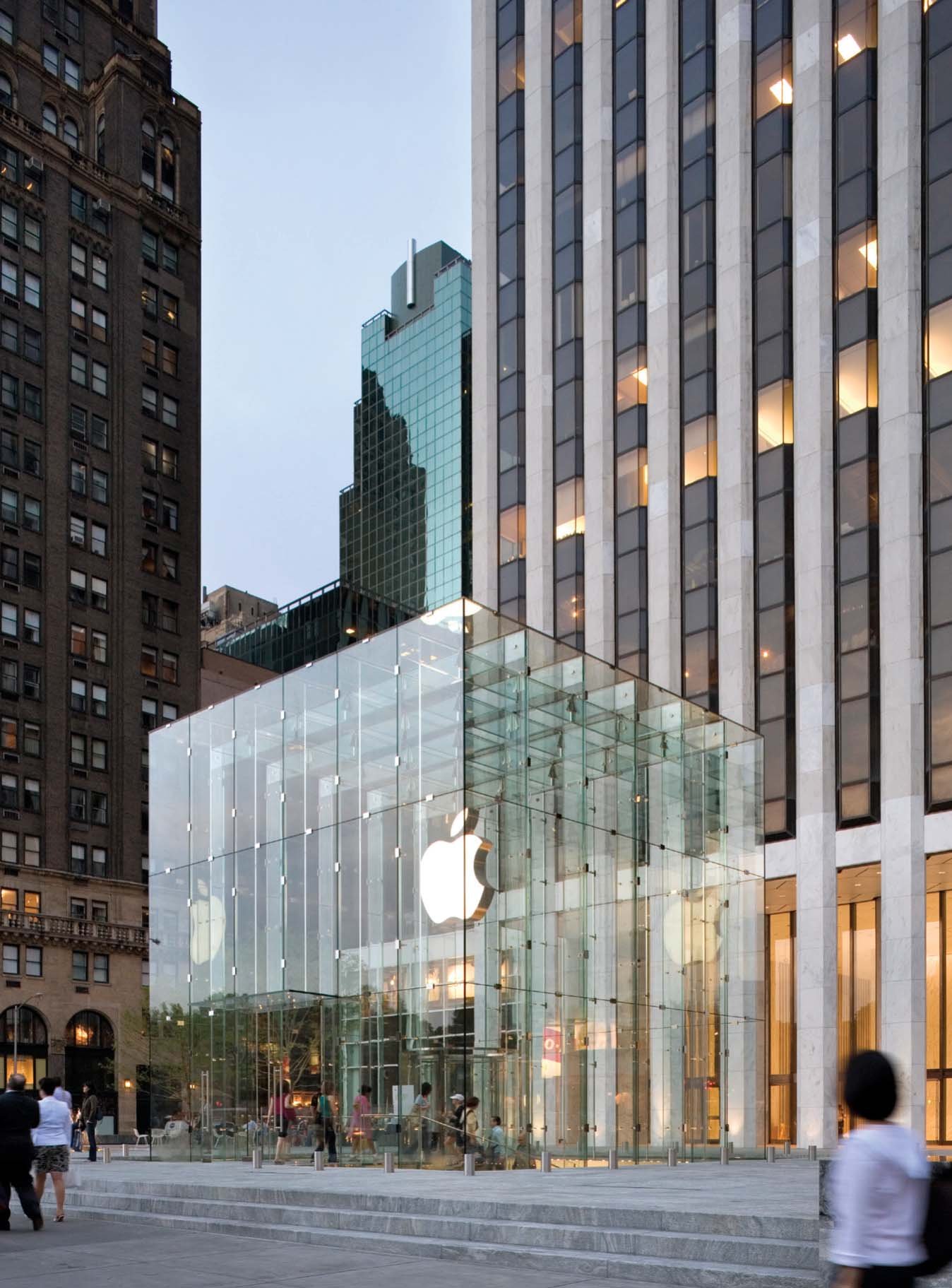
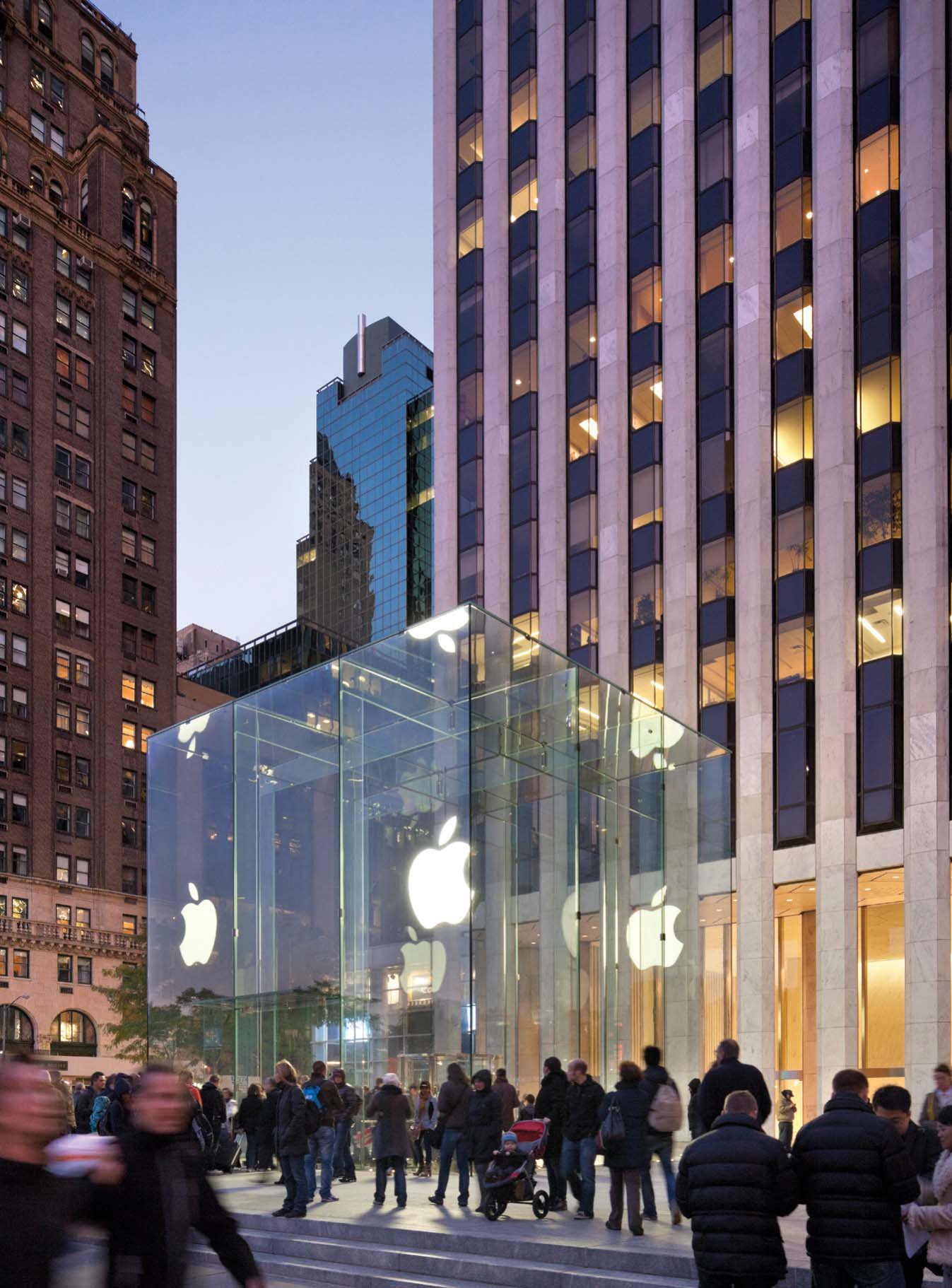
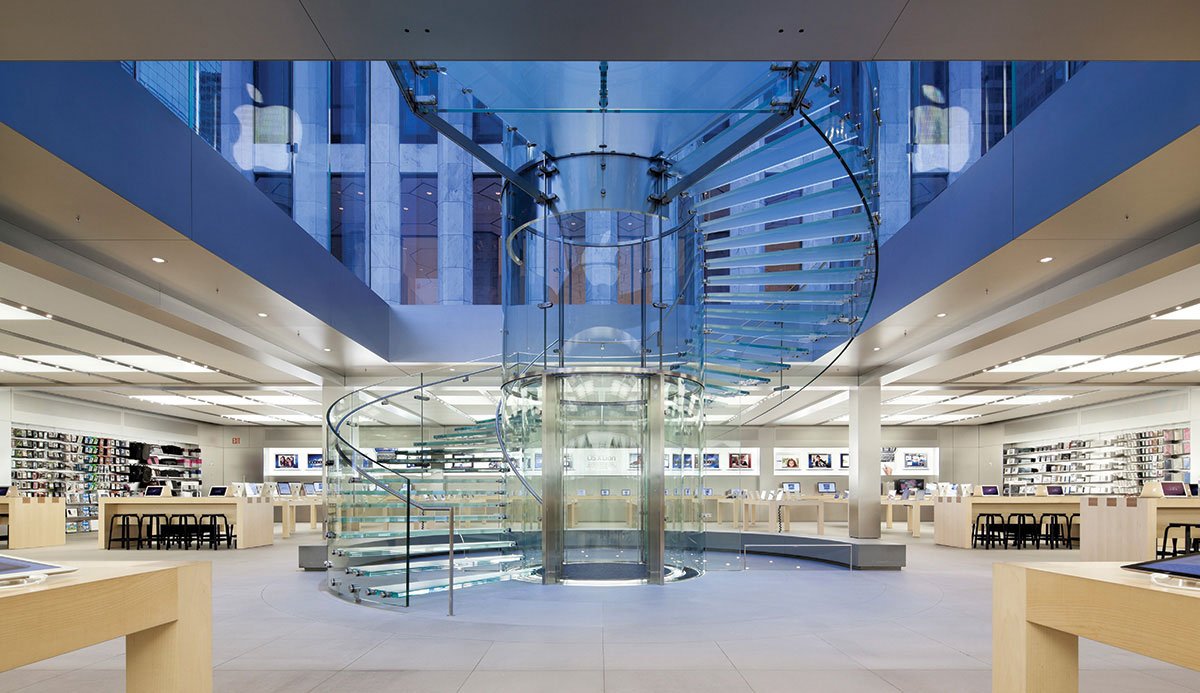
Apple continued to refine its staircases and bridges in each new store, and subsequently it scaled up to more complex envelopes and enclosures. These included spaces like the oblique prism of Apple Upper West Side (2009) and the stunning flagship Apple Fifth Avenue (2006)—perhaps the most recognizable retail location ever built. Here, in the center of the vast plaza fronting the General Motors Building, a 32-foot self-supporting cube comprises laminated-glass panels, fins, and beams held together by stainless-steel fittings. The volume brings light down to the largely subterranean store and encompasses a curving glass stair that swerves around a cylindrical elevator. “The detailing of transparent structures is critical—it’s often what your eye sees first,” says O’Callaghan. “It’s as important, if not more so, to focus on the elegance of the connections than on the glass’s transparency, because that’s what you perceive in many ways.” Just five years later, Apple outdid itself, by rebuilding the cube with fewer panes (down to 15 from the initial 90) and far fewer joints.
1
2
Apple Fifth Avenue’s glass cube (1), rebuilt with larger panes five years after it opened (2), covers a spiral stair (3). Photos © Peter Aaron/OTTO
3
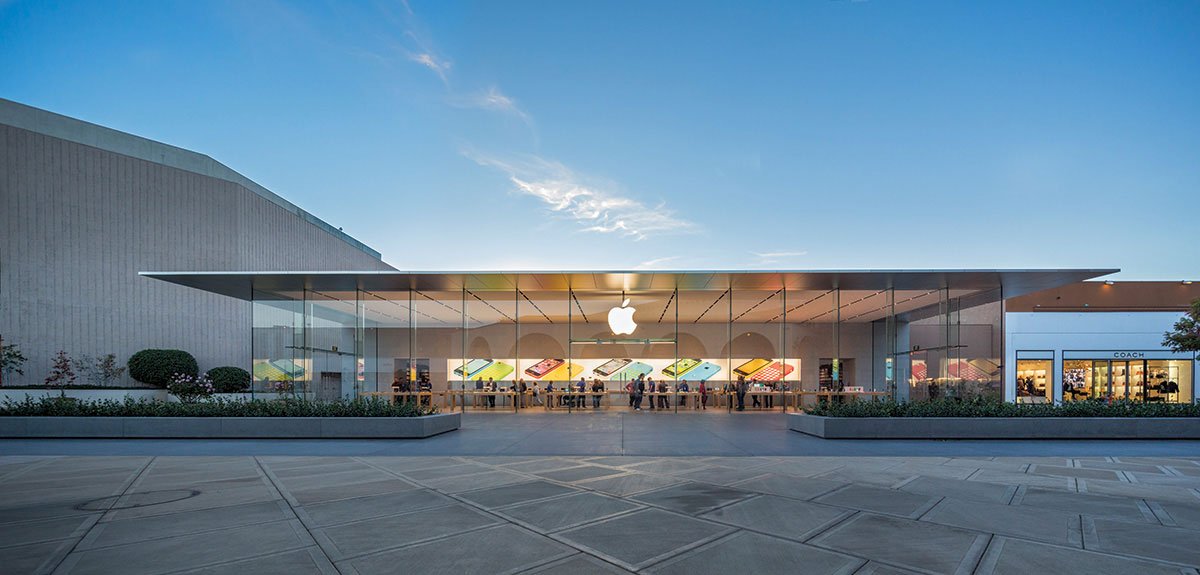
Critics were skeptical about the focus on high-design brick-and-mortar in the age of the Internet, but they were proven wrong—the stores became some of the highest grossing per square foot in the world. Hundreds, many jacketed in panelized stainless steel and emblazoned with a glowing Apple logo (backlit, as in the MacBooks of the time), popped up across the country and internationally. Frontages varied slightly, but a dogged, razor-sharp consistency ran through them. The glass sheets doubled or tripled in size from the earliest iterations—a feat tied not only to advances in the ability to produce the glass itself but also in related processes, including lamination, shipping, and construction.
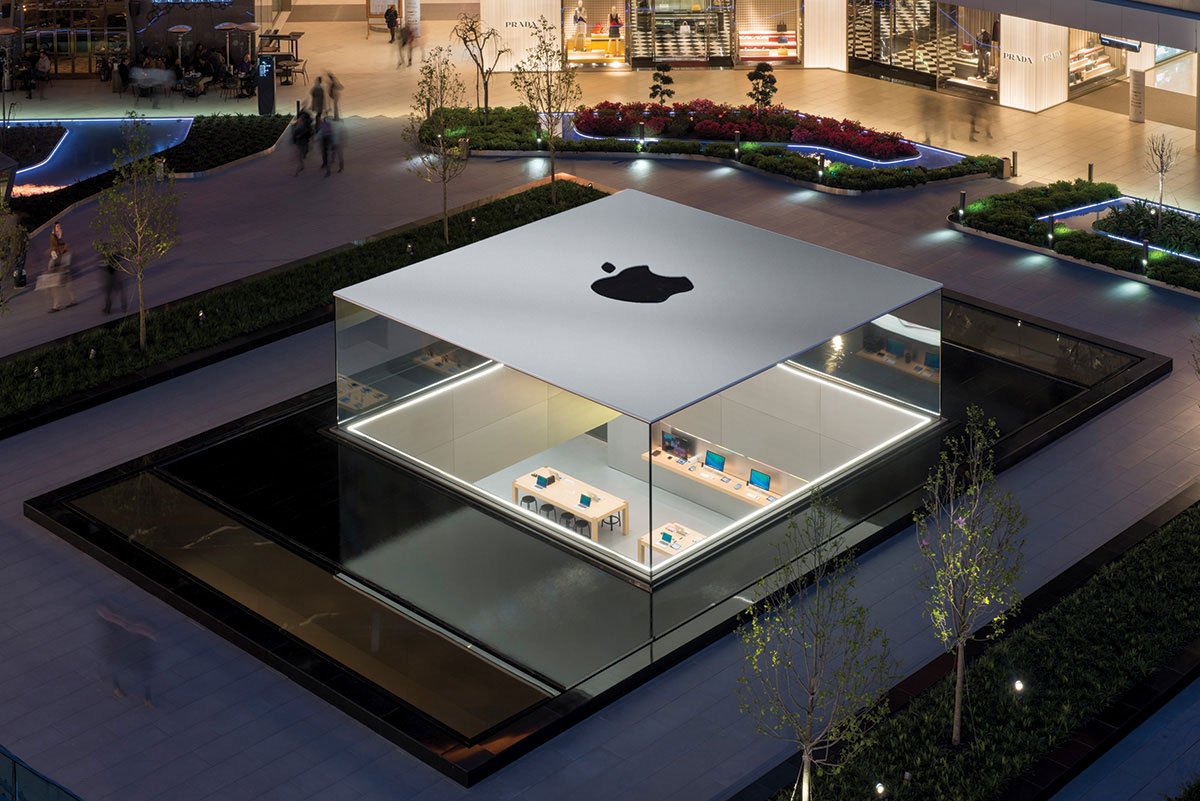
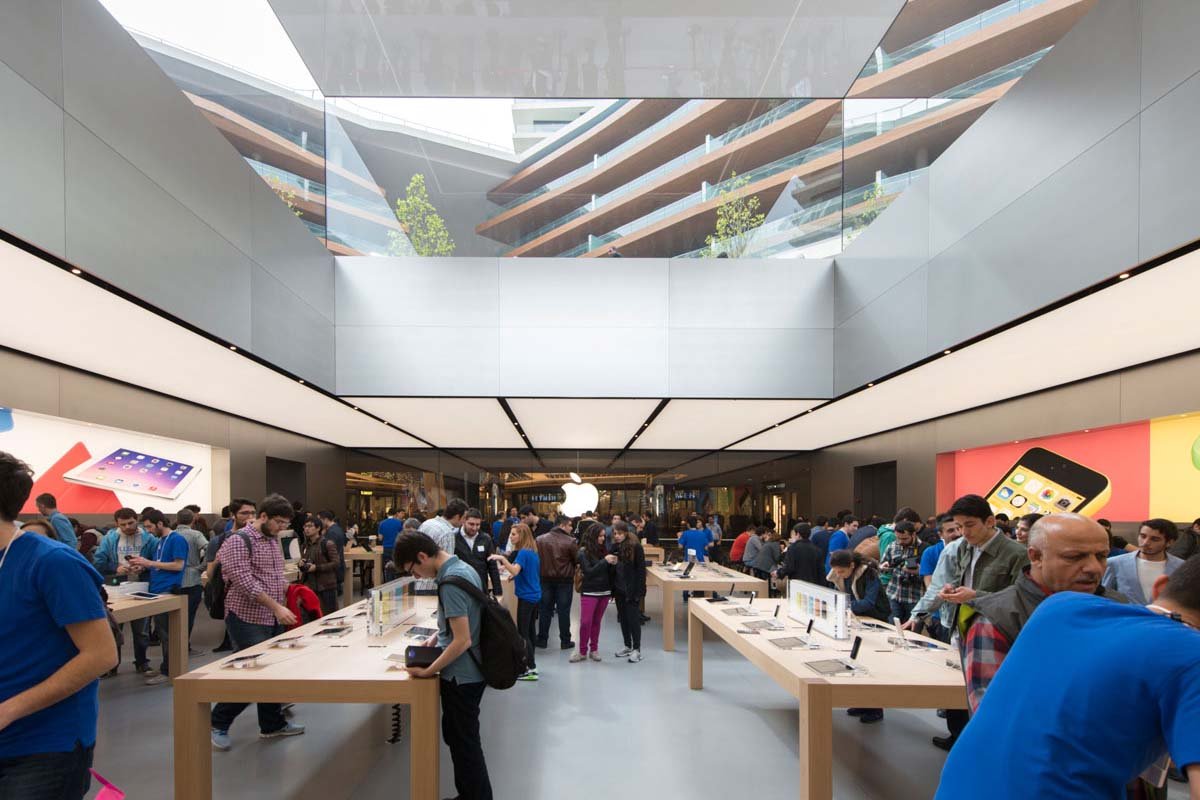
Apple nearly perfected its cube in Istanbul at Zorlu Center (2014), the first of 50 retail locations to be designed by Foster + Partners. A spectacularly pure prismatic lantern, held together without mechanical fasteners or structural fins, caps this sunken store. Each side is a single glass sheet, 33 feet in length, while an opaque panel of lightweight carbon fiber covers the top face. The assembly is set within a reflecting pool, with a staircase that leads down into a deceptively large space.
4
Crisp details define many Apple stores, like the one at the 2013 Stanford Shopping Center (4) and Zorlu Center in Istanbul (5–7). Photos © Peter Aaron/OTTO (4); Nigel Young / Foster + Partners (5–7)
5
6
7
Foster + Partners had begun working with Apple five years prior. “Steve Jobs called me directly, out of the blue, and said, ‘I need some help; how quickly can you get here?’” recalls Norman Foster. “We met some weeks later and spoke all day. It was total immersion in Steve’s vision for his project. He spoke about stone, glass, and the California landscape of his youth.” Apple had outgrown its cramped headquarters at 1 Infinite Loop in Cupertino, only a short drive from the garage where it all began. The by then global company had enlisted Foster + Partners to design a new headquarters that could consolidate 12,000 employees on a single 175-acre campus.
In June 2011, in what was his last public appearance before his death, Jobs presented the design of what became known as Apple Park to the Cupertino city council. “We’ve used our experience in making retail buildings . . . We know how to make the biggest pieces of glass in the world for architectural use,” Jobs said. Portending what the public would soon see elsewhere, he added, “There’s not a straight piece of glass in this building.”
8
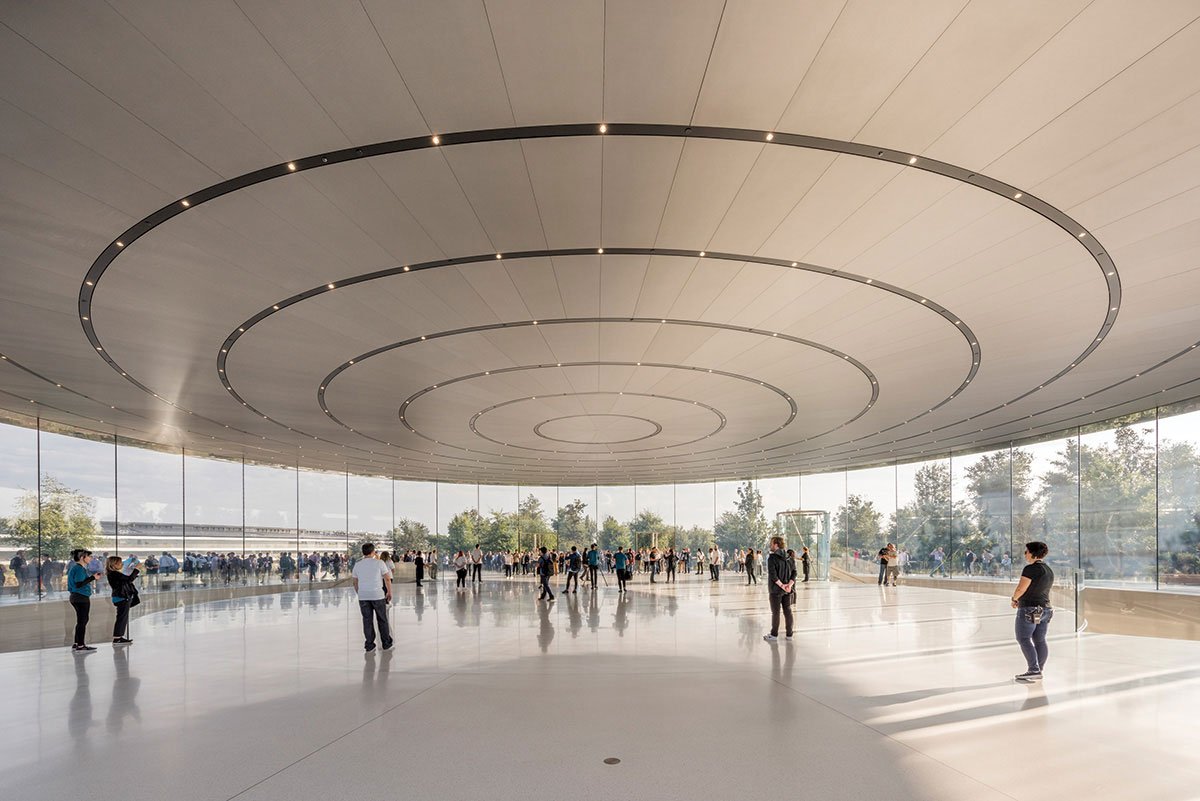
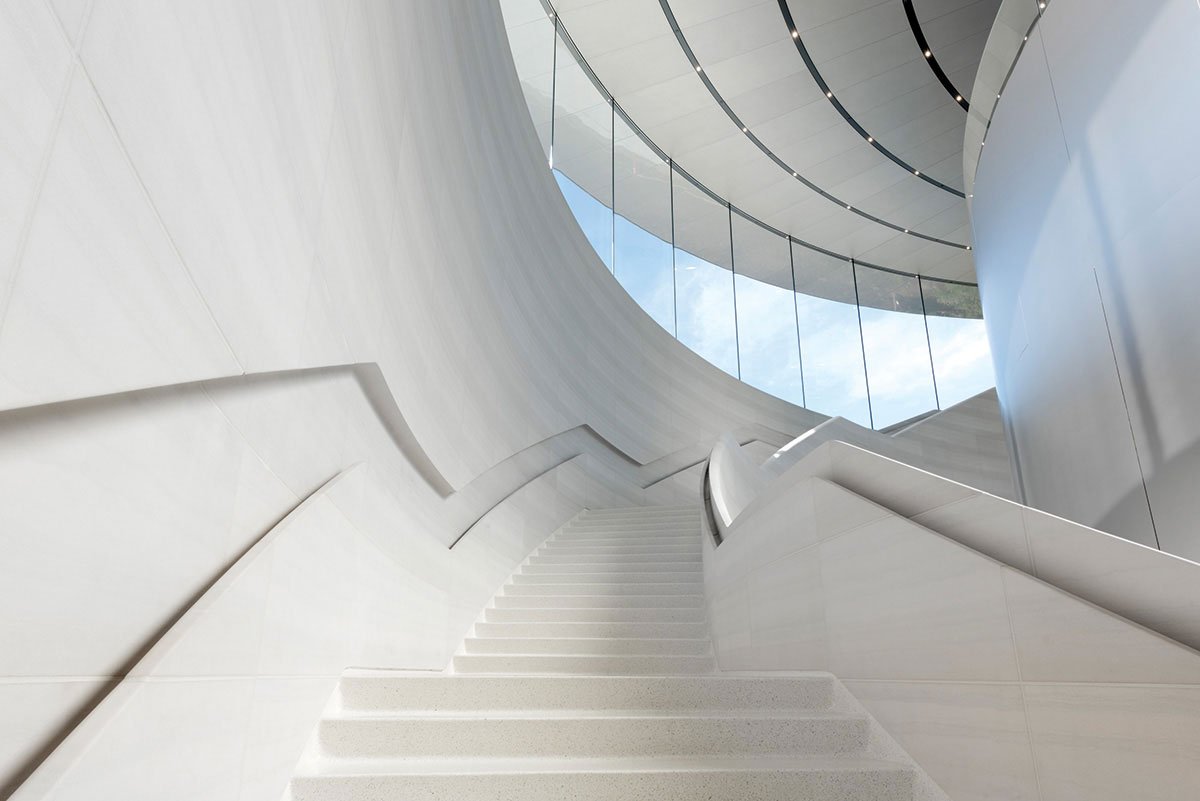
A perimeter of glass holds up a carbon-fiber roof (8) atop walls of serpeggiante castagna limestone (9) at the Steve Jobs Theater. Photos © Nigel Young / Foster + Partners
9
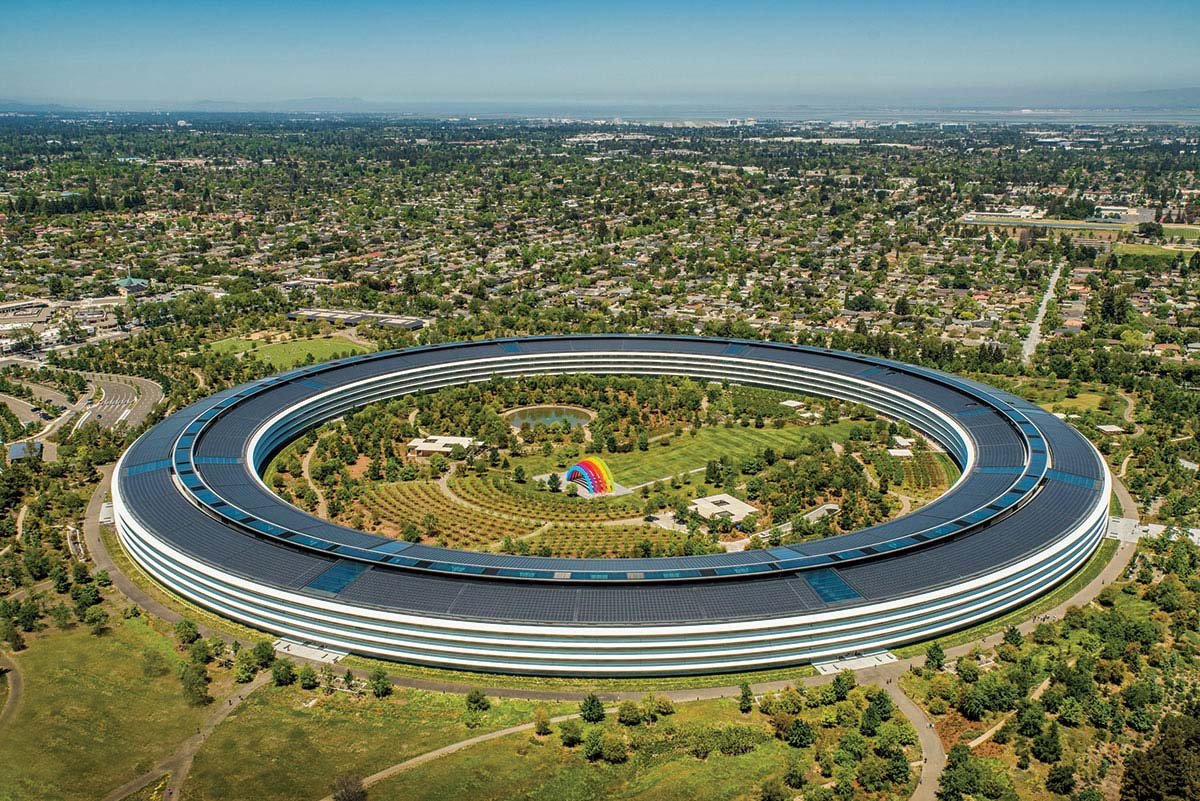
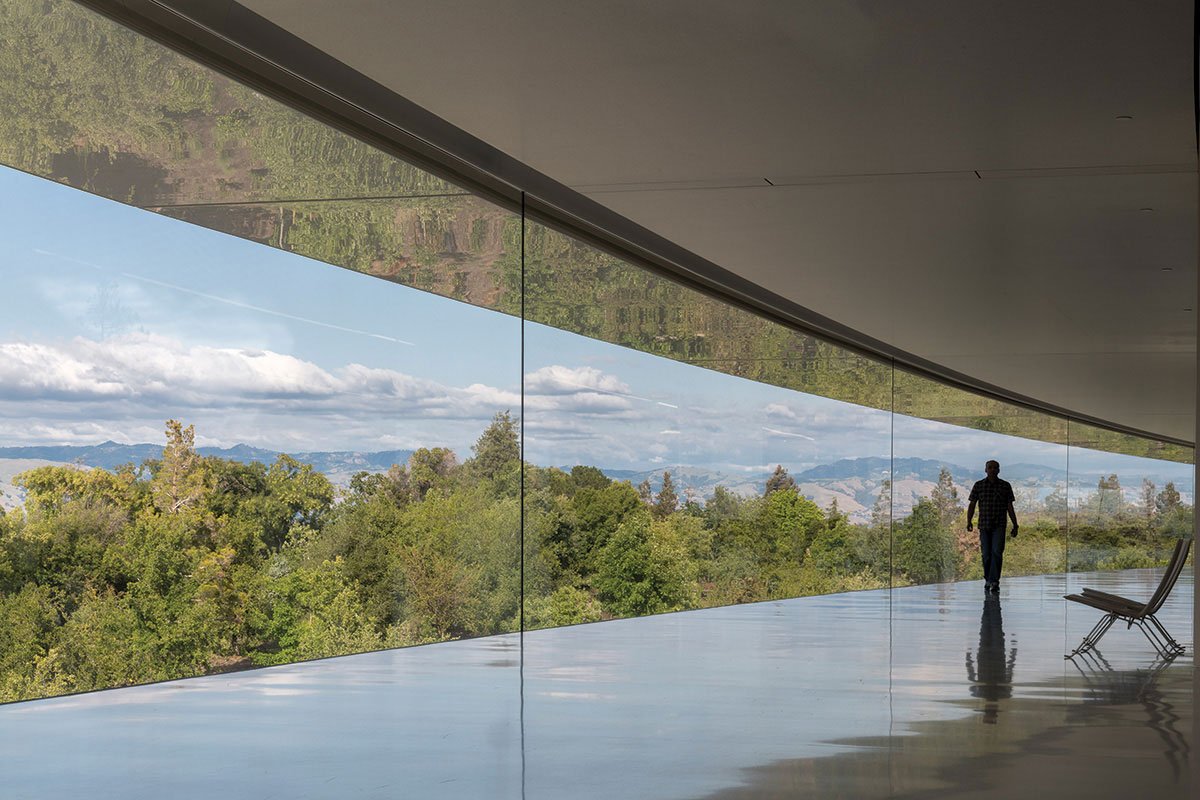
Apple Park was completed in 2017, and it has become an occasional backdrop in company announcements. The centerpiece—the Ring, yet another exercise in optimized form and perhaps a callback to the iPod’s scroll wheel—spans 1,560 feet in diameter. “The whole building is a kit of parts. It was designed like a product, so it could be assembled easily,” explains Stefan Behling, head of studio at Foster + Partners. “The highly sophisticated concrete structure integrated water supply, heating and cooling, and electricity, which then also became the interior finish where the underside was simply polished, and that is what you see as the soffit.” These so-called void slabs number over 4,000, while nearly 6½ miles of curved, laminated cold-formed glass panels—produced by Seele and measuring 46 feet in length by 10½ feet in height—encircle the structure. Bladelike glass fins, backed by pink-tinged silicone (the pigment cancels out the faintest green hue of the low-iron glass to create a radiant bright white), wrap around the office building at each of its four stories.
10
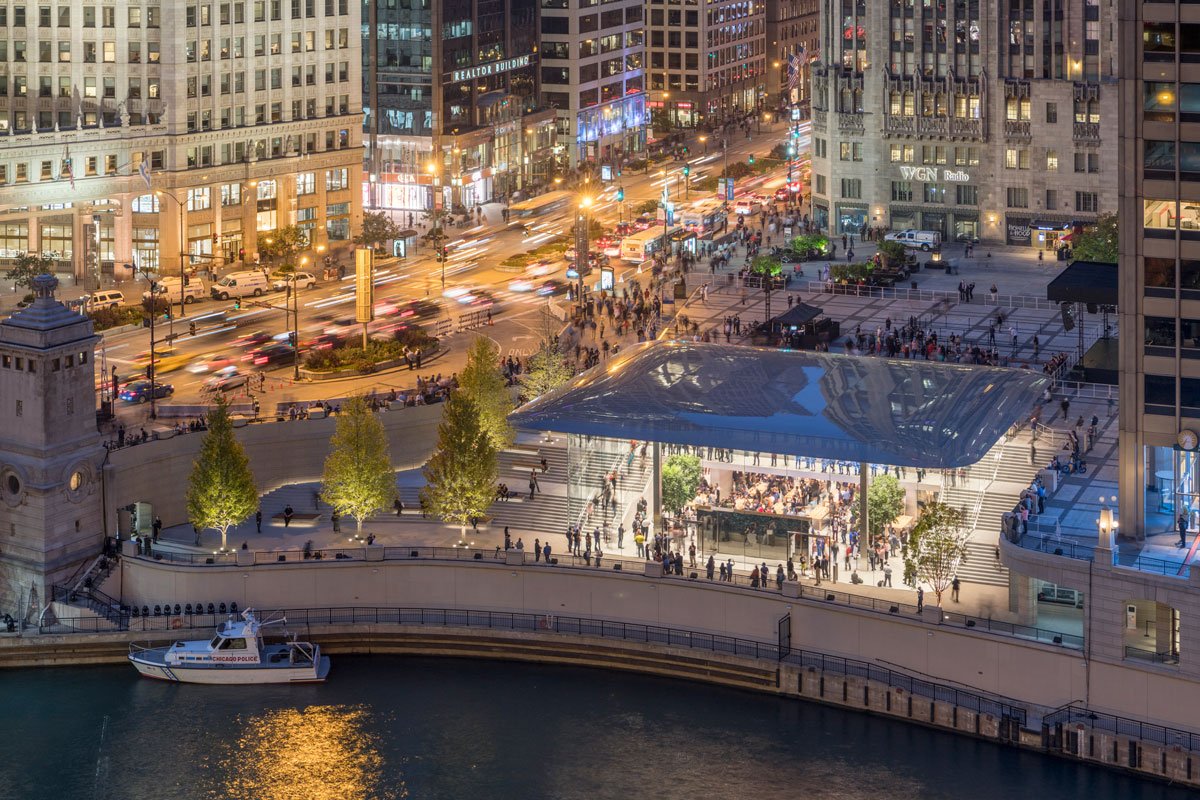
11
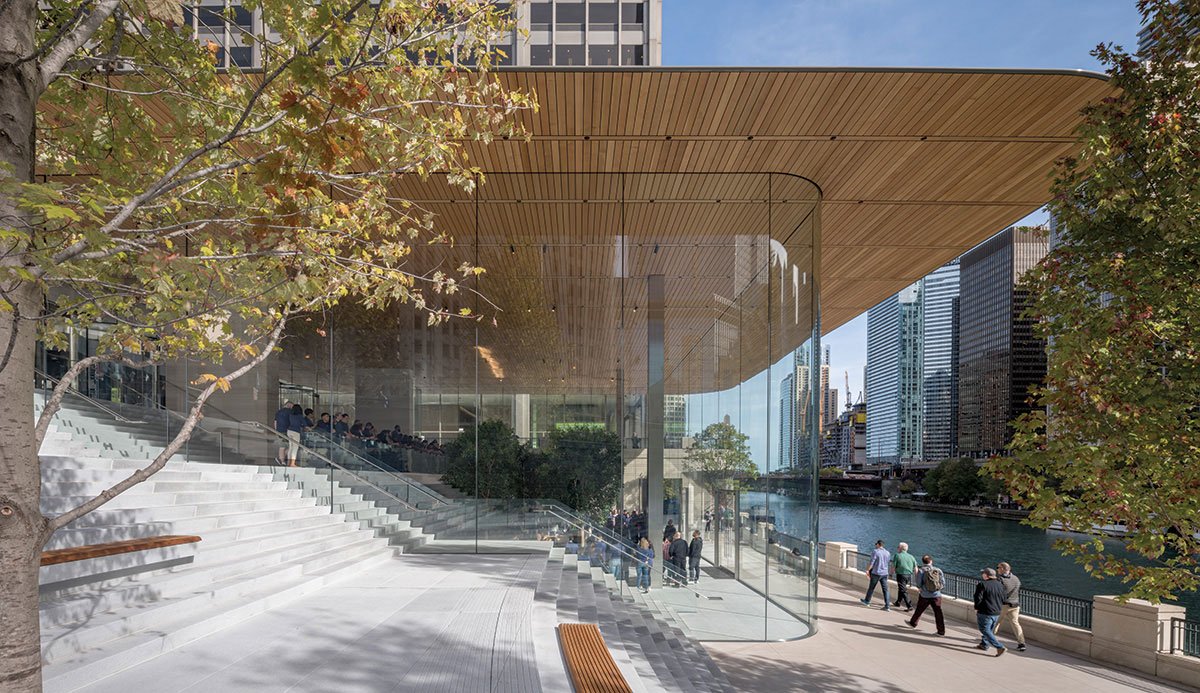
In Chicago (10 & 11) and Milan (12 & 13) stores offer public space to their host cities. Photos © Nigel Young / Foster + Partners
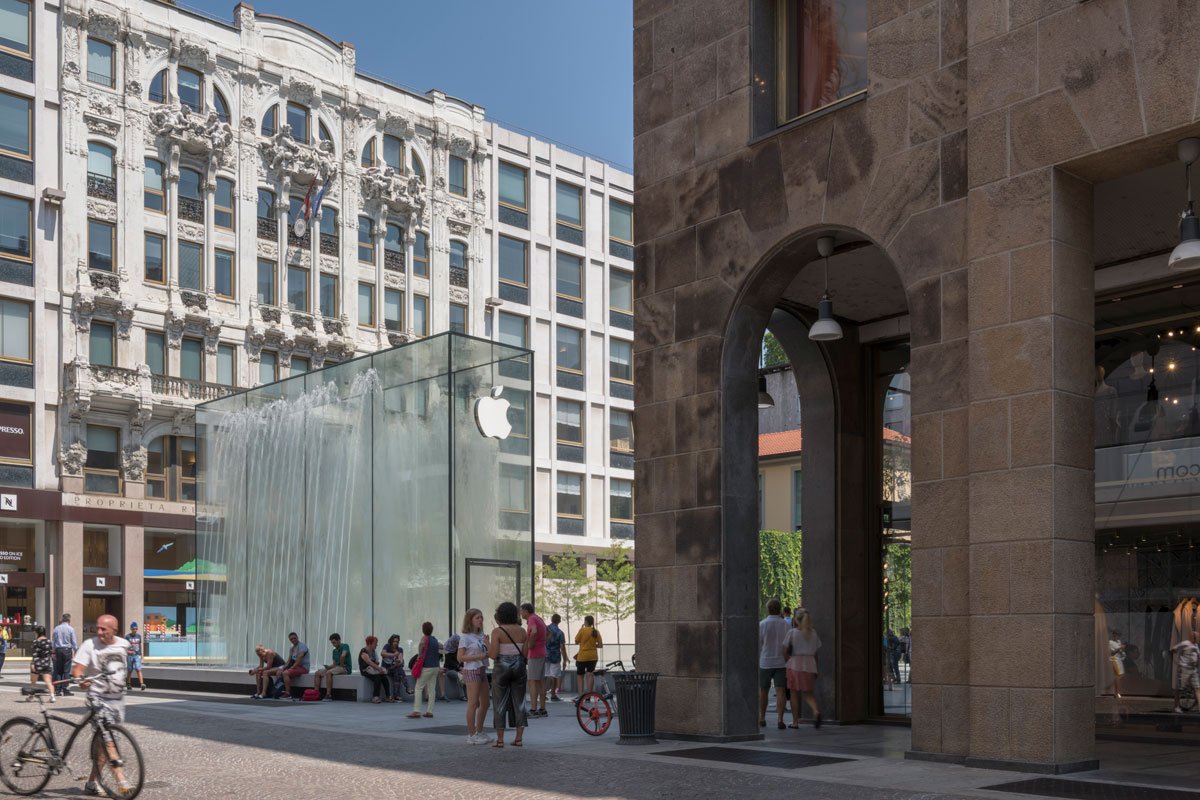
12
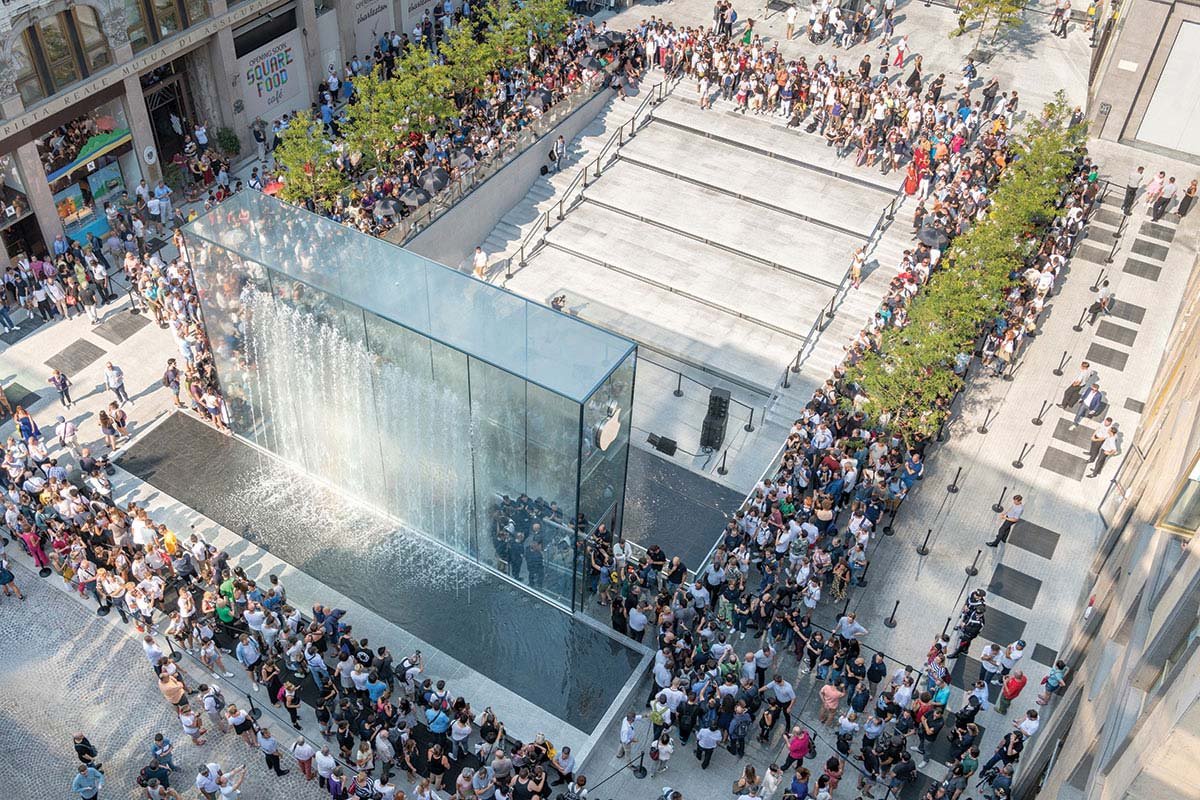
13
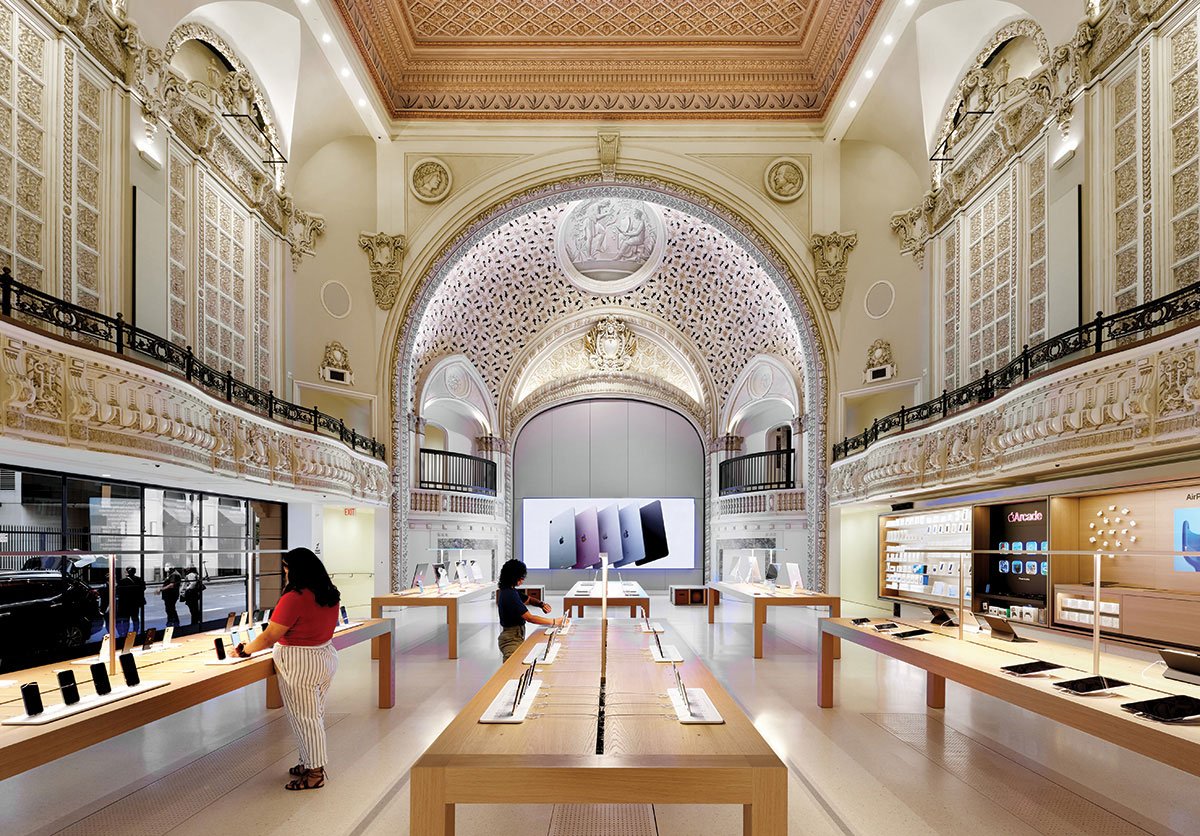
The Tower Theatre in L.A. is an example of Apple’s adaptive-reuse strategy. Photo © Cesar Rubio
At the edge of this idyllic campus is the Steve Jobs Theater (2017), a glass tempietto that is home to the 1,000-seat auditorium where Apple executives present the latest products. The entirely column-free entry level spans 135 feet; its slender 5-foot-deep carbon-fiber roof—the world’s largest—is held up only by 22-foot-high glass panes at the structure’s perimeter. Apple Park was an important testing ground for concepts and details that would appear in later stores.
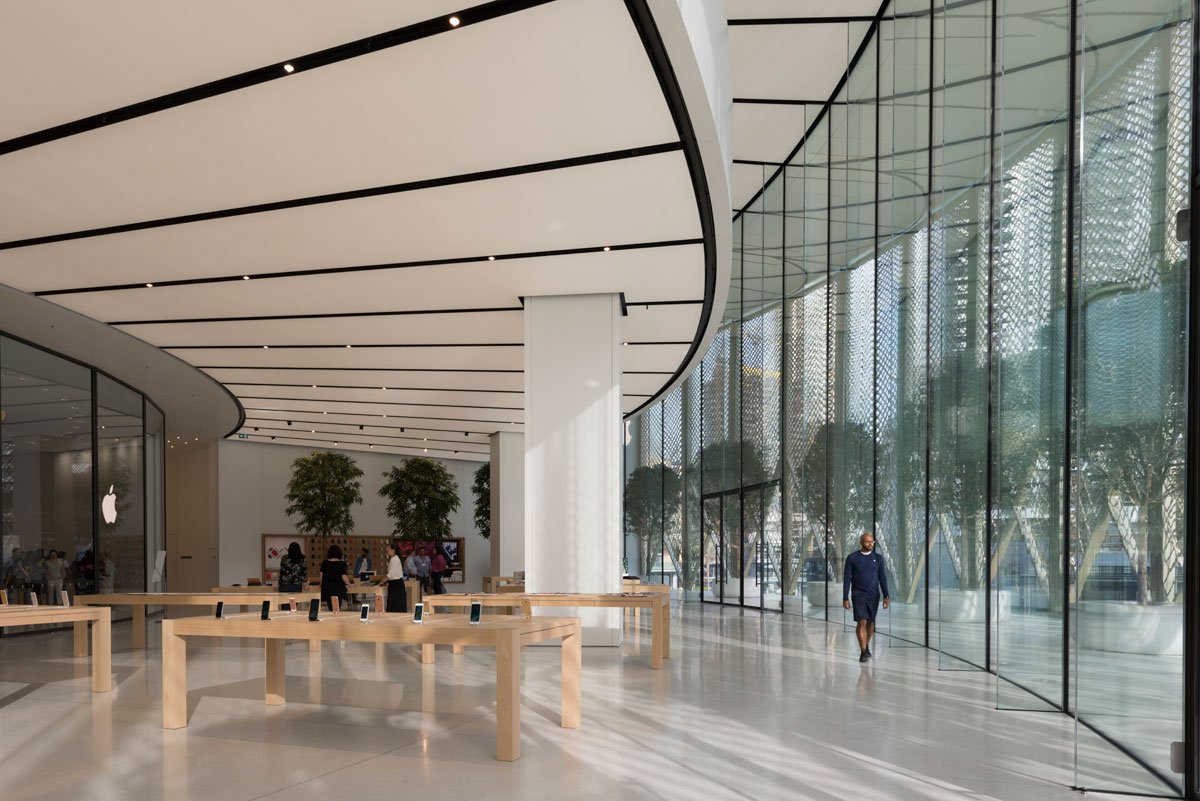
14
Apple Dubai Mall (14), which opened in 2016 and overlooks Burj Khalifa Lake, includes a retractable lattice wall (15). Photo/video © Nigel Young / Foster + Partners
If Apple iterates its retail locations in generations, as the company does its products, then the rethinking initiated by senior vice president of retail Angela Ahrendts, and showcased with Apple Union Square (2016) in San Francisco, certainly marks the beginning of one such chapter. “We actually don’t call them stores anymore,” said Ahrendts after the opening. “We call them town squares. They’re gathering spaces—for more than 500 million people who visit us every year.” Although the parlance never quite caught on with customers (who says, “I’ll meet you at the Apple town square”?), it signified a strategic reconceptualization.
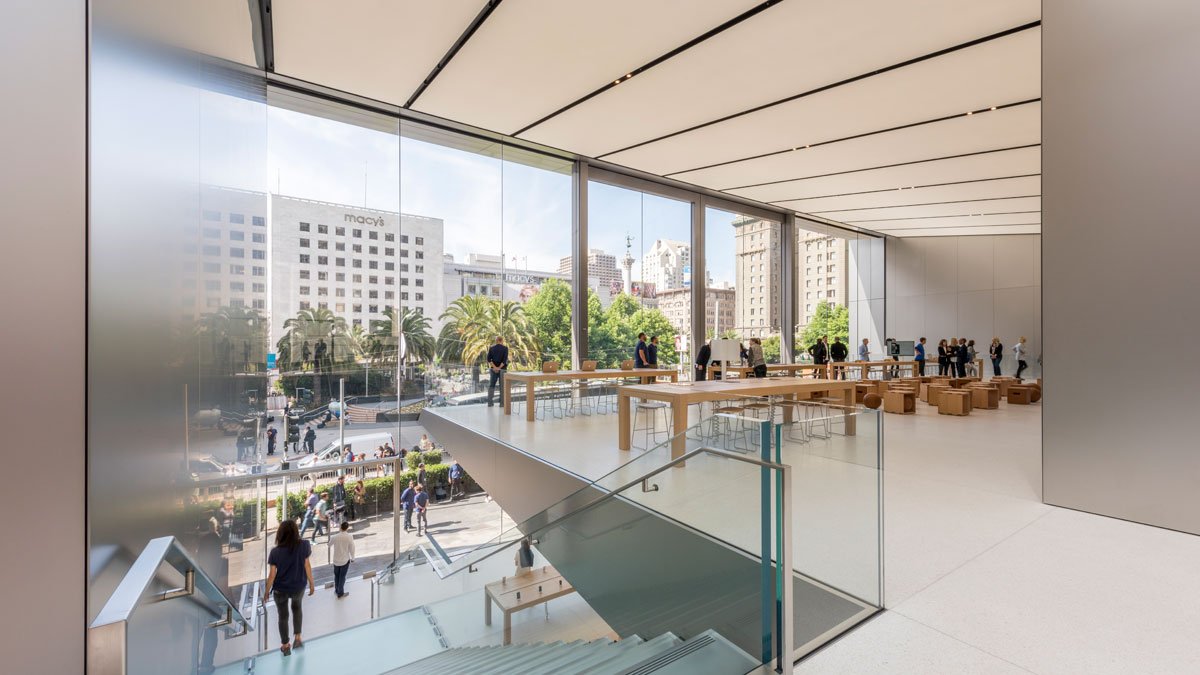
16
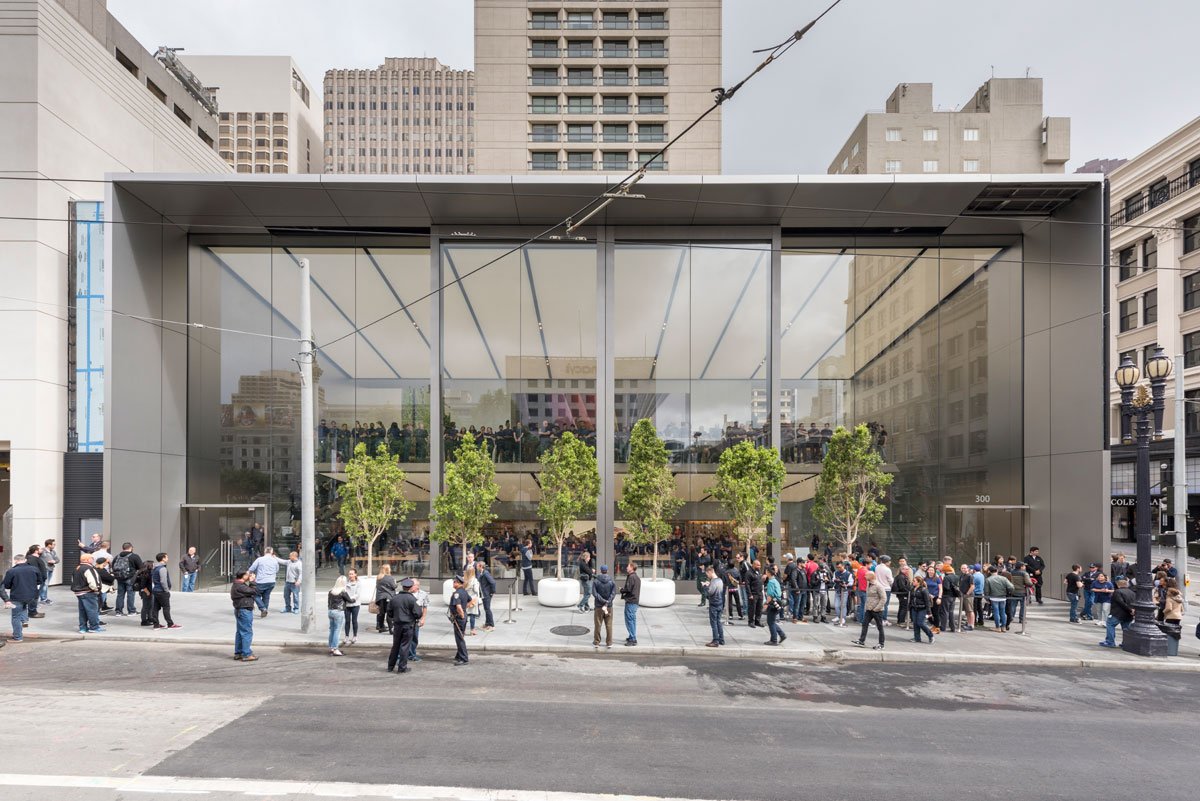
17
Apple Union Square in San Francisco features large sliding doors that open onto the adjacent civic space (16 & 17). Photos © Nigel Young / Foster + Partners
The Union Square location introduced several new spaces that now appear in other stores: the Avenue, a display area for accessories; the Forum, an enhanced learning environment; the Genius Grove, a more relaxed and greener version of the eponymous tech-support bar; and the Boardroom, a space for meetings with businesspeople, all set behind expansive sliding doors with glass panes measuring 42 feet tall by 20½ feet wide (when open, the public realm extends into the store). Although the hardware—the architecture, interiors, furniture, and details—largely reflected that of recent predecessors, the updated layout was supported by new software taking the form of dedicated staff and an expanded suite of programming and events.
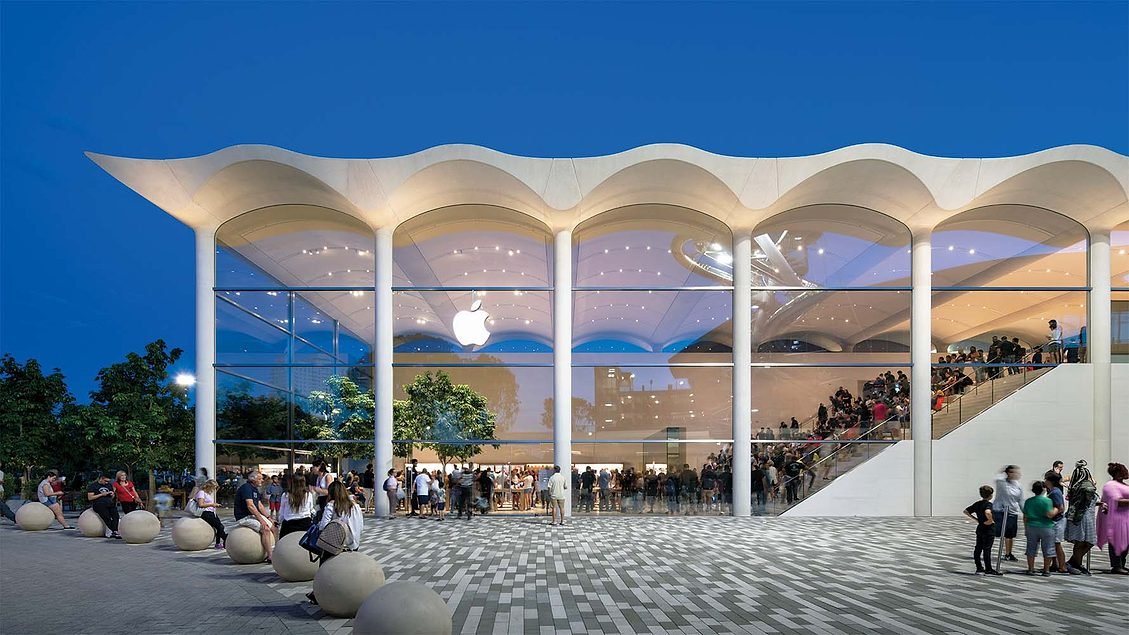
Over time, the stores became more idiosyncratic, wavering from the demands of a strict brand identity toward the needs of site specificity, without losing their essence. “Products are often designed to respond to universal human needs; in a way they are agnostic to location,” says Behling. “Architecture, on the other hand, should always be a unique response to its place.” In the heart of Milan, for example, Apple Piazza Liberty (2017) juxtaposes urban elements—a stepped plaza and fountain—with a tall and slender rectangular prism that doubles as an entry. Together they resemble something of an open-air cinema, an echo of what had previously existed at the site. Along the Chicago River, a flagship arrived with a public stair that offered waterfront access and softer, curving-glass details, like those seen at Apple Park. In an era of online shopping, and when many downtowns continue to struggle, these investments in civic infrastructure have taken on greater importance. Apple has also found ways to breathe new life into historical interiors, including a landmarked Parisian apartment building along the Champs-Élysées in 2018, the Tower Theatre in L.A. in 2021, and the former coal-operated Battersea Power Station in London in 2023, where Apple has also recently built an impressive workplace designed by Foster + Partners.
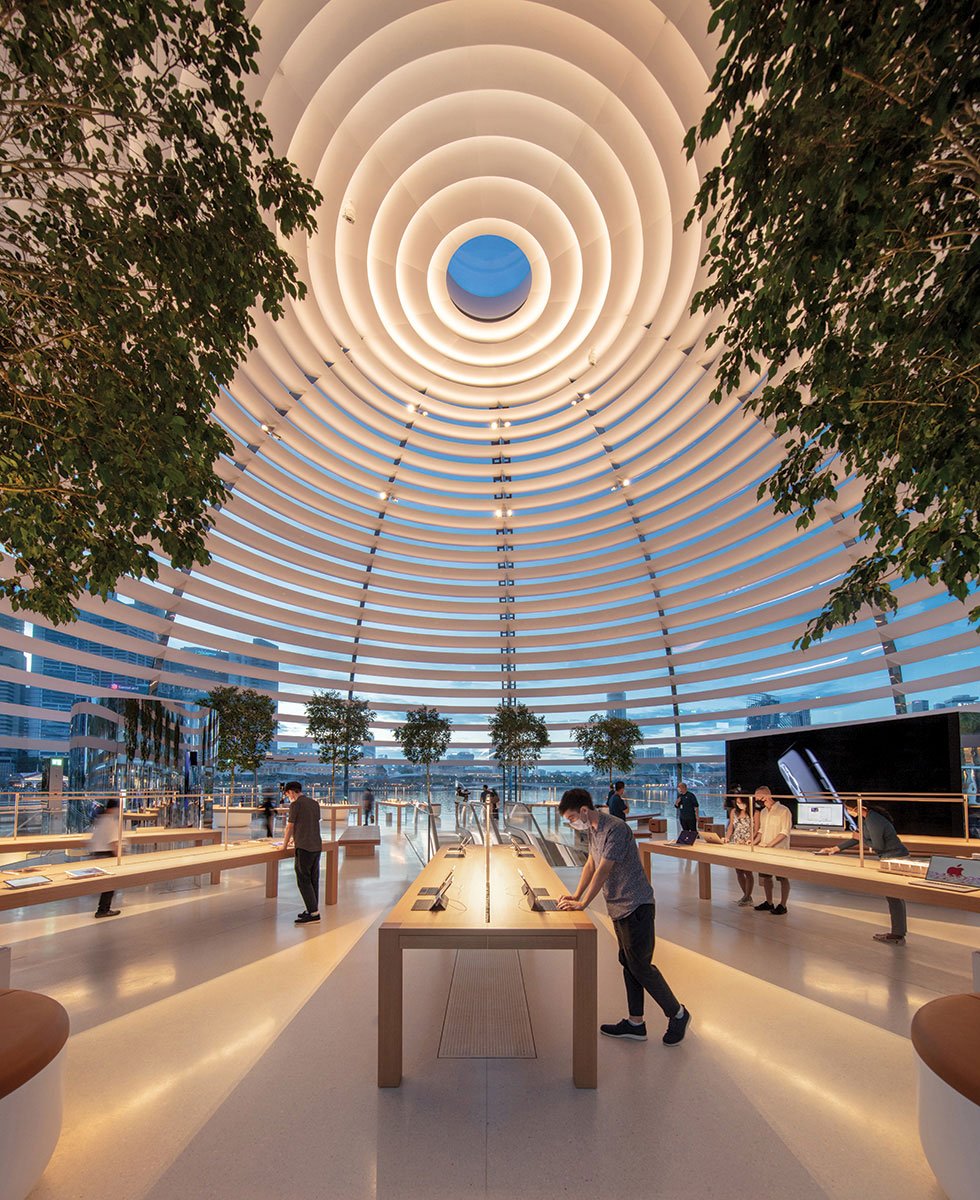
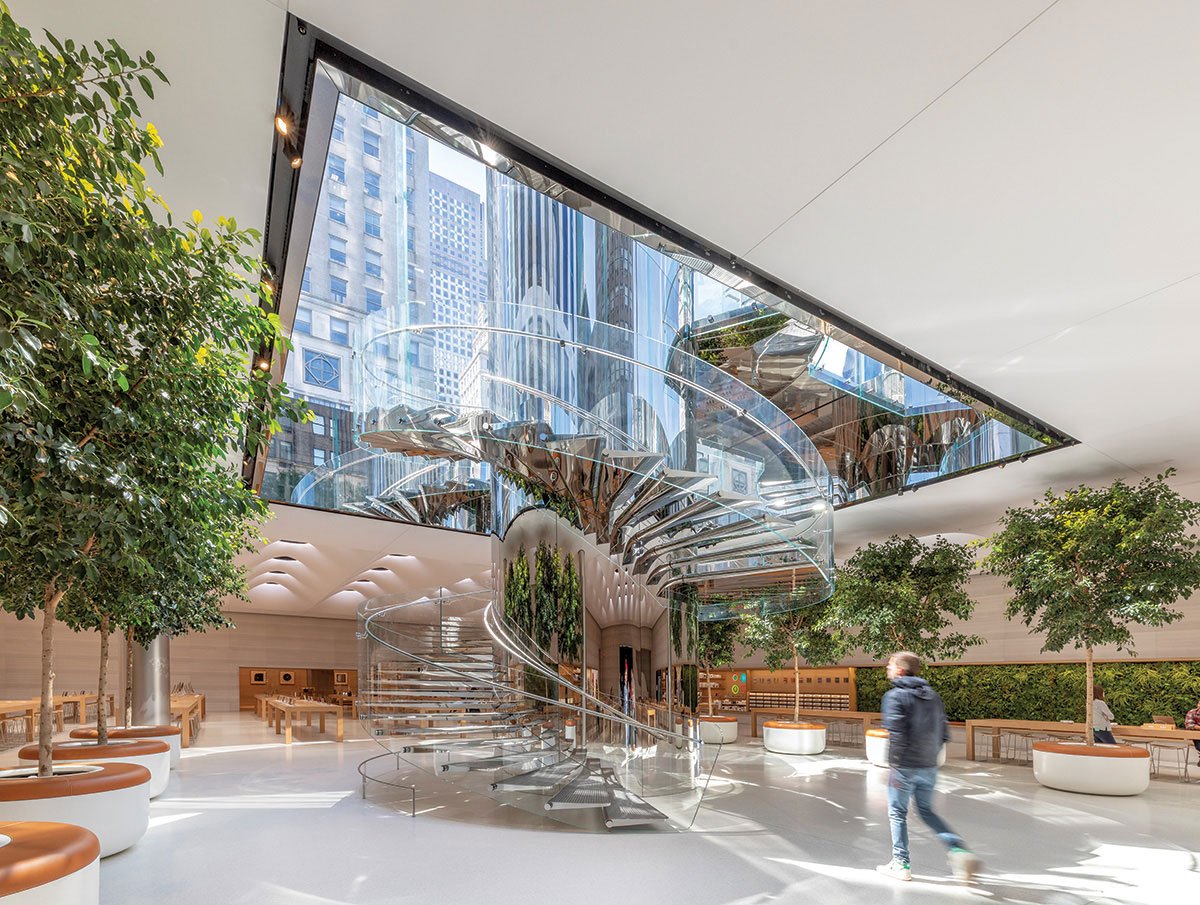
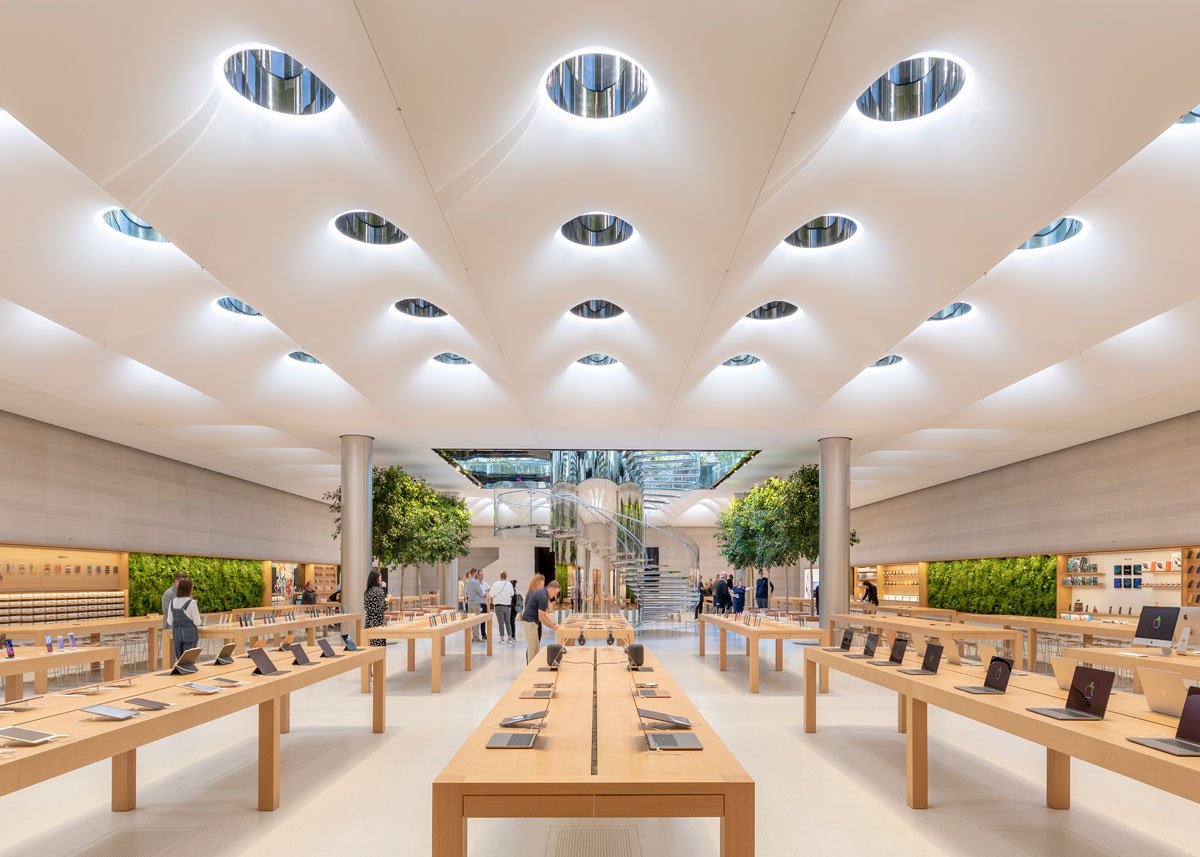
Stores of the latest generation center sustainability and well-being, reflecting the priorities of Tim Cook, who took over as CEO in 2011 and has since expanded the company’s focus on wearables (such as the Apple Watch and Apple Vision Pro), services, and entertainment. Visitors can now frequently find stores lined with warm oak and planted with stands of indoor trees, while polished steel reflects the greenery. The hemispherical Apple Marina Bay Sands (2020) in Singapore and Apple The Exchange (2024) in Kuala Lumpur, Malaysia, employ louvers to modulate daylight and enhance building performance. The Fifth Avenue flagship, renovated a third time, by Foster + Partners in 2019, reflects these ideals too. The store’s footprint was nearly doubled to keep up with ever increasing foot traffic, and plaza-integrated skylights added to naturally brighten the interiors. Apple claims that its stores are now all carbon neutral, and the Ring, in Cupertino, one of the largest LEED Platinum–certified buildings in the U.S., is entirely powered by renewable-energy sources.
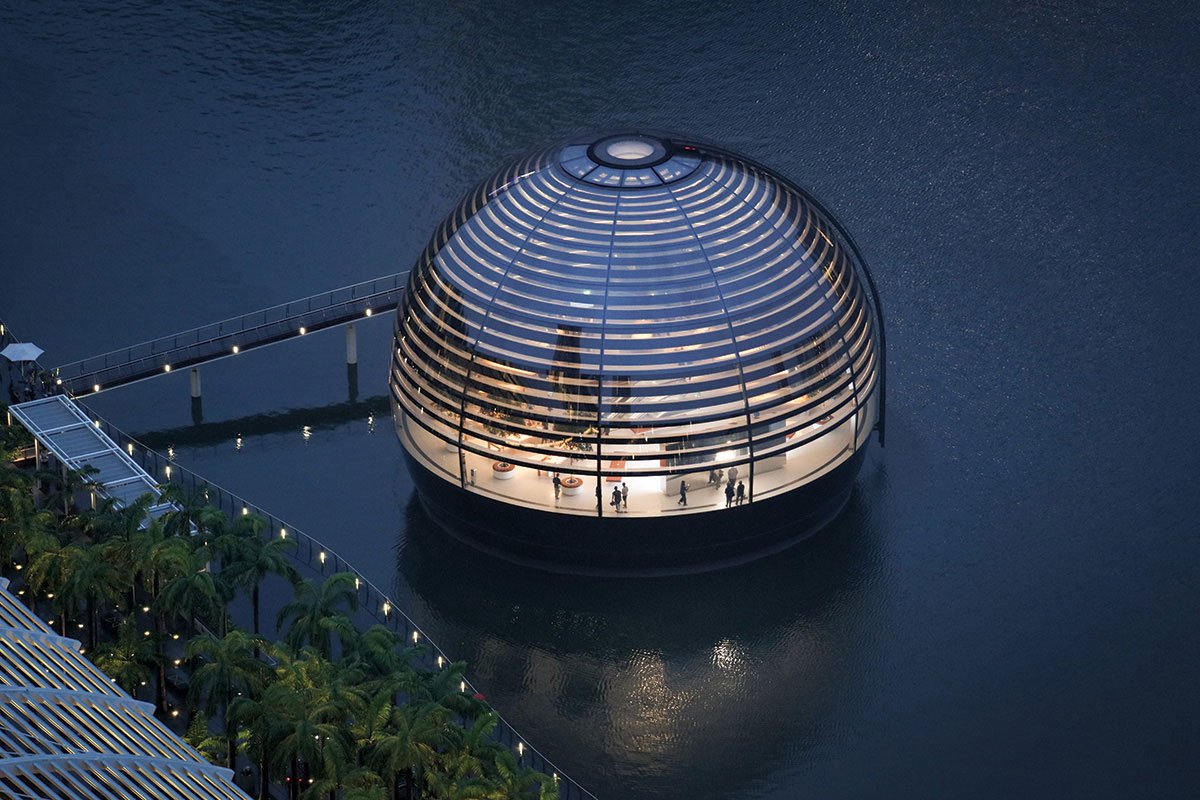
18
In Singapore, the Apple store floats in the bay (18) and modulates daylight (19). Photos © Finbarr Fallon
19
Apple has come quite a long way since Jobs and Steve Wozniak started tinkering away in 1976. Innovation does not happen overnight—it is slow and incremental. From one year to the next, those individual steps may seem minor or even inconsequential. But larger retrospectives reveal leaps and bounds only possible with time and a committed outlook. In its product design, Apple exemplifies this. How else could it build such a devoted clientele? The architecture, too, tells a story about how the company shaped, and was shaped by, advances in building technology. Surely there are big and sweeping ideas here, but they all started somewhere—with refining a single, elegant detail.
20
21
The Fifth Avenue flagship (20 & 21) was renovated in 2019. Photos © Aaron Hargreaves / Foster + Partners
22
Apple’s Cupertino headquarters (22), with its impressively large panes of glass (23), offers unobstructed views out to the landscape. Photos © Steve Proehl (22); Nigel Young / Foster + Partners (23)
23