De Nederlandsche Bank Amsterdam building renewal, Dutch office HQ refurb, Holland architecture photos
26 February 2026
Renewal Architects: Mecanoo
Original architect: Marius Duintjer
Location: Utrechtse Poort, Amsterdam, The Netherlands
Photos by De Nederlandsche Bank/Ossip Architectuurfotografie
De Nederlandsche Bank, Amsterdam Building Renewal
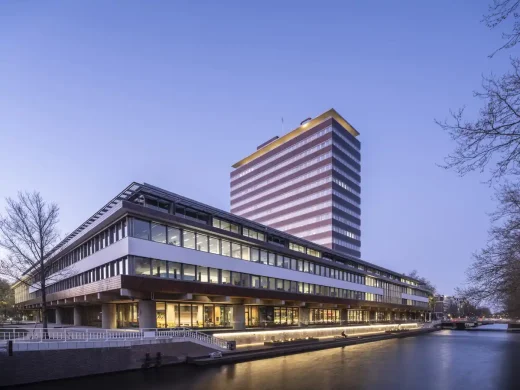
De Nederlandsche Bank (1968) is located on the historic ‘Utrechtse Poort’ site close to Amsterdam’s canal belt. Until 1929, this was the location of the Paleis voor Volksvlijt (Palace of Industry), designed by Samuel Sarphati, which was destroyed by fire that same year. Sarphati’s vision – uniting culture, economy, entrepreneurship, and science in one place for all people – was revolutionary at the time. De Nederlandsche Bank (DNB) is the independent central bank of the Netherlands, committed to financial stability, a smooth and secure payment system, and the supervision of financial institutions.
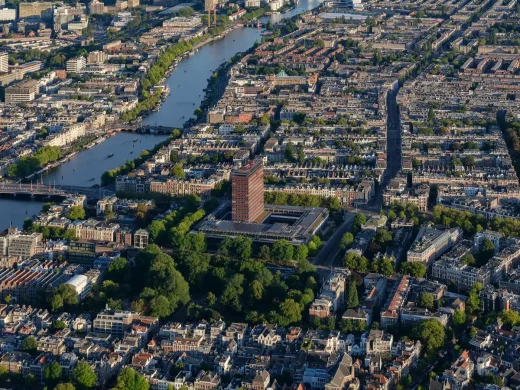
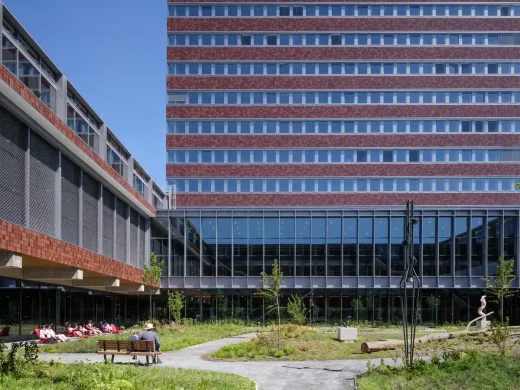
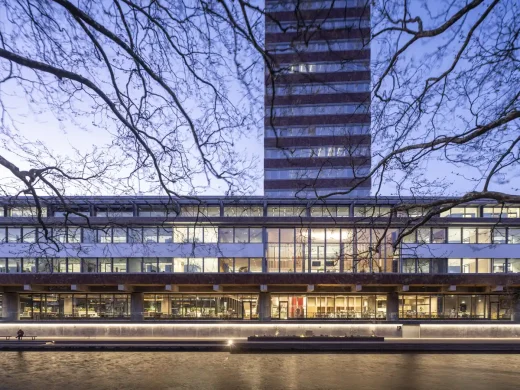
The DNB building, designed by architect Marius Duintjer, was modern and functional. However, it was not embraced by the people of Amsterdam, who found that it was unapproachable and contrasted with the historic architecture of the city centre. For the complex – consisting of a low-rise, square-shaped building (110 x 120 metres) and a 73-metre-high office tower – Duintjer drew inspiration from the mid-century modern architecture of Mies van der Rohe and SOM found in the United States.
At the time, the design was pioneering due to its minimalist lines, restrained use of materials, and transparency. However, that sense of transparency was soon lost due to security requirements; the building became a fortress with fences, large boulders, and armed military police. In 1991, a circular tower was added in the courtyard, and a third floor was placed atop the low-rise square.
With the decision to relocate the gold reserves and banknote operations to the Cash Centre in Zeist, the opportunity arose to transform this heavily secured and overdue-for-renovation building and open it up to the greater public in a more engaging way. The circular tower was no longer needed and could be dismantled in a modular manner.
The new treasury
In the winning design proposal (2018), Mecanoo decided to relocate the entrance of DNB to Frederiksplein (Frederik’s Square), aligning it with the Utrechtsestraat (Utrecht Street) axis, and to cut through the vault. The floors surrounding the vault were removed, exposing to the city a golden colossus measuring 61×18.5×11 metres, complete with six imposing vault doors.
Inside the vault, visitors can immerse themselves in exhibitions and interactive games that tell the story of gold, money, the economy, and DNB’s core activities. The most secretive part of the bank is now its most public: The New Treasury. At both ends, there are two auditoriums: a formal auditorium for lectures and performances, and an informal auditorium for hosting school groups.
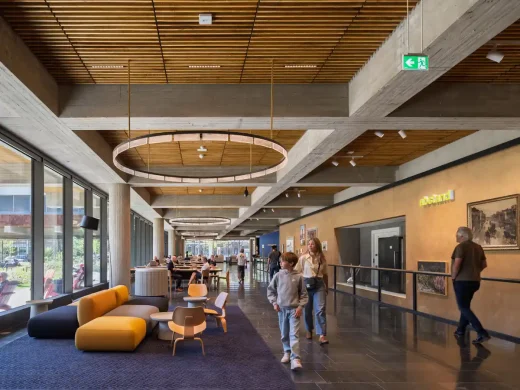
Between the vault and the new city garden, where the round tower once stood, lies the so-called ‘street’ with tables and seating areas for waiting, meeting, studying, having a coffee, or visiting the exhibitions. Francine Houben’s inspiration came from the vibrant ‘street’ of the central hall in the former Faculty of Architecture building at TU Delft, which was destroyed by fire. The reception desk functions as a welcoming coffee bar for the neighbourhood and visitors, but also as the check-in point for DNB guests entering the next security zones.
Atrium, restaurant, and ‘Singelgracht’
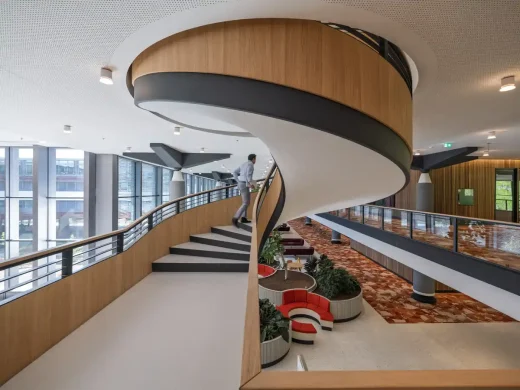
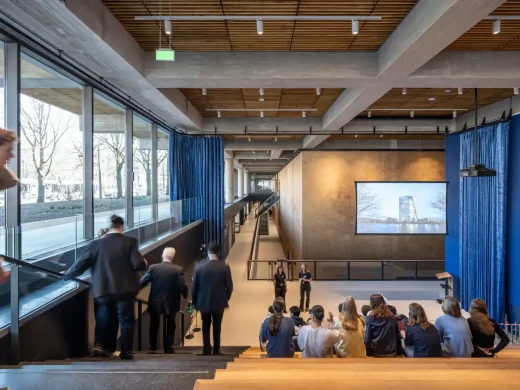
In the semi-public area, Mecanoo added a five-storey atrium with staircases along the Utrechtsestraat axis, encouraging movement and interaction. The atrium brings daylight to the basement levels through a double staircase, and serves as the venue for ‘Townhall Meetings’ for the approximately 2,300 employees. The grid-like, robust concrete structure of the former exterior wall now forms an open interior wall within the atrium.
The atrium leads to the restaurant, which, positioned like a mezzanine, overlooks the Singelgracht. Here, DNB employees and their guests can dine, both formally and informally, in small groups or in a lunchroom setting. Outside lunch hours, it serves as a work and meeting space. The quay along the Singelgracht has been transformed into a public gathering place, where passers-by can sit in the sun on the wooden deck hovering just above the water.

Cash Hall becomes the Forum
The double-height cash hall by Duintjer, characterised by its distinctive columns, was the place where money was counted. The hall has been transformed into the Forum, a meeting centre with meeting rooms at its heart. After passing the second security zone, guests are welcomed into this semi-public area, Intimate breakout zones with tables, seating areas, and numerous plants are located on the side of the city garden and the staff courtyard.
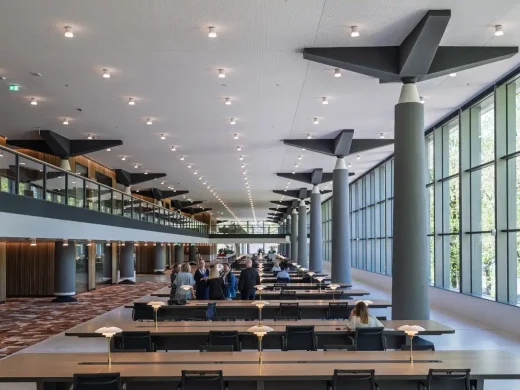
Inspired by the Rose Main Reading Room of the New York Public Library, the monumental 120-metre-long reading room faces Frederiksplein and is surrounded by the crowns of Dutch elms. Mecanoo designed eighteen DNB tables for the reading room, complete with lighting. The room is used daily as a workspace, but it is also suitable for special conferences and dinners. In the centre stands the spiral staircase designed by Duintjer. Mecanoo added a complementary staircase, in a yin and yang fashion, connecting the 2nd and 3rd floors.
A diverse work environment
Workspaces for DNB employees lie beyond the third security zone and are spread across the courtyard-shaped low-rise building and the tower. The work environment is designed not only for focus but also for collaboration and interaction. Employees can choose from a great variety of workspaces: from enclosed to open, interspersed with lounge areas, video call rooms, meeting spaces, and landing zones.
Every workspace has natural light, openable windows, and a view. Both inside and outside spaces are brought to life with abundant greenery. The top floor of the tower offers a spectacular view of Amsterdam. All installations are located in the basement, making it possible to create panoramic spaces on the top floor of the tower for special meetings and brainstorming sessions.
Circular and biobased materials
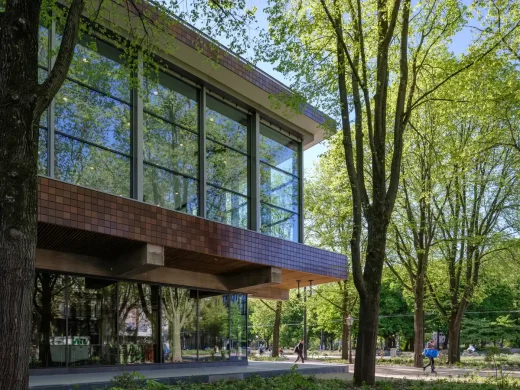
Mecanoo added a palette of warm circular and/or biobased materials to Duintjer’s selection of robust concrete, glass, and steel, contributing to excellent acoustics. The wood from locally felled old and diseased poplars has been beautifully incorporated into a wooden slatted ceiling beneath the concrete structure.
The walls are covered with coloured PET felt, interspersed with FSC-certified wooden panelling. The colour scheme is inspired by the vibrant paper currency from the last period of the Dutch guilder. DNB’s art collection is displayed thoughtfully throughout the building. Great attention has been given to the lighting: 1960s fluorescent tube lighting has been replaced with a combination of energy-efficient, functional, atmospheric, and theatrical lighting.
Facade tower and the colours of the city
For Duintjer, the red tiles on the facade referenced the brickwork of the Amsterdam canal belt. The colour nuances at the time were created through the manufacturing process. Today, ceramics are produced with precise colour specifications. After an extensive colour study, Mecanoo has reintroduced these nuances in the renovated facade. By opting for a mechanical suspension, the facade can be disassembled in the future in a circular manner. The so-called ‘kastenfenster’ system ensures that the building is well insulated and provides the option to open the windows for ventilation.
Circular and sustainable exemplar project
DNB sets a benchmark for circularity and has received the BREEAM Outstanding certification for its renovation. The round tower was modularly dismantled for repurposing. Demolition debris from the building has been processed into high-quality raw materials for the production of new, circular concrete. This circular concrete was used for the construction of the new quay. Additionally, CO₂ was injected into the concrete, resulting in CO₂-neutral concrete. Another portion of the concrete has been reused for social housing in Amsterdam. The cobblestones surrounding the building are being repurposed as climbing objects in a sports park on the east side of Amsterdam. Office furniture has been largely reused, and rainwater collection has been implemented on site.
The renovation has reduced energy consumption and CO₂ emissions by more than 80%. The tower facades are highly insulated with the ‘kastenfenster’ system, a ventilated double-glazed facade with integrated sun shading. The ventilation system reuses the heat from outgoing air. Solar panels on the roof meet part of the electricity demand. All energy needed is sourced as sustainably as possible. There is a heat-cold storage system, and wherever possible, solar panels and green roofs have been installed. In this way, the building contributes to a climate-neutral city.
Biodiversity and heat stress
The transformation of Frederiksplein into Frederikspark places the Bank amidst greenery. The former car park with the round tower has made way for a publicly accessible city garden. The logistics centre was given a roof with an indoor garden filled with herbs and vegetables for the staff. The rooftops now incorporate green terraces, and on the wooden deck, everyone can sit close to the cooling waters of the ‘Singelgracht’. All these elements contribute to enhancing biodiversity and reducing heat stress in the city.
Programme: Renovation of the national bank building (1968) covering 67,000 m², of which approximately 1,500 m² is new construction, including a redesigned entrance area with exhibition spaces in and around the former gold vault, a lobby with reception and coffee bar, formal and informal auditoriums, office workspaces, meeting centre, gym, atrium with stairs and seating, staff restaurant, logistics courtyard, bicycle storage, and car park. The project also includes landscaping for the courtyards and rooftop gardens. It is certified with BREEAM Outstanding and WELL Platinum.
De Nederlandsche Bank Amsterdam Redevelopment, Amsterdam, Holland – Building Information
Client: De Nederlandsche Bank
Design: 2018-2020
Realisation: 2020-2025
Architecture, restauration, interior and landscape: Mecanoo
Construction: Pieters Bouwtechniek
M&E engineer: Valstar Simonis
Building physics and fire safety: DGMR
Lighting design: Frans van Hooijdonk
Project management: Stevens Van Dijck Bouwmanagers en Adviseurs
Cost consultant: IGG Bouweconomie
Main contractor: SPIE
Exhibition design: Platvorm (design), Duinzand (concept), IJsfontein (interactive games), Redrum Bureau (3D experience)
Wayfinding: Mijksenaar
Photography: De Nederlandsche Bank/Ossip Architectuurfotografie
Mecanoo architecten
De Nederlandsche Bank Amsterdam building renewal images / information received 260226 from Mecanoo architecten
Location: Amsterdam-Noord, The Netherlands, The Netherlands, western Europe.
Amsterdam Buildings
Amsterdam Architecture : links
Amsterdam Architecture News
Major New Dutch Capital Building Designs
The Bow Overhoeks Amsterdam apartments building, Overhoeks, Amsterdam North
Architect: Orange Architects
photography : Sebastian van Damme, Tom de Kort, Emile Hoens
Tolhuiskade Apartments, Tolhuiskanaal
Design: Civic Architects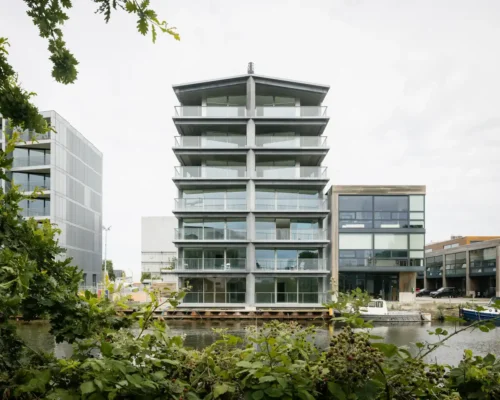
photo : Stijn Bollaert
Floating Gardens, Heathrowstraat, Sloterdijk
Design: Orange Architects, with Bureau Rowin Petersma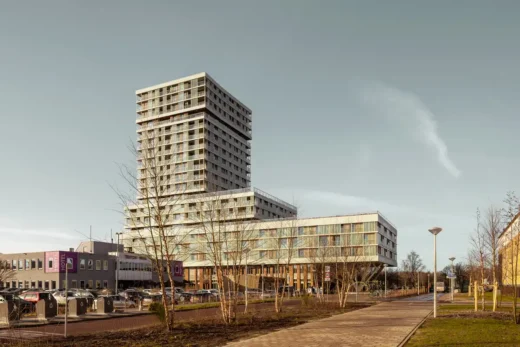
photos by Sebastian van Damme, Emile Hoens, Stijn Poelstra, Kees Hummel, Egbert de Boer
++
Dutch Architecture
Netherlands Architecture Designs – chronological list
Amsterdam Architecture – contemporary building information
Amsterdam Buildings – historic building information
Dutch Architecture
Comments / photos for the De Nederlandsche Bank Amsterdam building renewal design by Mecanoo architecten Netherlands, page welcome.
