Toronto Metropolitan University School of Medicine building, New Ontario campus design, Canadian property image
post updated March 26, 2026
Architects: Diamond Schmitt
Location: Toronto, Ontario, Canada
photos: Tom Arban Photography Inc.
Phase One of Toronto Metropolitan University’s new School of Medicine
The adaptive reuse project integrates medical education, clinical care, and community engagement, expanding equitable healthcare access in Peel Region.
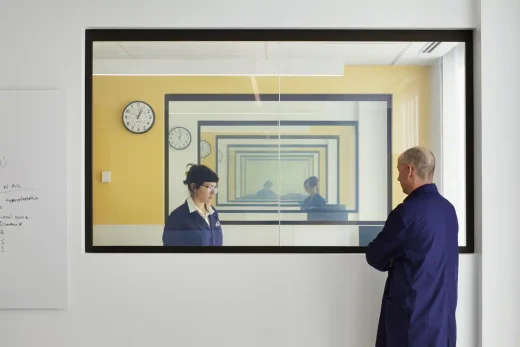
Phase One of Toronto Metropolitan University’s new School of Medicine is now open, establishing a new model for community-integrated medical education in one of Canada’s fastest-growing and most diverse regions. Designed by Diamond Schmitt, the project transforms the former Bramalea Civic Centre into a contemporary academic environment that integrates medical education with a public primary care clinic—directly addressing healthcare access in Peel Region.
“It is an incredible opportunity for a school to expand their reach and capacity to serve its community through a close integration between teaching and practice. When we looked to transform the former civic building into a place of healing and learning, we drew inspiration from local ecologies as way to bring new life to the space,” says Senior Associate Haley Zhou. “This desire to engage the design with its immediate surroundings mirrors the aspirations of the school program to contribute to the care of its own diverse community. With our unique combination of expertise in both health care facilities and post secondary institutions, we looked to create spaces that encourages both collaboration and exchange. Relationships that will be fostered between students, teachers, healthcare professionals and other experts across TMU’s programs under one roof to help each other become the next generation of healthcare leaders.”
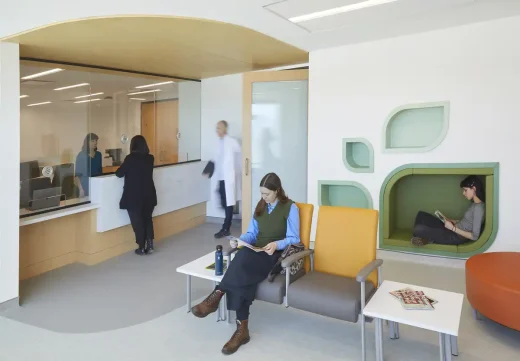
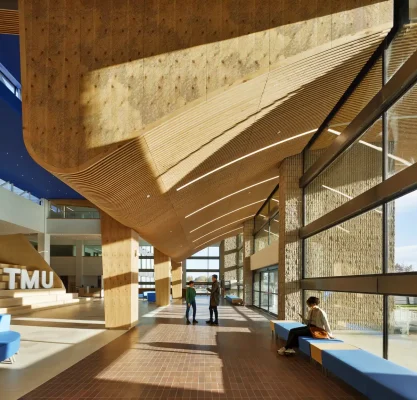
The design retains the strong civic presence of the original 1970s brutalist structure while introducing light, openness, and transparency throughout. Through the removal of interior barriers and the transformation of the four-storey atrium, the former civic building has been reimagined as a welcoming and inclusive academic environment where students, faculty, and community members intersect.
“By transforming a former civic building into a place of medical learning and care, the project extends the building’s original public purpose modernizing the space to remove barriers, advance equitable access, and create an inviting environment for the community,” says Senior Associate Dennis Giobbe.
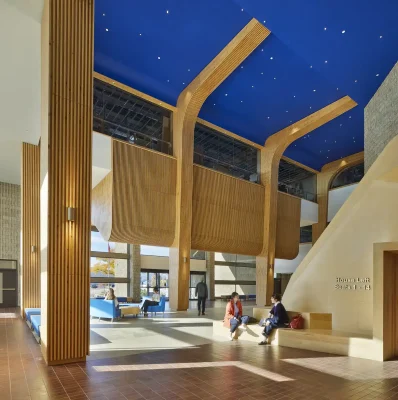
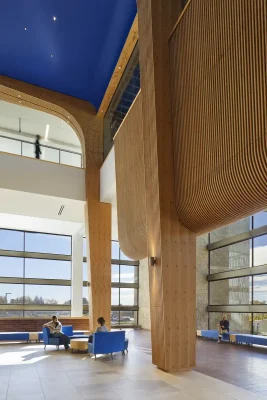
At the centre of the school is the renewed atrium, which serves as a crossroads for learning, gathering, and exchange. Designed as a safe and inclusive space, it supports both formal and informal interaction—encouraging dialogue between students, educators, and the surrounding community.
Indigenous design principles informed the project through collaboration with Two Row Architect, an Indigenous-owned firm, and guidance from TMU’s Indigenous Design Guidelines. Within the interconnected atrium, architectural elements reference the natural and cultural landscape of the region. The building’s original structural columns are clad in wood, evoking the tall pines of nearby Chinguacousy Park—whose name translates from Ojibwe as “Land of Tall Pines”—creating the feeling of being under a forest canopy. Above, an Ojibwe star map spans the ceiling, referencing the celestial knowledge systems that have guided Indigenous peoples for generations. Along the floor, portions of the original tile have been preserved and interwoven with new tile patterns inspired by the structure of a Wampum belt.
The School of Medicine is organized around three interconnected environments: active learning spaces for clinical training and the central atrium that functions as the social heart of the building which are part of Phase One; and academic and faculty areas that support research and administration which will be completed in Phase Two. Reflecting modern medical education—focused on evidence-based, simulation-based, and small group learning—the design prioritizes flexibility and collaboration, supporting interaction between students, educators, clinicians, and the community.
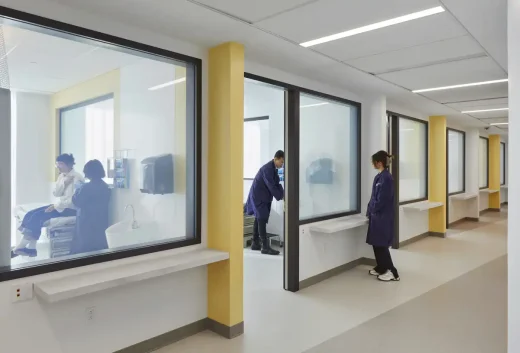
Active learning and clinical engagement are concentrated in the south wing of the building, anchored by a ground-floor primary care clinic that provides essential health services to local residents. By integrating the clinic directly into the academic environment, the school offers students meaningful exposure to community-based healthcare. This positions the school not as an isolated academic facility, but as part of critical health infrastructure—expanding access to medical services in Peel Region.
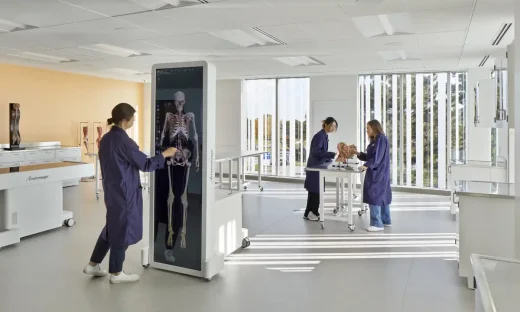
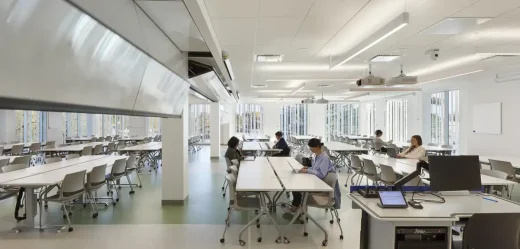
Above the clinic, highly flexible classrooms support multiple teaching configurations, accommodating in-person, hybrid, and asynchronous learning. Case-based learning labs, the hybrid anatomy lab, and high- and low-fidelity simulation spaces support TMU’s experiential learning approach for its 94 undergraduate and 105 postgraduate students.
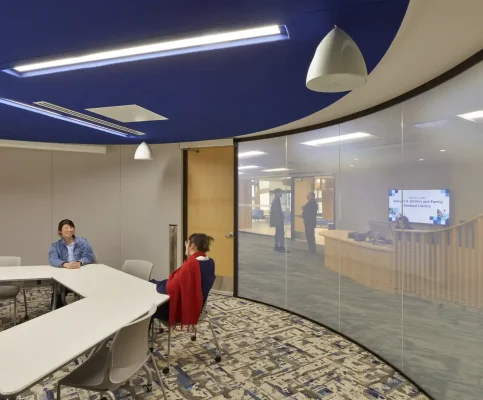
Connected directly to the atrium, the library offers quiet and collaborative study environments, alongside additional informal learning spaces. A round room dedicated to Indigenous smudging ceremonies and smaller gatherings anchors this area, offering an important place of reflection and cultural practice within the school community.
Throughout the building, the design strategically leverages the building’s original terraced structure to maximize access to natural light for learning and event spaces, while locating digitally focused environments deeper into the floor plan as central hubs for student activities.
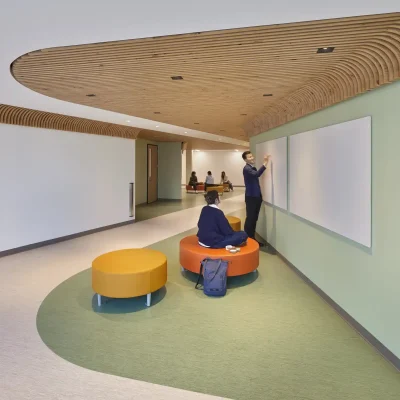
In repurposing the former Bramalea Civic Centre, TMU’s new School of Medicine demonstrates how existing civic infrastructure can be reimagined to meet evolving community needs. By bringing medical education, clinical care, and public gathering spaces together under one roof, the project positions the building as both a place of learning and an essential piece of community health infrastructure in Peel Region.
“This building reflects the vision behind the TMU School of Medicine—a place where learning, collaboration, and community come together,” says Mohamed Lachemi, President and Vice-Chancellor, Toronto Metropolitan University. “It’s a beautiful and thoughtfully designed environment that encourages curiosity, connection, and hands-on learning for our students, while remaining open and welcoming to the community around it. Spaces like this help shape the kind of physicians we hope to graduate: skilled, compassionate, and deeply connected to the people they serve.”
Phase Two of TMU’s School of Medicine will see the completion of the north wing which will house academic research spaces and administrative offices for the Dean and faculty. Designed to support evolving hybrid working models, the workplace incorporates flexible layouts and adaptable furnishings that accommodate both focused work and collaborative activity. It will connect to Phase One via an informal shared space with lounge seating and a student-run internal herb garden will further contribute to well-being and cultural exchange.
Photography: Tom Arban Photography Inc.
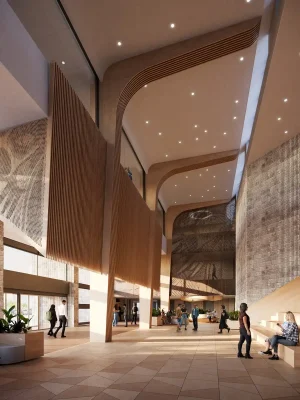
Image courtesy of Diamond Schmitt
April 4, 2024
Toronto Metropolitan University’s School of Medicine Building, Ontario
Diamond Schmitt has been selected as the primary consultant to design and plan Toronto Metropolitan University’s (TMU) new School of Medicine. Located in Brampton, the School of Medicine will transform the former Bramalea Civic Centre into a state-of-the-art medical school that will be home to aspiring medical students and a primary care clinic.
To complement the School of Medicine’s design goals of belonging, community and connection to nature, Indigenous design elements will be integrated into the plan. Diamond Schmitt has engaged Two Row Architect, an Indigenous-owned design firm, to consult on the project.
“Equity, diversity and inclusion and Reconciliation will be intentionally infused throughout all facets of the School of Medicine, including its physical environment,” says President and Vice-Chancellor Mohamed Lachemi. “This is the first-ever university building project to integrate TMU’s Indigenous Design Guidelines – developed in consultation with Indigenous community members – in the design process.”
The school will feature functional, flexible and collaborative active learning classrooms, lab and study spaces that will support various modes of pedagogy. A four-storey interconnected atrium at the primary west entrance will welcome students, staff and visitors into a vibrant, inclusive and safe environment where they can interact and engage with one another.
The library will provide quiet individual and group study spaces, and additional learning opportunities outside the classroom. Case-based learning teaching labs, simulation and digital anatomy labs will further bolster TMU’s experiential learning approach for its medical learners.
Other amenities include event, gallery and maker spaces established as central hubs for student activities, and a communal kitchen with a student-run internal herb garden that contributes to well-being. The north wing of the building will house the academic research and administrative offices for faculty and staff, and the south wing of the building is designed as a hub for teaching and learning, anchored by the community clinic on the ground floor that will add much-needed healthcare capacity for the Brampton community.
“The School of Medicine will serve the Brampton and Peel communities with its many diverse groups of people. We are committed to building a space that provides equitable access, safe and inclusive places to gather, and opportunities to learn and engage with the landscape and each other,” says Dr. Teresa Chan, Dean of the School of Medicine and Vice-President, Medical Affairs. “We look forward to working with Diamond Schmitt to bring our vision to life.”
In alignment with TMU’s long-standing commitment to sustainability, the project is designed to LEED standards, repurposing an existing building to reduce the construction footprint and minimize energy and greenhouse gas emissions, with the integration of on-site renewable energy sources.
“The design of TMU’s School of Medicine embraces the brutalist architecture of the original civic building, while opening it up to become a welcoming and inclusive space for medical education,” says Cecily Eckhardt, principal at Diamond Schmitt. “Designed to support the next generation of healthcare professionals, with many lab spaces to conduct simulation-based training and flexible work areas to encourage cross-disciplinary collaboration, the School of Medicine will not only build community amongst students and faculty, but be a truly integrated health centre, providing access to quality medical care to the community of Peel Region through clinical support programs.”
The School of Medicine is set to open in September 2025. This development is led by the Project Management Office within TMU’s Facilities Management and Development department, in collaboration with the School of Medicine leadership team.
Diamond Schmitt
Diamond Schmitt is a global architecture firm that designs transformative and highly sustainable buildings. Delivering innovative architecture that empowers people, communities, and organizations to harness change for the greater public good, Diamond Schmitt employs a collaborative research process focused on exceptional performance and meticulous craftsmanship.
With offices in Toronto, Vancouver, and New York, the firm has designed industry-leading spaces for research and education, including the University of British Columbia’s BioSciences Complex and the Peter Gilgan Centre for Research and Learning at the Hospital for Sick Children—known for their excellent laboratories, versatile planning, and striking design. On-going projects include the Scarborough Academy of Medicine and Integrated Health at the University of Toronto Scarborough Campus, the Temerty Faculty of Medicine’s new James and Louise Temerty Building at the University of Toronto, and the Clinical Support and Research Centre at St. Paul’s Hospital in Vancouver.
Notable civic projects include Lincoln Center’s new David Geffen Hall in New York, the Senate of Canada Building and the National Arts Centre in Ottawa, along with current work on the Art Gallery of Ontario’s new Dani Reiss Modern and Contemporary Gallery and the New Brunswick Museum.
Diamond Schmitt Architects
Render courtesy of Diamond Schmitt
Metropolitan University School of Medicine Building, Toronto, Ontario images / information received 040424
Architects: Diamond Schmitt – https://dsai.ca/
Location: Toronto, Ontario, Canada, North America.
Toronto University Building Designs
Contemporary Toronto Buildings
Contemporary Toronto University Buildings – selection from e-architect:
Scarborough Academy of Medicine and Integrated Health, Markham, Regional Municipality of York, Southern Ontario, Canada – 30 km northeast of Downtown
Design: Diamond Schmitt and MVRDV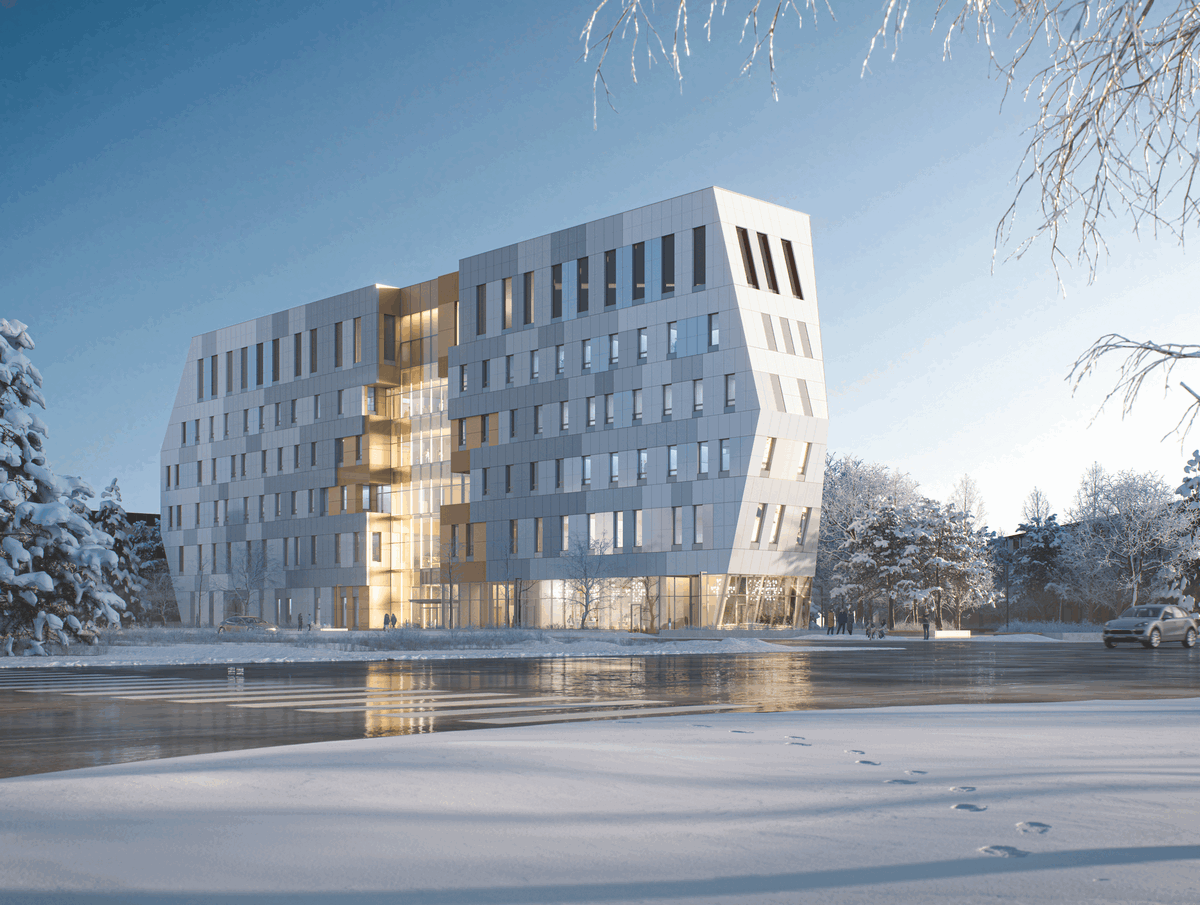
renders : Diamond Schmitt Architects and MVRDV
Scarborough Academy of Medicine and Integrated Health
Renewal and Expansion of the University of Toronto’s Innis College
Architects: Montgomery Sisam Architects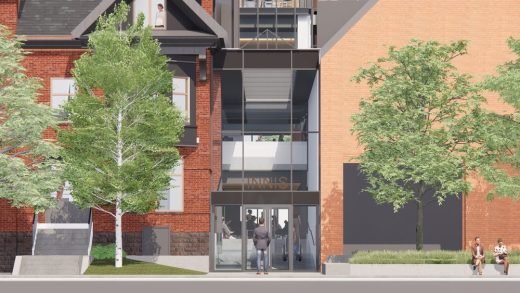
image : Montgomery Sisam Architects
The University of Torontos Innis College
Toronto Architecture
Toronto Architectural Designs – chronological list
Ontario Architecture News on e-architect
New Ontario Properties – recent selection from e-architect:
Design: dkstudio architects inc.
Mila Sales Centre Scarborough
SMYTHE, Summerhill district, north Toronto
Design: Ashley Botten Design and Tommy Smythe
SMYTHE flagship Store
Toronto Architecture
Comments / photos for the Toronto Metropolitan University School of Medicine Building design by Diamond Schmitt Architects Office page welcome.
