RIBA House of the Year 2025 shortlist news, Best British homes designs photos, Good UK residential properties
22 November 2025
Remote self-build home and a Hastings house extension shortlisted for RIBA House of the Year 2025
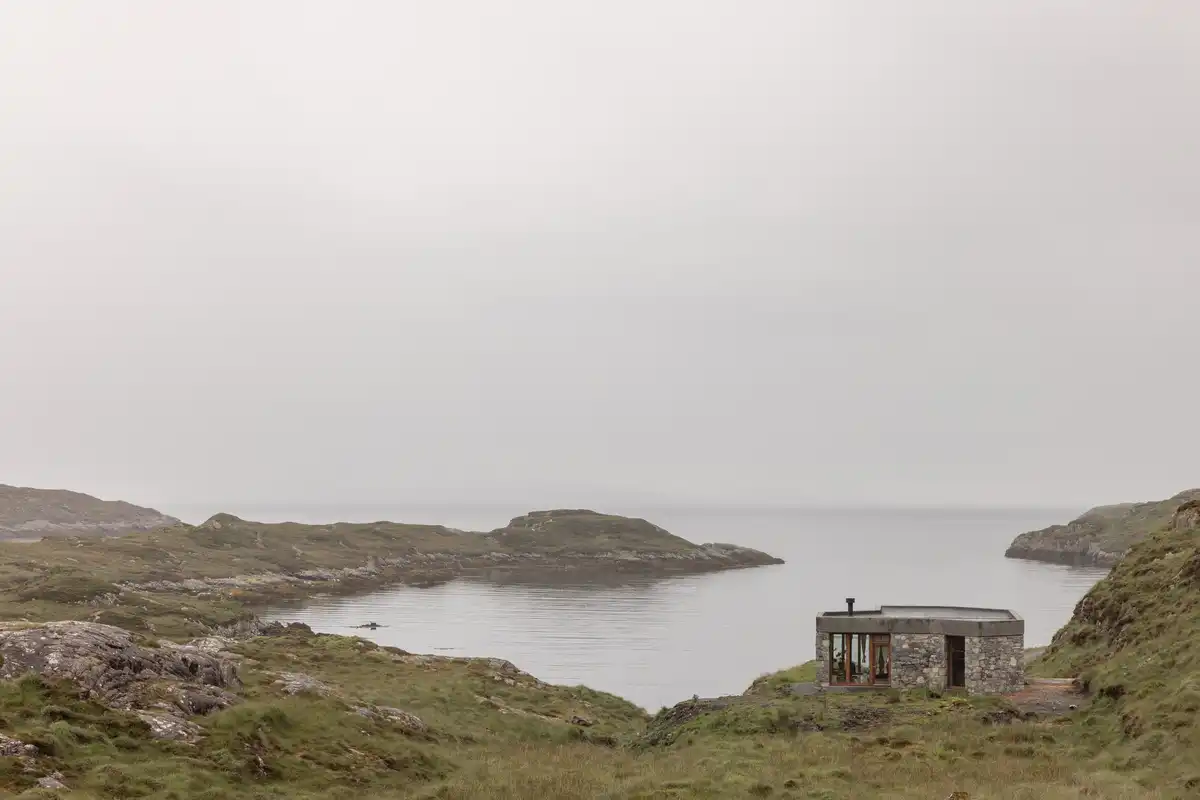
Caochan na Creige – a timber-frame, stone clad, self-build home in the Outer Hebrides, and Hastings House – an inventive house extension stitched into the Hastings hillside, are the first of two homes to be shortlisted for RIBA House of the Year 2025 (sponsored by Renson). The annual award is awarded for the UK’s best new home, with the shortlisted houses revealed on Grand Designs: House of the Year, Wednesdays at 8pm on Channel 4.
Caochan na Creige © Richard Gaston (left) and Hastings House © Rory Gaylor (right).
RIBA House of the Year 2025 Shortlisted Designs News
The shortlist for the RIBA House of the Year 2025 is:
• Caochan na Creige by Izat Arundell
• Hastings House by Hugh Strange Architects
• To be announced on 26 November 2025
• To be announced on 4 December 2025
• To be announced on 4 December 2025
• To be announced on 10 December 2025
The next episode of Grand Designs: House of the Year airs on Wednesday 26 November at 8pm on Channel 4.
The RIBA House of the Year award was established in 2013 and is awarded to the best new house or house extension designed by an architect in the UK.
Previous winners include Six Columns by 31/44 Architects, Green House by Hayhurst & Co (2023), David Kohn Architects for The Red House (2022), Alison Brooks Architects for House on the Hill (2021), McGonigle McGrath for House Lessans (2019), HaysomWard Miller for Lochside House (2018), Richard Murphy Architects for Murphy House (2016), Skene Catling de la Peña for Flint House (2015) and Loyn & Co for Stormy Castle (2014).
The RIBA Awards have been running since 1966 and are judged and presented locally. No matter the shape, size, budget or location, RIBA Award winning schemes set the standard for great architecture all across the country. RIBA Awards are for buildings in the UK by RIBA Chartered Architects and RIBA International Fellows.
+++
These shortlisted houses in more detail:
Bury Gate Farm by Sandy Rendel Architects
photos © Ståle Eriksen
Jury citation:
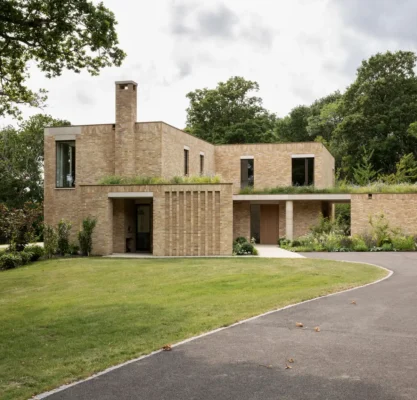
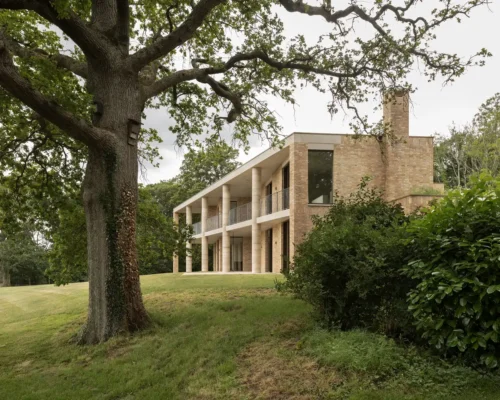
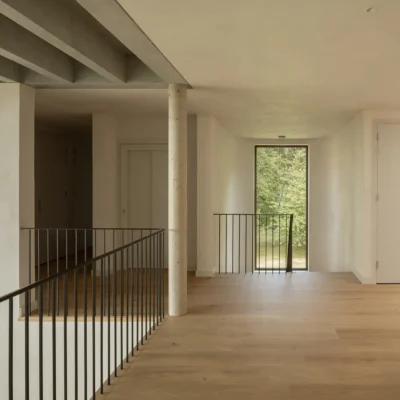
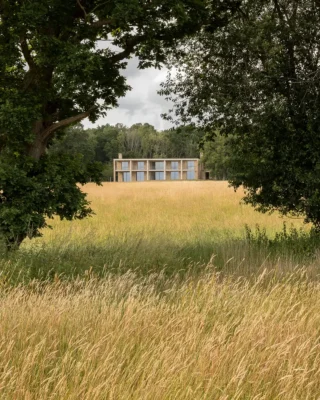
Bury Gate has been a worthwhile, if challenging, labour of love. Planning approval for a large traditional house on the rural Sussex site had been obtained prior to the architects being commissioned. They instead set about convincing the officer tasked with protecting the character and appearance of the South Downs National Park of the advantages that a ‘modern’ design, of roughly the same volume, could offer.
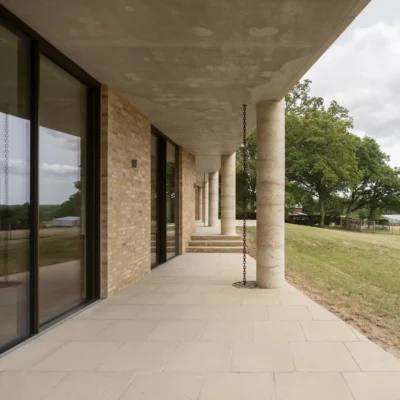
The detailing and execution are near faultless. But what is truly exceptional about Bury Gate is its calm, gentle and yet solid presence in the landscape of rolling fields, woodland and tree-lined ditches. Its fragmented plan articulation is very skilfully handled, so that despite its large footprint and, at points, considerable volume, it feels rooted in the place, and its presence has an unexpected modesty, seriousness and constancy. The landscaping and planting, where undertaken, are also of a high quality.
Minimising carbon emissions was central to the client’s aims, and for a house of this size, its sustainability credentials are solid. The house is well-insulated and airtight, heated by two air-source heat pumps, fitted with mechanical ventilation with heat recovery (MVHR) and supporting a massive 15.87kWp photovoltaic rooftop array which could feasibly provide 75% of the annual energy demand. Demolition waste from a long-derelict 1950s bungalow on the site was crushed and reused for the base, and sandstone and blockwork were sourced locally to minimise the carbon generated from transportation. The house is also highly accessible and inclusive, fitted with a lift and provided with annexe accommodation that could become home to a teenager or carer.
Conscious of the high embodied carbon involved in traditional cement, the architects and client wanted to achieve the highest permissible level of cement replacement, notably in the floor slabs. Structural testing in relation to this left works at a hiatus for a time. Undeterred, the client, who has a construction background, chose to undertake the remaining works on a self-build basis, employing specialist subcontractors. The cement content of the build was reduced without loss of thermal mass, and the five-bedroom house was completed almost six years after planning approval was granted.
This is one of those rare projects that has such an easy presence that it transcends questions of why or how it came to be. It now stands as a permanent testament to both the architects’ and clients’ aspirations and skills.
Caochan na Creige by Izat Arundell
photos © Richard Gaston
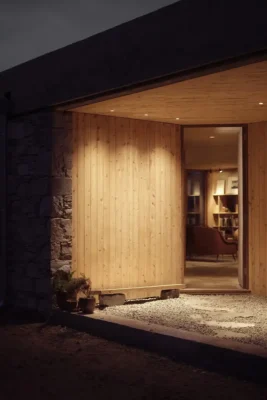
photo © Jack Arundell
Jury citation:
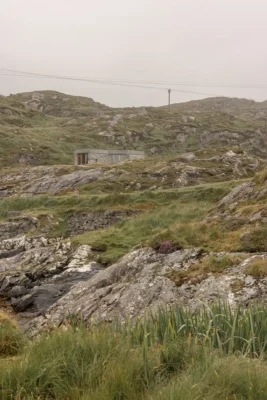
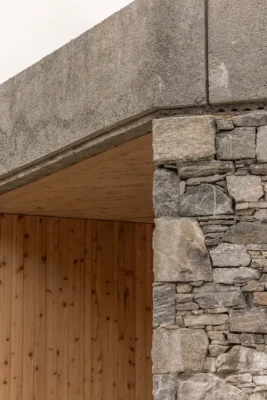
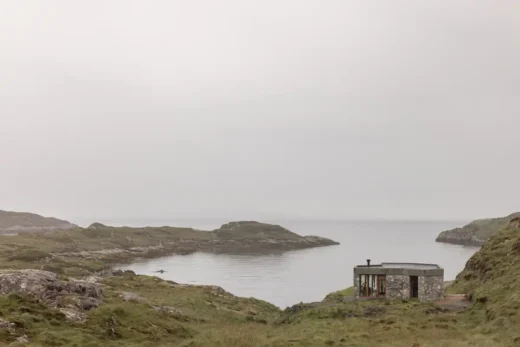
This self-built home in the Outer Hebrides is an exceptional project by young practice Izat Arundell (Eilidh Izat and Jack Arundell). Designed and hand-built by the architect-founders themselves, it stands as a rare example of deep-rooted, site-responsive design, conceived with care and executed with remarkable craft and restraint.
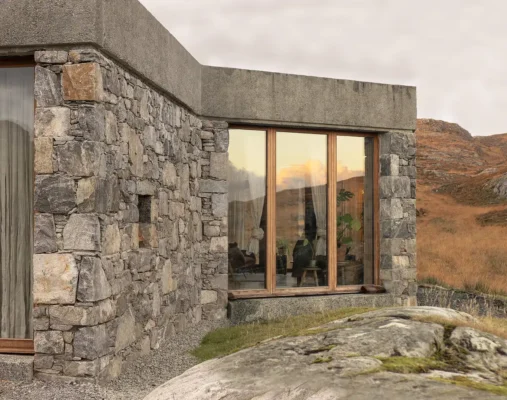
The building blends effortlessly into the rugged Hebridean landscape, with a material palette that honours the ancient Lewisian gneiss rock surrounding it. Initially conceived as a concrete structure, budget constraints led to a creative redesign: the final timber-framed house is clad in full-thickness local stone, giving the home the appearance of a modern-day blackhouse, nestled in the terrain. An exposed concrete ring beam, washed to reveal the stone aggregate, echoes the original concept and adds a contemporary contrast to the handcrafted exterior.
Inside, the house is compact but feels generous. Its 85m2 plan is shaped around the natural contours of the land, with a 135-degree geometry guiding the layout. The interior materiality is restrained but richly textured: warm-toned lime plaster walls, polished concrete floors embedded with local aggregate, Scottish larch ceilings and finely crafted beech joinery. Artworks collected by the couple over the years are positioned in carefully planned locations, designed into the architecture itself.
Every room has a distinct character and a strong relationship to the wider context – whether through the living room’s expansive glazing to the glen and sea, the bedroom’s seasonal light alignment, or the angled kitchen that maintains privacy while encouraging neighbourhood connection.
The construction process itself fostered strong community ties, with local stonemasons and craftspeople contributing to its realisation. Executed on a very modest budget, this quietly poetic building is a testament to what can be achieved through patience, skill and profound respect for place. It is a richly personal and beautifully crafted work that shows the strength of emerging architectural voices.
Clayworth by ArkleBoyce Architects Ltd
photos © Jim Stephenson
Jury citation:
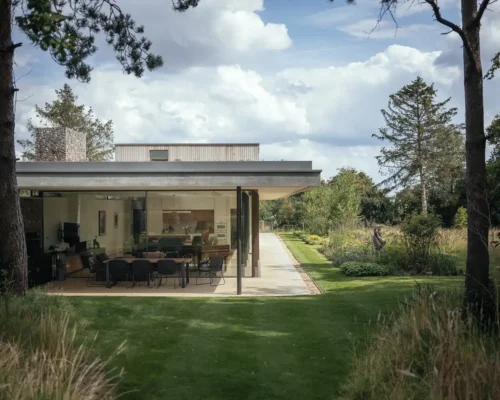
The couple who commissioned the architects to design this fully accessible modern home for them describe the project as ‘transformational’. The client had found it increasingly challenging, becoming almost impossible, to look after his disabled wife in their old home. During the jury visit he was keen to extol the virtues of writing down a clear brief. This has served them very well, as they seem to have achieved everything they aspired to – living comfortably, albeit with a carer on site but independently located.
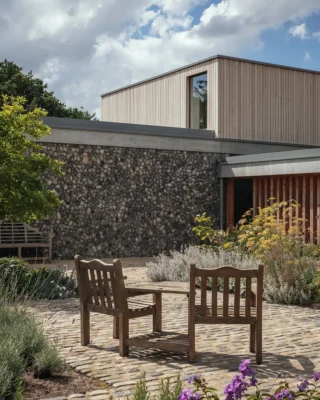
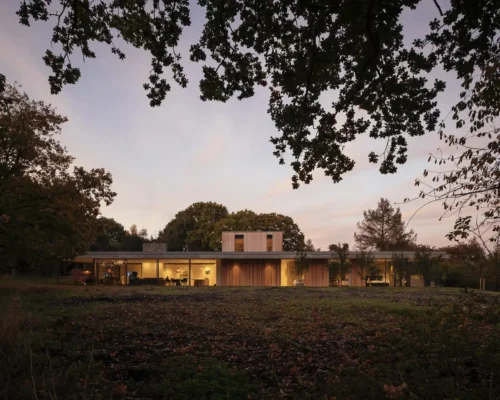
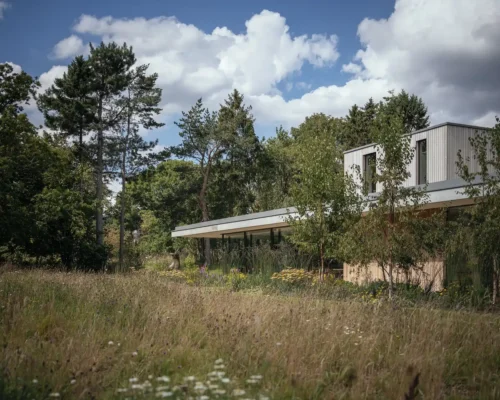
The house sits down low, virtually invisible from the entrance until you venture down the drive. It uses the site of the previous 1970s cottage. The landscaping around the drive is informal.
None of the house is revealed by the flint-clad wall on the drive. Punctuated by a prominent chimney, it lines one side of the entrance yard, and at right angles from the front door there is a large porte cochere. This space provides an elegant screen to a courtyard garden and is linked to the carer’s accommodation.
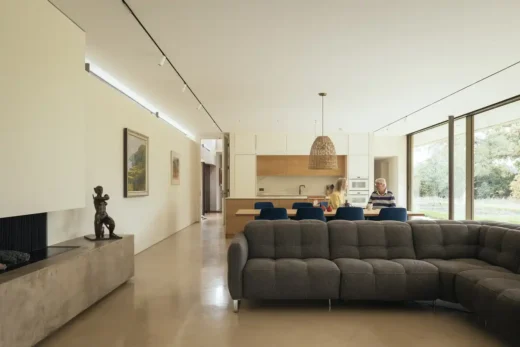
Everything from this point on is about comfortably handling a disability. Getting out of the car is sheltered, and the entrance hall provides a singular linear route off which the open-plan living space, bedrooms and bathrooms are all easily accessible and enjoy garden views. The kitchen-dining-living room is a generous and sophisticated space surrounded by floor-to-ceiling glass, well shaded by a simple monolithic overhang. Electric solar blinds for all windows are hidden in the ceiling.
There are three large sliding panels which allow the space to open up to an outside barbecue area and walkway that doubles as an exercise path for the client’s disabled wife. At the other end of the house is a glamorous bedroom with a similar glass enclosure to the garden. The bedroom is spacious enough to have guests visit the bedside when wished, and the bathroom is large and joyfully clad in large-chip terrazzo. Nothing about these rooms reduces quality in the effort to ensure accessibility.
The ambition is stylish living, and this is elegantly delivered throughout the house. The only space not fully accessible is the client’s private first-floor study – an eyrie overlooking the garden and the sedum roof areas, a space for stepping away from the flow of daily life, a retreat.
A good-sized gym for medical exercise, a shower/changing room, utility rooms and a grown-up ‘play room’ complete with an impressive wine storage wall extend the space in a more deliberately utilitarian basement suite of rooms – all accessible by lift.
The house opens completely to the garden along the south-west. The linear form is reflected in thoughtful landscaping and meadow planting. This is a house totally at peace in its setting, delivering generous, flexible and accessible space to a family who wanted something special – and, working collaboratively with their architects, they got exactly what they wanted.
Haringey Brick Bungalow by Satish Jassal Architects
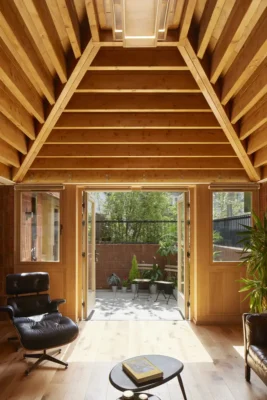
photos : Richard Chivers
Jury citation:
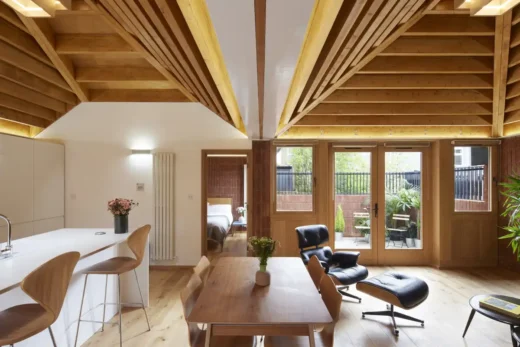
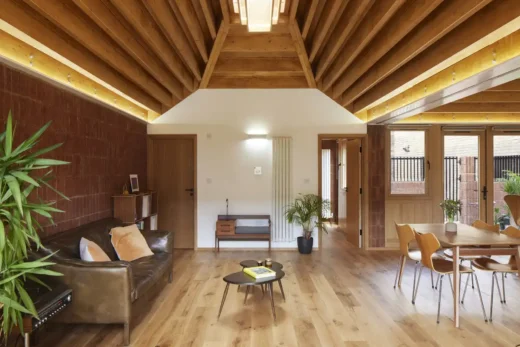
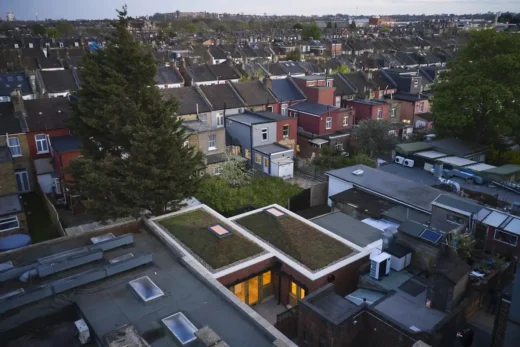
This bungalow demonstrates what is possible on a seemingly inopportune and overlooked backland site for a client without any previous development experience and only a modest budget. Conceived pre-COVID-19 as the clients’ own home, it has been built in a constrained yard behind their butcher’s shop.
Accessed, and constructed, through a narrow pedestrian passage, the layout of this single-storey dwelling fills the site with two offset volumes under asymmetrical, pyramidal roofs. This arrangement creates two diametrically located courtyards – an entrance courtyard to the front and a private courtyard to the rear. These buffer the interior from its immediately adjacent commercial neighbours and bring in light throughout the day. Rooflights on both apexes provide further light while maintaining privacy.
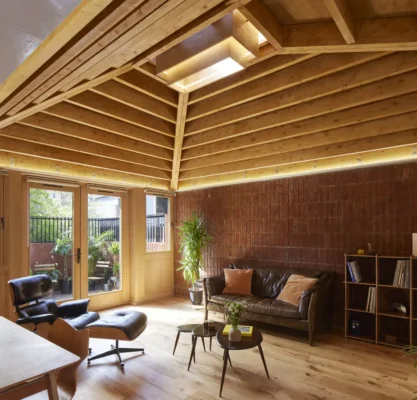
Internally, a single central living area is defined by two glulam (glue-laminated timber) coffered ceilings that bring an unexpected generosity to what is a minimum-area two-bedroom, three-person home. The valley between the two roof forms gives an implied boundary between kitchen/dining and living areas. Two bedrooms, one with en-suite shower room, and a bathroom are directly accessed off the central space and benefit from views into the courtyards. The arrangement avoids the loss of any precious area to corridors.
The building abuts its neighbours and sits on low-impact steel screw piles. A superstructure comprising a simple palette of materials combining load-bearing brick, certified sustainable structural timber and oak joinery give it a robust yet warm materiality. The detailing of these simple construction elements, whose use was necessitated by the restricted access, has been thoughtfully considered.
Good levels of natural light and cross ventilation combine with a well-insulated and airtight building fabric. An air-source heat pump is the final component in making this a low-carbon bungalow. The sedum roof adds biodiversity and attenuates rainwater discharge from the site.
The jury not only felt that this project, through project architect Satish Jassal’s ambition to elevate the scheme beyond a more prosaic response to such sites, delivers a delightful home, but also that it serves as an exemplar of what can be achieved on these types of constrained sites that sit behind many of London’s high streets.
Hastings House by Hugh Strange Architects
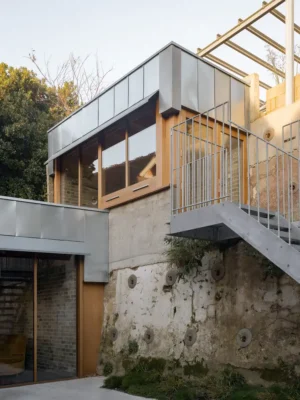
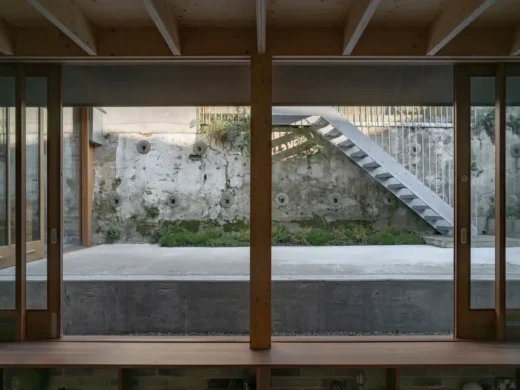
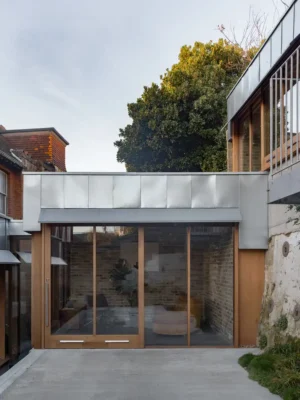
photos : Rory Gaylor
Jury citation:
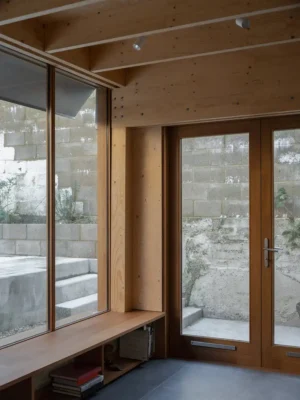
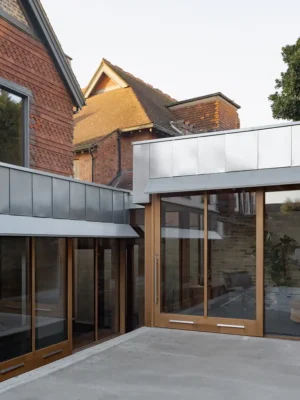
The eccentric late 19th-century Hastings House perches on a west-facing slope just above the town centre, sandwiched between the street and a secondary rear access road. Hugh Strange Architects embraced the awkward three-storey level change across the site to turn an otherwise mundane domestic refurbishment project into a game of concrete structural repair and new interlocking timber-framed rooms.
The detached house is barely altered and beautifully refurbished, retaining fine mouldings, stained glass, fretted barge boards and decorative hung clay tiles. At ground-floor level, however, the openings in its rear wall – which previously accessed a gloomy full-width lean-to extension – are adjusted, with no loss of solidity, to form a threshold into a new world of cellular spaces that ascend the rear terraced garden.
Wide timber-framed sliding glass doors, which enclose the new rooms, open onto a repaired but still rough concrete yard that has the promise of becoming the most important room in the house. A galvanised steel staircase skirts the patched retaining wall to its rear, to reach a shelf-like pathway where a cherry laurel clings to its edge, and unpretentious concrete blockwork walls form planted beds. A pergola of bolted galvanised steel sections tops off the pile of architecture at the upper road level.
The complex articulation of the new structures, with their finely detailed joinery (both fabric and fitted) set against the found vertical garden of roughly cast concrete and basic blockwork, strikes a very poetic chord. It is both charming and intriguing, and clearly very liveable – despite the perhaps disconcerting absence of furniture in the plans and photographs.
The client is now so fluent in the language of relaxed repair and carefully crafted interventions that, since occupation, he has undertaken his own self-design-and-build kitchen-garden project on the front garden terrace, where his produce can soak up the afternoon sunshine.
Two-Family House by Rundell Associates
photos © John Hersey
Jury citation:
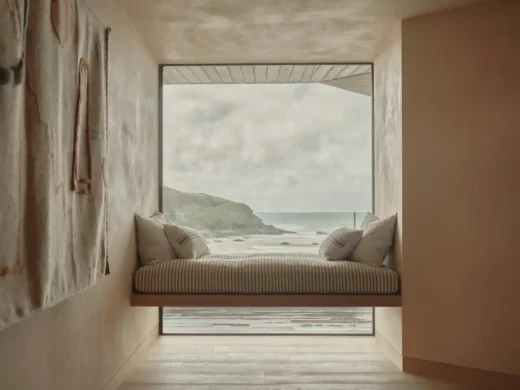
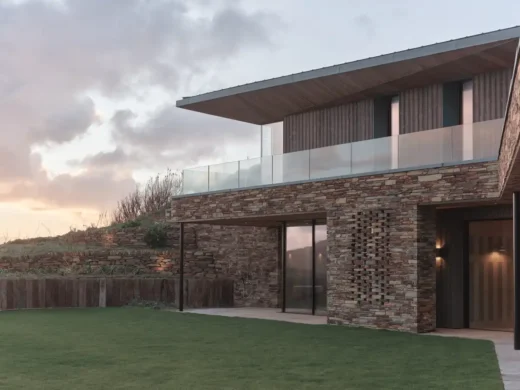
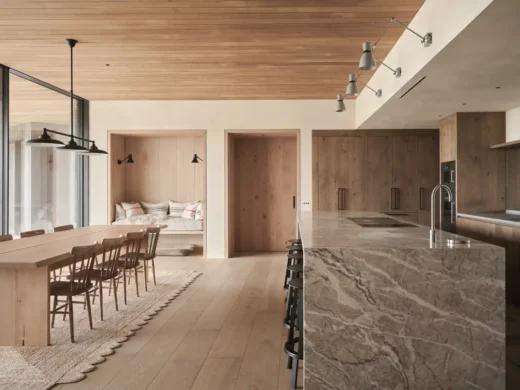
The design of this genuine two-family home from home in Mawgan Porth, Cornwall demonstrates an intimate understanding of its highly sensitive site and coastal environment. This is perhaps unexpected for an area that has been popularly dubbed ‘Hollywood on Sea’, where properties more often seek attention and prominence. The overall volume has been sensitively positioned on the site. When viewed from the adjacent coastal path and other nearby areas, its visual impact has been minimised. Set into the cliffside, it has a palette of naturally raw materials and a planted roof.
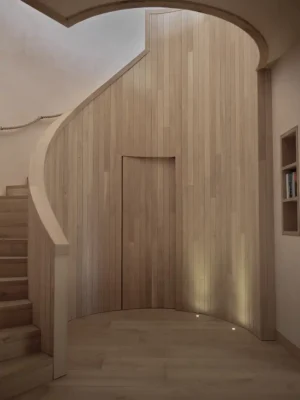
Externally the mass of the building has successfully been broken down through its articulation. The architects achieved this through a lower storey of grey and brown local Cornish stonework and an upper level predominantly of timber and glass, with a copper cantilevered roof. Internally the finely executed and orchestrated stone, timber and plaster finishes create subtle transitions between spaces, punctuated with clear thresholds between rooms and the pivotal central hub, which houses the main stair.
The plan provides a dramatic entry, with both free-flowing communal spaces for relaxing, eating and entertaining, as well as a series of wings and back-of-house spaces that provide high-quality accommodation for the owners and guests.
The framing and orientation of key views from the building have been meticulously planned. Almost devoid of signs of human habitation, they ensure privacy and also provide a uniquely personal experience of the landscape. Leading down to the beach below, the tiered landscaping of stone walls and paths established by the previous owner over many years was retained, carefully preserved throughout the construction work.
The structural choices are well thought through and sustainable, including a cross-laminated timber (CLT) frame. The wood joinery, which often provides playful nooks and recesses, is effective and well executed.
The house has very good environmental technologies including ground-source heat pumps and roof-mounted photovoltaics. Simple but with beautiful detailing, materially stunning, cleverly planned and masterfully disguised within its context, this is a technically impressive building, not just in construction resolution but also in project management.
RIBA House of the Year 2025 Longlist images / information from Royal Institute of British Architects
Location: UK
+++
Previously on e-architect:
RIBA House of the Year Awards
RIBA House of the Year 2022 Winners
RIBA House of the Year 2021 Winner
RIBA House of the Year 2021 Shortlist
RIBA House of the Year 2021 Longlist
RIBA Manser Medal
RIBA House of the Year
++
RIBA Awards
Stirling Prize
RIBA Awards
RIBA Special Awards
RIBA Royal Gold Medal
Architecture Studios
Comments / photos for the RIBA House of the Year 2022 Longlist – best new British home designs page welcome.