Julia West House Downtown Portland, Oregon supportive housing design, Modern US BIPOC property photos
December 4, 2025
Architects: Holst Architecture
Location: Downtown Portland, Oregon, USA
Photos © Christian Columbres, Courtesy of Holst Architecture
Julia West House Portland – Tallest Mass-Timber Building in Oregon
Julia West House, a permanent supportive housing development for houseless elders and BIPOC individuals in downtown Portland, opens as Oregon’s tallest mass-timber building
• The 12-story structure, developed by Community Development Partners and designed by Holst Architecture, offers a new paradigm for affordable housing with a focus on resident well-being and programmatic support
• The innovative high-rise merges sustainable, biophilic living with trauma-informed design, bringing natural materials, natural light, and art to a development serving our most vulnerable community members


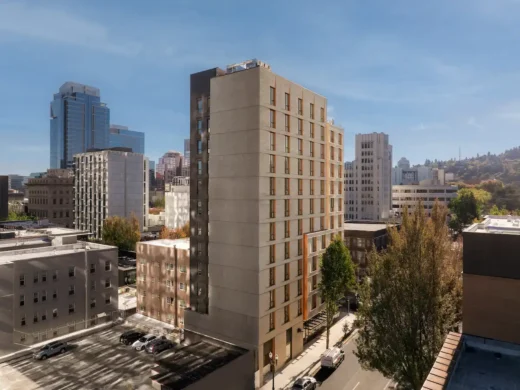
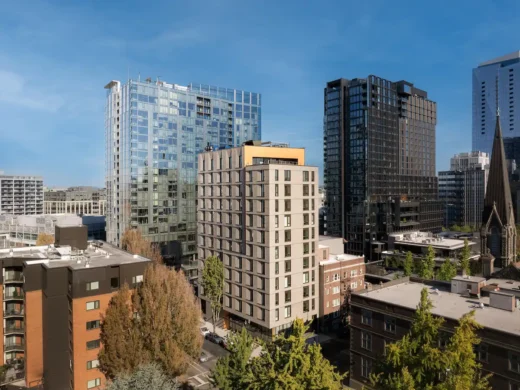
Portland, OR, December 2, 2025 – Today, joined by community leaders and partners, Julia West House celebrated opening as a new home for residents in need of affordable, permanent supportive housing in Downtown Portland. What was once an underutilized 5,000-square-foot lot is now a twelve-story mass-timber building that introduces a new paradigm for quality affordable housing close to healthcare services, amenities, and public transportation. At 145 feet tall (44.19 meters), Julia West House also takes the honor of becoming Oregon’s tallest mass-timber building.
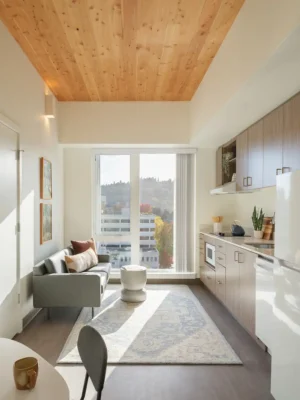
Recent data shows that nearly a quarter of Portland’s houseless population is aged 55 and older, with BIPOC individuals overrepresented in this crisis. Responding to local needs, the 56,000-square-foot (5,203 square meters) building houses 90 fully furnished apartments—60 studios and 30 one-bedrooms—for individuals earning 30% or less of the area median income (defined as $26,070 in 2025 for a one-person household). With abundant natural light, biophilic elements, and integrated supportive services, the community provides a restorative environment for houseless elders, of whom 45% identify as BIPOC individuals.
Residents started moving in in early October and the building is now over 65% occupied. This milestone marks the culmination of an effort initiated by the First Presbyterian Church of Portland (FPC). The church, which acquired the property in the 1980s and used it for a variety of community programs, sold the site to Community Development Partners (CDP) in 2024 following their proposal to create affordable housing, carrying forward FPC’s mission of service. The original structure—a single-family house named in memory of Julia West Lindsley, the wife of the church’s first pastor, was demolished to make way for the new building.
Developed by California- and Oregon-based Community Development Partners, designed by Holst Architecture, structurally engineered by KPFF, and built by Walsh Construction Co., the project broke ground in February 2024. The team cites its early consideration of mass timber as one key driver of the project’s success, setting them on a path toward completing one of the first examples of type IV-B construction in Oregon. The building will be National Green Building Standard and Energy Star certified, ensuring long-term environmental benefits while reducing operating costs.
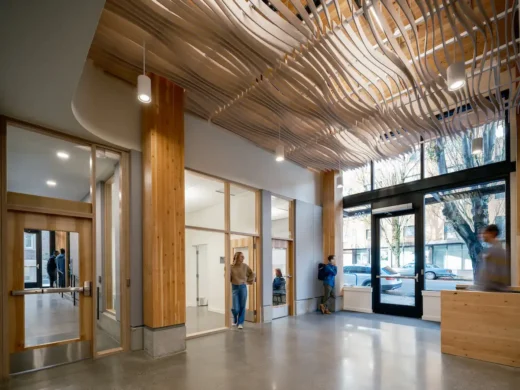
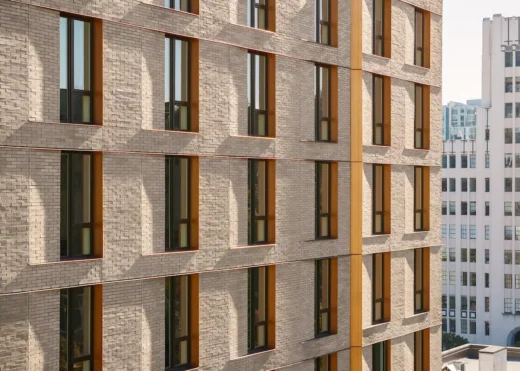
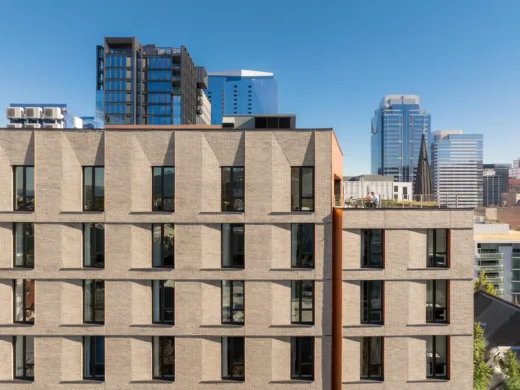
Design highlights like exposed wood ceilings and glulam columns and beams, visible from the exterior through large windows, are key elements of a warm material palette inspired by local ecology of the Pacific Northwest. Communal spaces are expressed on the façade of the building as large carve-outs in its massing. Much like the historic communities who remained connected through traveling the ancient waterways of the Columbia River, these spaces are connected through a single, basalt-like fissure that travels between them and adds a subtle articulation to the façade.
Programmatically, Julia West House interweaves affordable housing with comprehensive supportive services provided by local organizations Northwest Pilot Project (NWPP) and Native American Rehabilitation Association of the Northwest (NARA NW), along with resident services facilitated by Community for Positive Aging (CfPA) and Lift Urban Portland. These organizations are collaborating with Multnomah County Homeless Services Department’s coordinated access system to identify and transition residents into the building.
Service providers for Julia West House will provide a host of wraparound services focusing on housing stability, community building, and aging in place. These services include case management targeting social determinants of health in seniors, combating isolation and improving access to benefits that support long-term housing stability. For the 20 households served by NARA NW, services will focus on recovery programs rooted in traditional Native American culture and spirituality.
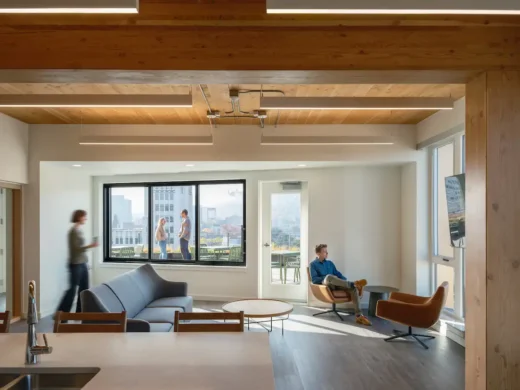
Residents also have access to a community room, lounge area, communal kitchen, rooftop patio, laundry facilities and secure bike parking. Offices for property management, resident services and case management are located on-site.
The project was made possible through a combination of public and private funding sources, including a 4% Low-Income Housing Tax Credit (LIHTC) allocation, USDA Wood Innovations funding, a Portland Clean Energy Community Benefits Fund (PCEF) grant awarded by PHB, rental assistance from OHCS and supportive service funding from OHCS and HSD. Additionally, services are partially funded through the voter-passed Supportive Housing Services measure.
For more information about Julia West House, visit CDP’s website or read a recent case study, “Small footprint, big impact: 12 stories of mass timber affordable housing,” published by WoodWorks.

Julia West House, Downtown Portland, OR, USA – Building Information
Project Details:
Location: West End, Downtown Portland
Address: 580 SW 13th Avenue, Portland, OR 97205 U.S.
Size: Site – 5,000 square feet (465 square meters)
Building – 56,000 square feet (5,202 square meters)
Program: Housing
Construction Type: IV-B (mass timber with steel braced frames)
Sustainability: National Green Building Standard; Energy Star Certified
Project Dates: Design – 2019; Construction – 2024-2025; Opening – October 2025
Project Team:
Owner/Developer: Community Development Partners
Architect: Holst Architecture
General Contractor: Walsh Construction Co.
Owner’s Representative: Shiels Obletz Johnsen
Structural Engineer: KPFF
MEP Engineer: PAE
Civil Engineer: Vega Civil Engineering
Landscape Architect: Understory Landscape Architecture
CLT Manufacturer: Kalesnikoff
Mass Timber Installation: Carpentry Plus Inc.
Connectors: Simpson Strong-Tie
Acoustical Engineering Consultant: Veneklasen Associates
Case Management: Northwest Pilot Project (NWPP) and the Native American Rehabilitation Association (NARA)
Resident Services: Community for Positive Aging (CfPA), Lift Urban Portland
Service Collaborators: Multnomah County’s Homeless Services Department (HSD)
Property Management: Guardian Management
Equity Investor: Aegon
Construction Lender: Bank of America
Permanent Financing: Citibank
+++
About the Project Team:
Community Development Partners
Founded in 2011, Community Development Partners develops and operates sustainable, life- enhancing affordable housing with a focus on long term community engagement and innovative design. As a mission-driven, forwardthinking organization, CDP is focused exclusively on creating vibrant affordable housing communities that incorporate art, public parks, gardens, fresh food, and cultural and social programming. Today, CDP has built, preserved or is actively developing over 55 unique projects comprising 4,800+ affordable homes throughout Oregon, California, Nevada, Arizona and Colorado. It is a certified B Corporation.
Holst Architecture
Holst is a comprehensive design firm with studios in Portland, OR and Minneapolis, MN. As a certified women-owned B Corp practice, we’re committed to both design excellence and positive social impact. Our team of over 50 professionals, led by owners Kim Wilson, Renée Strand, Dave Otte, and Kevin Valk, is driven by a single mission: creating meaningful architecture that people love.
KPFF
KPFF is a creative and collaborative team of engineers who have designed innovative solutions for projects of all scales by providing cost-efficient and valuable contributions to the built environment. Founded in the Northwest in 1960, their extensive design experience encompasses all building types, including the development of low-impact public housing and other residential projects.

PAE
Founded in 1967, PAE is a leading sustainable engineering and consulting firm on a mission to deliver clean air, energy, and water for all. Specializing in mechanical, electrical, and plumbing engineering services, PAE designs some of the nation’s highest-performing and most regenerative built environments across the U.S., from living buildings to all-electric buildings and beyond.
Carpentry Plus Inc.
Carpentry Plus Inc. (CPI) is a family-owned leader in mass timber construction with more than 30 years of experience. Since 1993, CPI has delivered 80+ projects totaling over 2.1 million square feet across the Pacific Northwest and beyond. Operating as a turnkey partner, CPI provides design-assist, modeling, procurement, and installation services that deliver predictable results for owners, architects, and builders. CPI is also the creator of Timber Core™, the industry’s first modular mass timber stair-core system, helping teams build faster, safer, and greener. Guided by integrity, safety, and collaboration, CPI sets the standard for excellence in mass timber construction.
Walsh Construction
Founded in 1961, Walsh Construction Co. (Walsh) is a Pacific Northwest leader in multifamily construction, as well as commercial, healthcare, retail, education, and hospitality projects. We are a company of builders with tested experience implementing a variety of building types, including wood-framed, mass timber, concrete, steel, and masonry. Our teams work collaboratively with owners and design teams to meet project goals around cost efficiency, building performance, and sustainability. Walsh has earned a solid reputation for our commitment to the community, paired with an industry-leading quality control program, and a detailed knowledge of sustainable construction.
Portland Housing Bureau
Guided by a vision that all Portlanders should have equitable access to affordable housing and to the opportunities that a safe, stable home can deliver, the Portland Housing Bureau leads housing policy for the City of Portland and administrates programs to produce affordable rental housing, expand homeownership and stabilize homeowners, and regulate and assist tenants and landlords in the rental housing market. The Portland Housing Bureau is one of several bureaus and programs in the Community and Economic Development service area. This service area aligns City programs focused on building prosperity for all Portlanders. We aim to create and deliver efficient, transparent, and equitable solutions for a resilient built environment – as well as services, resources, and experiences for our community.
Metro
Metro is working to create new affordable housing and to reduce homelessness through services that support housing access and stability. It does this through the oversight of two measures: In 2018, voters in greater Portland approved the affordable housing bond to generate $652.8 million to create homes for approximately 12,000 people, and in May 2020, voters approved a supportive housing services fund to expand services for people experiencing or at risk of homelessness. Metro collaborates with local cities and counties to implement these local solutions to address a homelessness crisis affecting all communities across greater Portland.
Multnomah County Homeless Services Department
The Multnomah County Homeless Services Department oversees the delivery of services for people experiencing and at risk of homelessness in Multnomah County.
That includes rehousing, shelter, street outreach and recovery services. The department works with community-based organizations and other government entities to provide participant-driven, coordinated and equity-based services. The department also monitors funds issued by the U.S. Department of Housing and Urban Development’s Continuum of Care program, manages systems of care, and oversees system reporting and evaluation.
First Presbyterian Church of Portland
Located in the heart of downtown, First Presbyterian Church of Portland is one of the region’s oldest and largest congregations. Its active, multi-generational community welcomes all with open arms. Worshiping in a historic sanctuary completed in 1890, the church is dedicated to living out its vision: being engaged, inclusive, compassionate, and faithful.
Photos © Christian Columbres, Courtesy of Holst Architecture
Julia West House Downtown Portland, Oregon, USA information / images received 041225
Location: Downtown Portland, Oregon, USA
Oregon Architecture Designs
Oregon Architecture
Oregon Architectural Designs
Tetherow Overlook House, Bend, Central Oregon
Architects: Hacker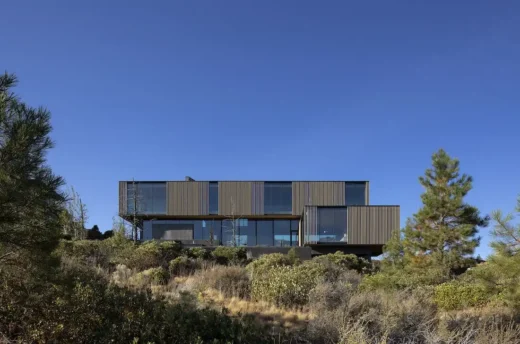
photo : Jeremy Bittermann
Oregon State Supreme Court Rehabilitation, Salem
Architecture: Hennebery Eddy Architects
photo : Josh Partee
Cascades Academy, Bend, Central Oregon, USA
Architecture: Hennebery Eddy Architects
photo : Josh Partee
Furioso Vineyards, Dundee
The Lodge at Black Butte Ranch, Sisters
++
US Architecture
America Architectural Designs – latest building updates
American Architecture
American Architects
Comments / photos for the Julia West House Downtown Portland, Oregon tall mass-timber design by Holst Architecture USA page welcome

