Governors Point juts almost due north into the bay below Bellingham, Washington. The peninsula is thick with coastal forest canopy above and ferns below. The terrain, previously unbuilt save for one lone house, is part of the Chuckanut Formation, which came to be tens of millions of years ago and consists of layers of siltstone, sandstone, and conglomerate. On the overcast afternoon when I visited last summer, the road was blocked by an entry gate whose two arms were clad in asymmetric swarms of cedar burl orbs. The message was clear: Something magical lives here.
The land will eventually hold 16 custom homes designed by Omer Arbel, cofounder of Bocci, a Vancouver, British Columbia–based multidisciplinary design studio best known for its glass light fixtures. Randy Bishop, Bocci’s other cofounder, is the developer of Governors Point. Seventy-eight percent of the project’s 125 acres will be held in a land trust and will be publicly accessible as a nature reserve, and the south-facing parcels, each of which is between 1 and 2 acres, will support homes limited in size to 2,900 square feet. Pricing for the lots starts around $5 million.
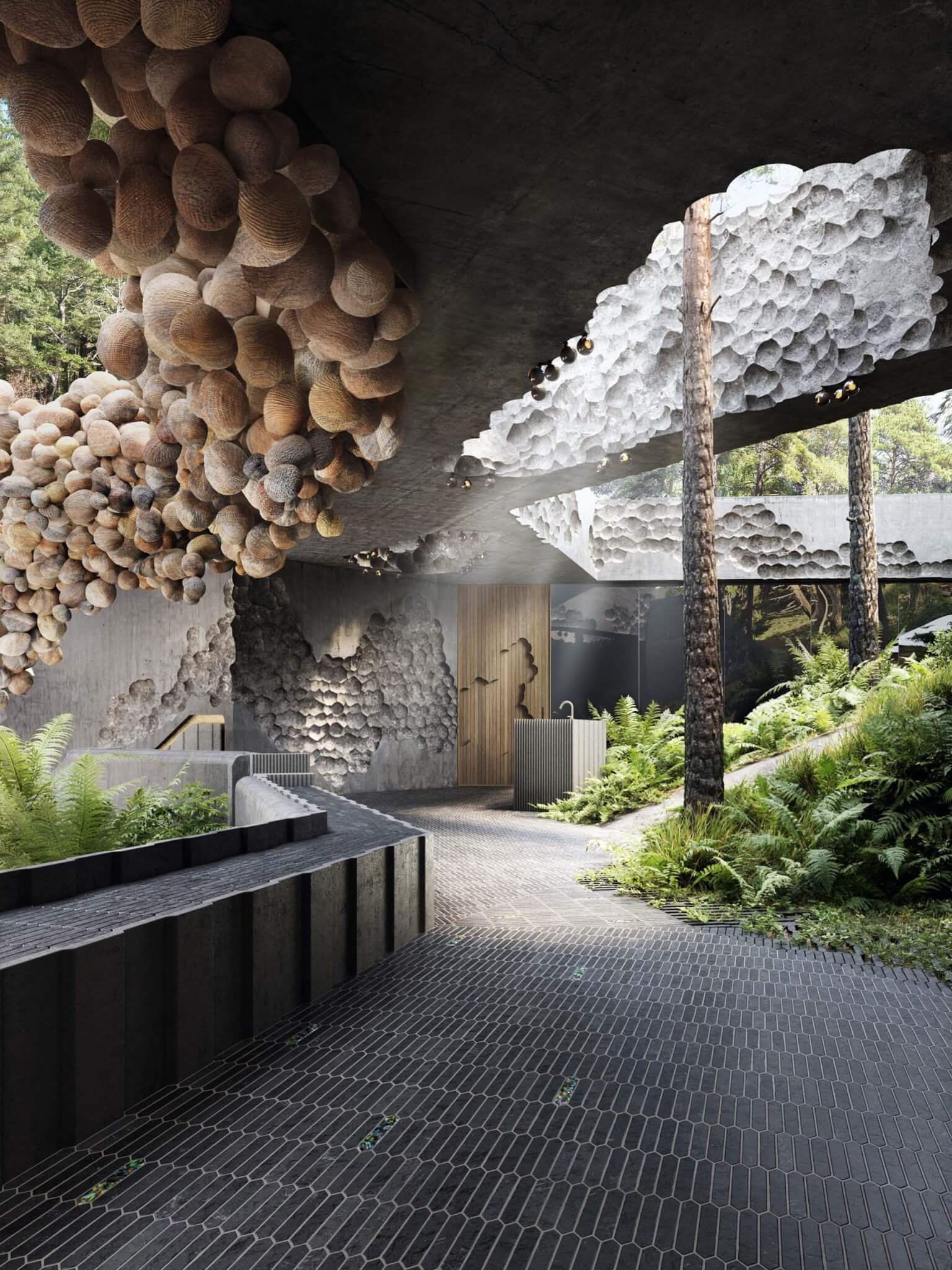
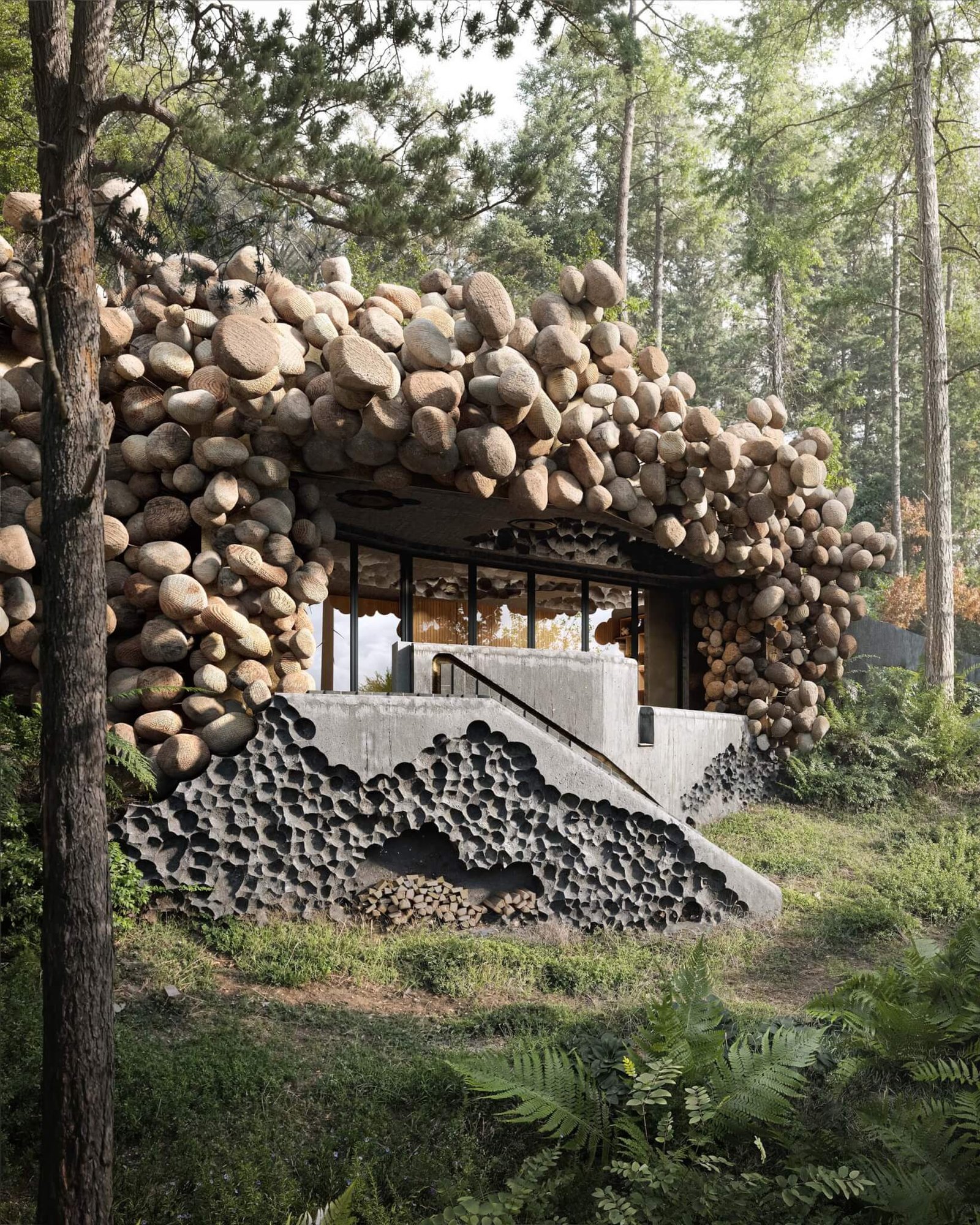
Arbel’s design fits the unspoiled setting: The residences are sited to disappear into the landscape. Under the planted roof, the space is something like a spider’s lair or a grotto; black-concrete walls are punctuated with hollows of varying sizes that bubble across the project like the pocked faces of nearby bluffs. At times these recesses deepen to form an occupiable seat or foam upward into skylights.
The finishes are exacting: Cabinets, wood floors, and stone walls within bathrooms are profiled with serrated edges and layered in picket tile shapes. This detail relates to 1.2, an early shelving system by Arbel, which is used throughout the interior. (Arbel’s ideas are numbered in order of arrival; Governors Point is 94.2.) Sightlines unite the rooms, framing views within views. It creates the sensation that by occupying the space you are watching a movie of yourself living there. The first home, for Bishop, will finish construction this summer.
Like the entry gates, the residence’s exposed west facade is clad in surreal clouds of wood spheres. The pieces are waste products from the logging industry that are tumbled in vats to create boulders. These are individually affixed to stainless-steel rods that then run back to grommeted stainless-steel plates that cleat onto stainless-steel shelves installed on the concrete walls.
Later in the year, when I met Arbel in the lobby of the Greenwich Hotel in New York, he was already reworking this assembly, which contains “shocking amounts of labor and material.” He talked me through a potential updated version that would entail pouring the concrete outboard of the insulation and embedding the grommets directly into the formwork in order to eliminate all the steel and allow the interior concrete to be cast as a finish surface with more precision. There are “so many other things that we get to refine for the second house, and I realize what a luxury that is,” Arbel said. “In architecture, you only get to build once. Everything’s a prototype, right? Every building we’ve ever seen is just some one-off.”
For the remaining homes, Arbel said, the clients who purchase the lots must agree to “recede completely from any involvement after the conceptual design phase.” Once the concept is approved, the client’s next visit to the project will, preferably, be “to pick up the keys.” In this sense, the development becomes more like an artistic commission, which aligns with his critique of architectural practice: that the procurement method limits risk. And Arbel, admittedly, “likes risk a lot.”
Bocci and Omer Arbel Office
At Bocci, Bishop and Arbel favor a slow, methodical route for product development. The duo follow their instincts; Bishop told me they have never created a business plan.
Lately, it seems like the bet is paying off. The company numbers almost 100 employees, who work from a warehouse in East Vancouver, where everything from design to glassblowing, wiring, packaging, and shipping takes place under one roof. (The brand also operates a “cultural space” within a foundry in Berlin and owns an apartment near Milan’s Parco Sempione where it hosts installations during Salone del Mobile.) Beyond a growing family of entrancing lights—take 87, which is made by looping taffy-like strands of glass, or 141, which suspends two puddles of thick glass from a central curved rod—the company also makes 22, a suite of electrical outlets that sit flush in a wall without a trim plate. The device is like catnip for architects.
Arbel prefers to design the context for the project, which establishes the parameters for others to explore and refine, with feedback. The processes, which emerge from experimentation, are often chemical or procedural. His organic methodology also means things happen slower. “I’m okay with doing a lot less in the way of volume of work if I get to control it more and it’s less compromised,” Arbel reflected.
Bocci is Arbel’s primary creative vehicle, but regardless of output, he pursues his ideas with an intense focus that transcends scale and disciplinary boundaries. For the last two years, his architecture practice, Omer Arbel Office (OAO), has landed on AN Interior’s Top 50 Architects and Designers list. “We spend so much more time (on a project) than any fee would ever support. So if we’re not getting money out of it, we better get the project we believe in,” said Arbel. “That becomes the only criteria (for me): a context favorable enough for me to spend three to five years of my life on it, feel good about what we made in the end, and stay friends with everyone.”
On His Way
Arbel’s work is the product of sharp, procedural thinking combined with free-range, fantastic inspiration. This tracks with his upbringing: His father is a lawyer, and his mother, a professor, studied ancient Mesopotamian mythology and mysticism. From Iraq and of Russian Jewish descent, respectively, the couple met in Israel; Omer was born in Jerusalem, and the family immigrated to Vancouver in 1989, when he was 13.
Arbel knew from an early age that he wanted to be an architect, and he enrolled at the University of Waterloo. A semester spent working at the studio of Enric Miralles was foundational: Although he didn’t speak Spanish or Catalan, he knocked on Miralles’s door and refused to leave until he was hired. Arbel remembered that Miralles “had an amazing capacity to collaborate. He really wanted to connect with you on a creative level. He didn’t want to tell you what to draw; he wanted to invite you to contribute. Each person was like a mystery that he wanted to unfold.” Arbel felt a kinship toward Miralles’s forms and tectonics. After a year and a half, Arbel returned to school, and soon after, Miralles died suddenly in 2000 at the age of 45. If that hadn’t happened, Arbel “would have been perfectly content to be part of his team forever.”
After graduation, Arbel worked for Patkau Architects in Vancouver. He began prototyping objects during a subsequent job with Busby & Associates. Around 2004, he was invited by enRoute, Air Canada’s magazine, to participate in a feature in which young Canadian designers imagine rooms in the house of the future—Arbel was assigned the bedroom. Arbel used the commission to make a drawing in collaboration with a painter, which was guided by the belief that “we just had to capture someone’s heart.”
The idea wooed Bishop, who saw the coverage while flying overseas. He needed an architect for a high-end interiors project, so he reached out. Bishop has always been entrepreneurial. After high school, he imported ponchos from Mexico. Later, he owned gas stations and ran a candy company. Bishop became interested in architecture and interiors when he was still a teenager: When driving back and forth to Mexico, he would stop and visit his aunt, a landscape architect in Santa Rosa, California, who got him hooked on design.
Arbel, meanwhile, kept trying to sell pieces, but he was a “terrible businessperson.” He considered quitting his day job and becoming a finish carpenter. His decision to persist was due in part to consistent encouragement from his father: When Arbel was a teenager, his father feigned interest in a proposal from the prominent Canadian architect Arthur Erickson (also famously bad at business) so Arbel could have lunch with him.
With parental support, Arbel readied a show for ICFF in New York in 2005 and included a prototype of a cast-glass light, a sphere with an equatorial seam that became Bocci’s popular 14 series. Arbel was thinking he would license the design to a manufacturer. Bishop, in town for a candy conference, stopped by and saw the buzz. The two got to talking, and then decided to “start a company and do it ourselves.” Thus, Bocci was born. Arbel’s penthouse for Bishop, 15.2, was 14’s first large-scale residential application.
Test Castings
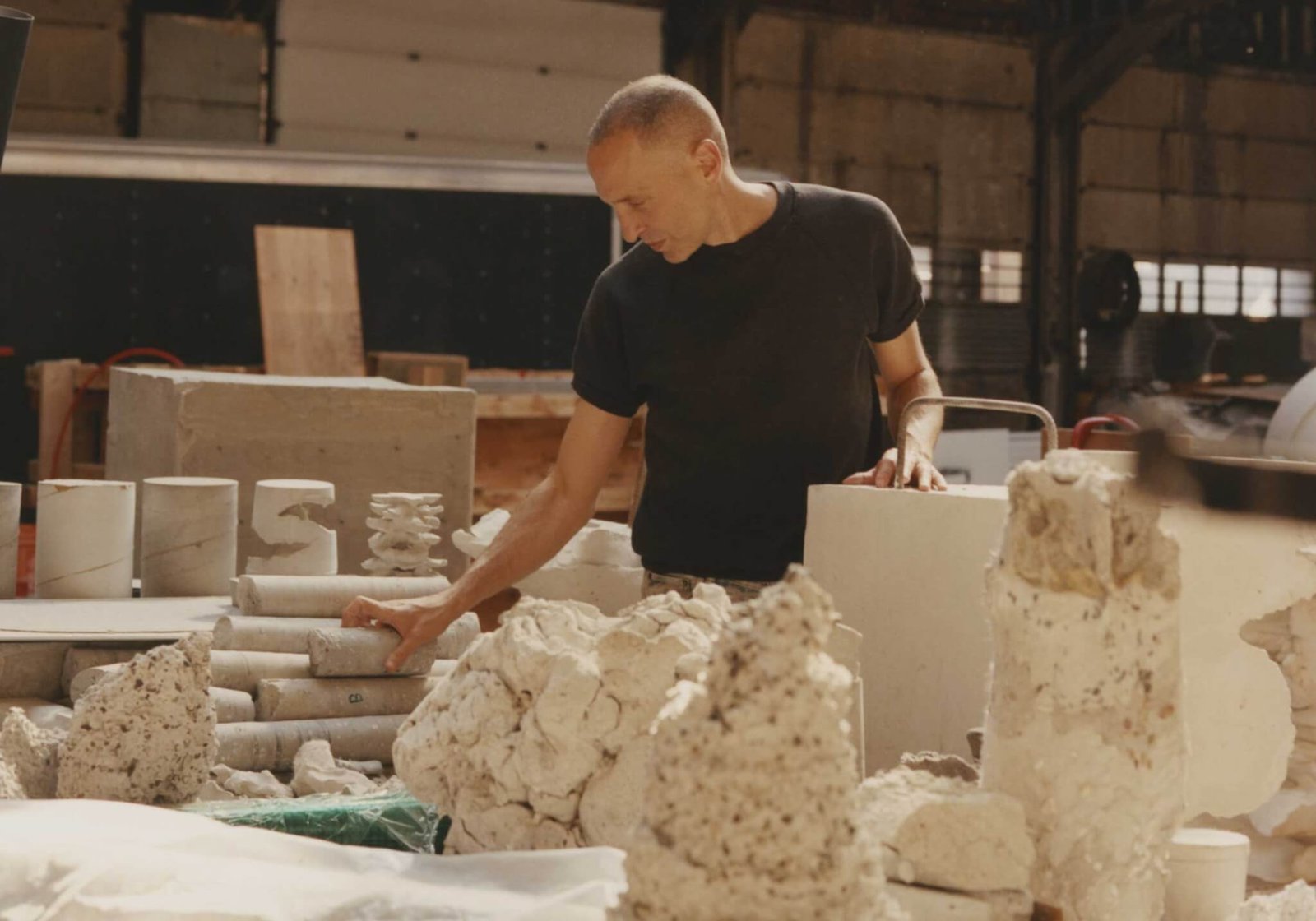
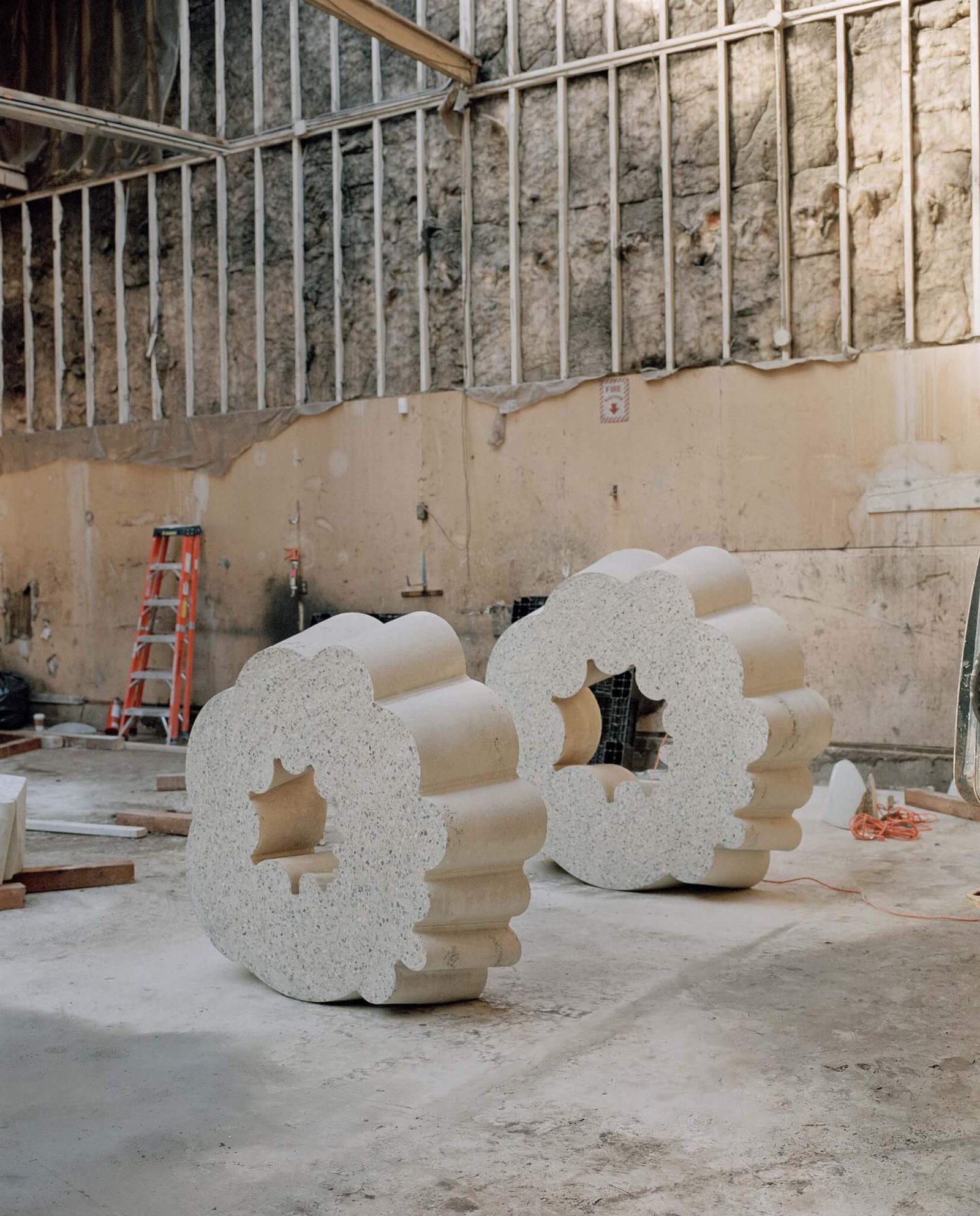
While most of Arbel’s material experiments have gone into Bocci’s products, some have ballooned into architecture projects. Blocks from Bocci’s headquarters, Arbel maintains a separate warehouse where he can work at a 1:1 scale.
Some of the larger items in the space are fragments from realized work. There are pieces from Arbel’s 75 series, which includes 75.9, a house that uses concrete made with fabric formwork set atop a plywood rib structure to create billowing columns. To achieve this effect, the slurry is cast slowly to cure continuously, which reduces hydrostatic pressure and allows tall pours without cold joints. The home, completed in 2024, sits among hay fields in White Rock, south of Vancouver, on a property next to 23.2, an earlier, Miralles-like residence designed by Arbel for Bishop and finished in 2010.
The workshop plot was supposed to be the site of 86.3, a 50,000-square-foot, ground-up building for Bocci made using concrete cast into pillowy forms. The team received a development permit by the time Bocci stopped work on the project during the pandemic. (Arbel said they may revisit the idea at a “less weird time globally.”) Maybe it was for the best: Since then, the company has outgrown the floor plates, and the plans show clumps of squiggly poche that are at odds with the logistics of practical things like shelving or copy machines.
For 86.3, Arbel initially wanted to create the void forms by using hay bales, but he eventually landed on using cinched piles of recycled plastic buoys harvested from the ocean. These “big, thick plastic buoys get beat up in the oceans, and they come to shore deformed like seed pods or like edamame beans or something,” Arbel recalled. Wet hay also causes a problem with spontaneous combustion.
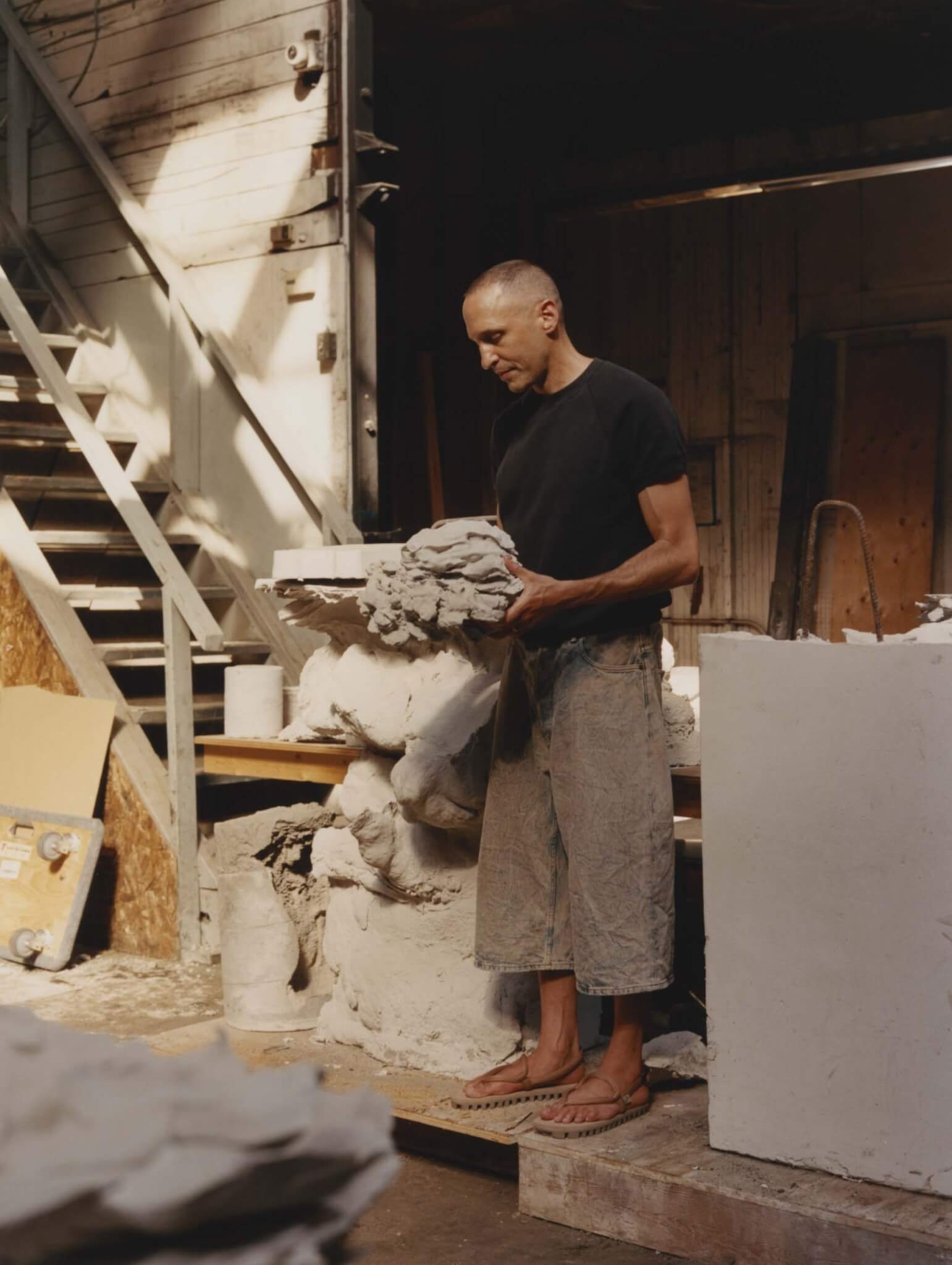
Lately, Arbel and his team are experimenting with fluid casting, where concrete is poured into mud and finds an equilibrium before setting. The mud includes bentonite clay, which is used in ceramics to add plasticity, in addition to other ingredients. The activity further reduces his control over the outcome. He can set the floorplan at the ground in terms of “which rooms lead to other rooms or where the plumbing is,” but the form migrates in section due to hydrostatic forces. Through this process, Arbel allows the material to establish the final dimensions of the interior.
Arbel then imagines mixing the bentonite with porcelain and letting it dry atop rubber, which would make the pieces curl like a clamshell. Once fired, these would then be mounted atop the concrete to act as the armature for the next layer of mud and concrete and serve as the cladding. The whole thing would look like “a school of fish or something,” he said. Arbel is exploring the use of the technique in building 35.8, a house for his family in Hastings-Sunrise, a neighborhood that overlooks the industrial port in East Vancouver.
Island Life
Galiano Island, across the water west of Vancouver, is a thin strip of land about 17 miles long, thickly forested and ringed with rocky coastline. Accessible via a quick ferry or a faster seaplane ride, the terrain inspires Arbel, who calls it a “wonderful pocket of eccentric specificity.”
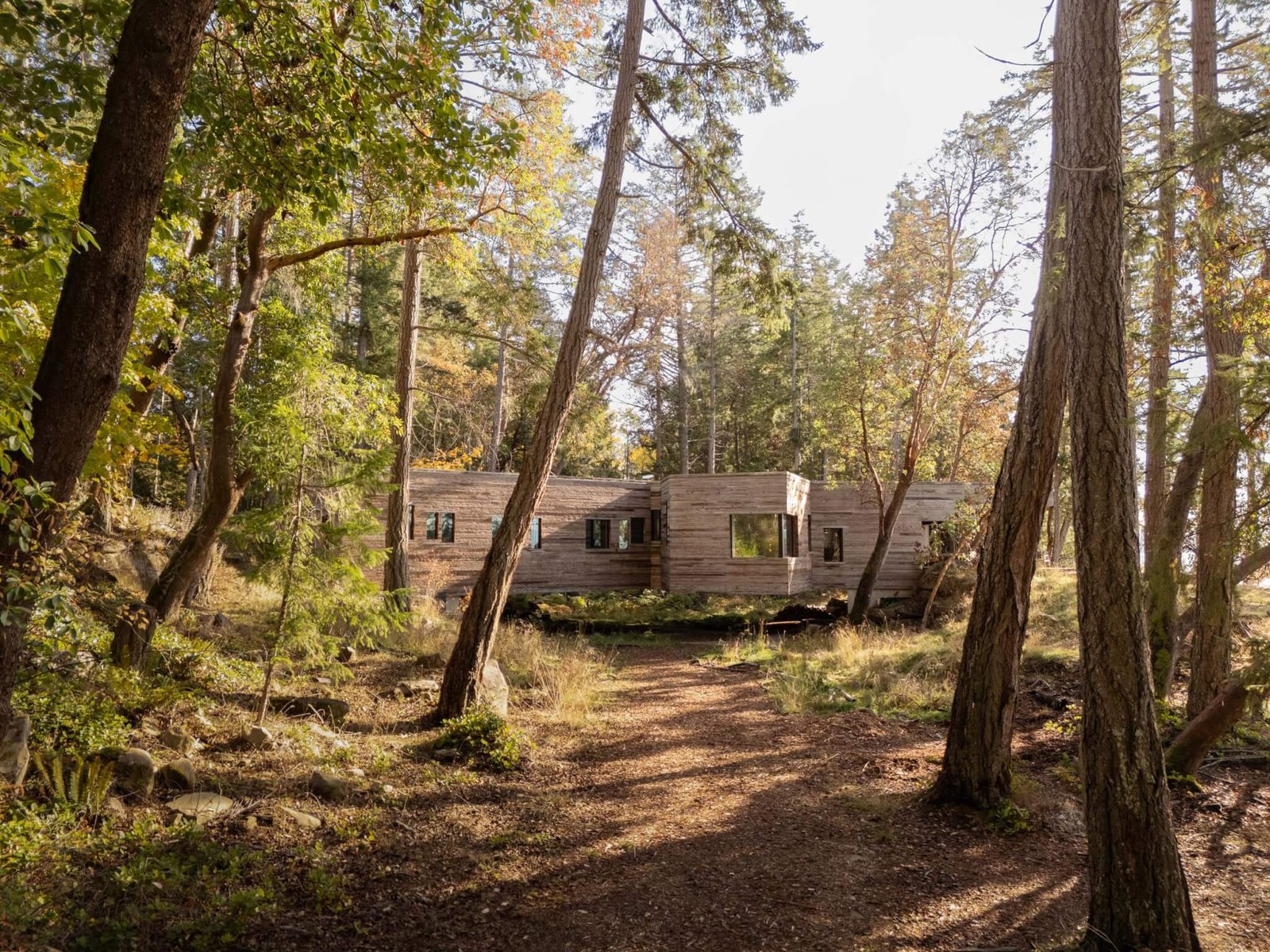
91.0, a 3,200-square-foot residence that is perhaps Arbel’s most orthogonal building to date, is on Galiano. Arbel met the owners, Josh Pekarsky and Marla Guralnick, early in his career: They purchased one of his 2.4 chairs around 2004 at a charity auction. Pekarsky, who works in communications, and Guralnick, a pediatrician, get along with Arbel, so when they acquired some land on the island in 2017, they hired him to design their weekend house. It was an adventure, “a project for our empty-nest era,” Guralnick said.
The plot previously only had a shack with an outhouse, set on a narrow, rocky outcropping that runs perpendicular to the water; a large gully separated it from high ground closer to the road. Arbel’s proposal was to span the ravine with the home. The bridge-like gesture, which allows Pekarsky and Guralnick to appreciate views of the coast and the forest, “made immediate sense to us,” Pekarsky said. “It was a great insight.”
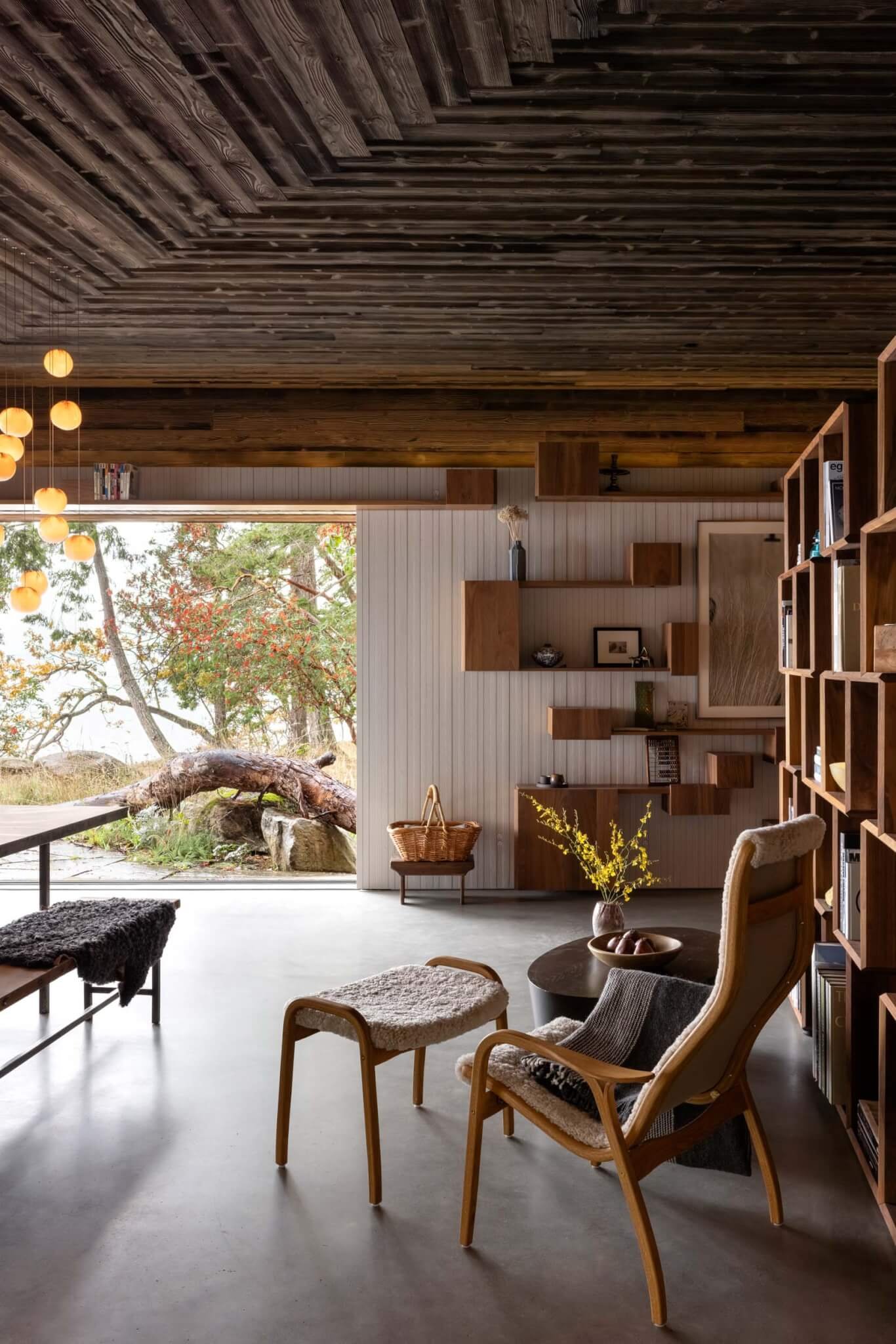
Upon entry, a long hallway lined with train-car-like nooks opens onto a combined kitchen and living room with an adjacent primary suite, all on one level. A second wing has additional bedrooms and can be opened as needed. A triangular punch through the middle of the span reminds occupants that the ground has dropped some 15 feet below the entry grade. OAO designed the built-in items, but the rest of the interiors were handled by Guralnick and Pekarsky. The results are rustic, textural, and warm, thanks in part to the Bocci light fixtures.
The owners spend every weekend they can out here. The arrival is something of a ritual. “When we get there, it’s like shedding the stress of the week,” Guralnick said. “It’s very peaceful; it’s like something comes over us.”
Arbel took special interest in the cedar cladding, which is sandblasted to highlight its grain. The boards run the long length of the home but read like end-grain pieces on its short ends and in the window returns. At first Arbel wanted to use the tumbled orbs on the facade here; Guralnick and Pekarsky, who praised their architect as an endlessly creative talent, politely declined.
Arbel also thought through climate change as another aspect of site context: In a century, its valley may be flooded due to sea-level rise, which is further rationale for its structural span. “What are the poetic potentials of climate change?” Arbel asked. 91.0 is one answer.
After I toured Guralnick and Pekarsky’s home, they recommended I check out a nearby cove. I left my car at the end of the road and scrambled along the shore. The low tide exposed outcroppings of stones flecked with moss and topped with grass. In another spot, the wind and water had smoothed the rock into doughy lines that curved up into waves, creating a tiny, shaded cave with whorled openings. It looked, I thought, like Arbel’s architecture.
A Mind in Motion
Bocci, which is equally owned by Arbel and Bishop, celebrated its 20th anniversary last year. The company, powered by instinct and research, still resists the urge to speed up its product development. Bishop figures that “companies are kind of like trees: If they grow slow and steady, they’re going to survive.” Arbel is also in it for the long haul: “Twenty years is just kind of the beginning.”
The duo continues to work on development endeavors: Arbel has purchased the second lot at Governors Point, so his will be the second home built there. They are also in the early stages of their next collaboration together for a piece of land on Galiano.
Arbel has yet another project underway. Near the current Bocci office, an old garage is being renovated into Autobody, a theater for the dance company of Rachel Meyer, his partner. It will open in January 2028.
Beyond Bocci’s demands and OAO’s ongoing architecture projects, Arbel and Meyer have two daughters, ages eight and two. The vertices of work, children, and partner form an “equilateral triangle of unreachable things” that keep him busy. Once a self-described “spaz,” Arbel, who will turn 50 this year, is leaning into maturity without losing his energetic drive. “One of the crazy things about Omer’s brain is that every time you ask him a question, he looks at things from a fresh, different perspective,” Bishop said. “He is a wonder in so many ways.”
Arbel said that his career followed from two choices: The first was to reject the conventional, service-based trappings of architectural practice, and the second was to make his own work at the scale of an object. Because he is involved in every aspect of production, he will build fewer buildings, release fewer products, and have less news. Still, he is happy with “these epic, magnum-opus-style projects that last for a decade,” he told me. “Somehow, this is the path I’ve chosen.”
Nguồn: archpaper.com